The high-altitude regions of the Indian subcontinent are currently undergoing a dramatic transformation. As the monsoon rains sweep across the Western Ghats and the Greater Himalayas, a brief but spectacular window of biodiversity opens, turning rugged mountain passes into vibrant galleries of wildflowers. From the rare Dzukou lily of Nagaland to the ephemeral carpets of the Kaas Plateau, flower-chasing has emerged as a distinct and growing niche within adventure tourism.
However, this "botanical pilgrimage" is more than just a search for the perfect photograph. It is a race against time, dictated by shifting climate patterns and the increasing pressure of over-tourism. This comprehensive guide explores the premier floral trails of the season, the experts leading the charge for sustainable exploration, and the ecological challenges facing these fragile ecosystems.

I. The Seasonal Calendar: A Chronology of the Bloom
The flowering season in the mountains is not a singular event but a rolling calendar that shifts with altitude and geography. Understanding the chronology is essential for any trekker wishing to witness these phenomena in their prime.
The Early Monsoon (June – July)
The season begins in the Northeast and the higher reaches of Himachal Pradesh. In Nagaland, the Dzukou Valley sees the emergence of its eponymous lily, a rare species found nowhere else on Earth. Simultaneously, in Himachal, crossover treks like Hampta Pass begin to show the first signs of alpine flora as the snow melts, giving way to lush greenery.

The Peak Monsoon (August – September)
This is the zenith of the wildflower season. The Kaas Plateau in Maharashtra transforms into a multicolored mosaic, while the Miyar Valley in Lahaul offers vast, rolling meadows. In Nepal, this "underrated" season breathes life into the landscape, bringing out Himalayan poppies and orchids that remain dormant during the drier months.
The Autumn Transition (October – December)
As the rains recede, the palette changes. In the valleys of Nepal, the focus shifts from wild alpine species to the cultural significance of the Marigold, woven into the fabric of the Dashain and Tihar festivals. In Nagaland, the Cosmos flowers take center stage at viewpoints like Mosen, signaling the approach of winter.

II. Regional Deep Dives: Supporting Data and Trail Insights
1. The Volcanic Canvas: Kaas Plateau, Maharashtra
Located 25 kilometers from the northern part of the Koyana Sanctuary, the Kaas Plateau is a UNESCO World Heritage Site that serves as a vital case study in ecological management. The plateau is home to over 170 species of wildflowers, many of which are endemic to the Western Ghats.
Randhir Jaya Naidu, founder of Deccan Drifts, has observed the evolution of this landscape since 2011. "The plateau is a fossilized volcanic landscape," Naidu explains. "From mid-September to mid-October, the blooms are at their peak, but the window is narrowing." The plateau is famous for the Karvi flower and various species of insectivorous plants like Drosera indica. However, Naidu notes a sharp drop in bloom density due to climate change and human interference.

2. The Valley of Celestial Charm: Dzukou, Nagaland
The Dzukou Valley, sitting at an elevation of 2,438 meters on the border of Manipur and Nagaland, is often described as the "Valley of Flowers of the East." The trek is famous for the Dzukou Lily (Lilium chitrangadae), which peaks from June to early August.
Khriebu Zhasa and Nino Zhasa, founders of Explore Nagaland, have spearheaded custom tours in this region for over two decades. They emphasize that the experience has shifted from rugged, unregulated camping to a more structured, community-led model. "The village youth have popularised these trails via social media," says Nino Zhasa. "While this brings in revenue, maintenance remains a communal effort. We now use designated campsites to protect the valley floor."

3. The Great Crossover: Hampta Pass, Himachal Pradesh
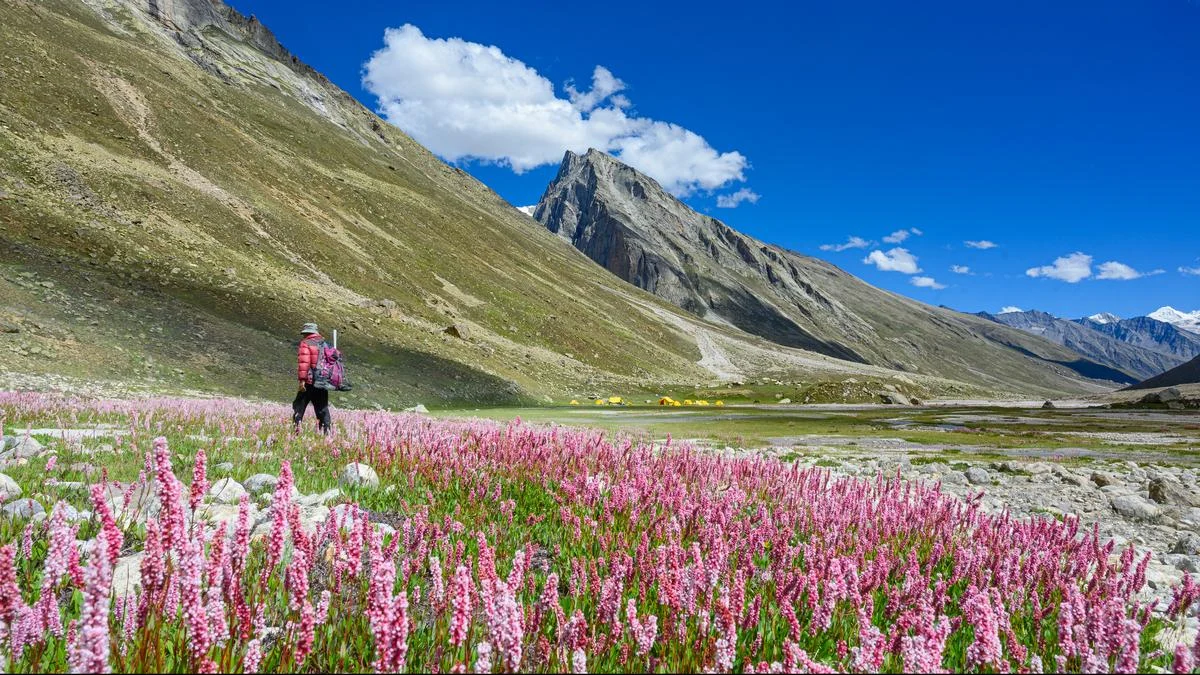
Hampta Pass (14,000 ft) offers perhaps the most dramatic ecological transition in the Indian Himalayas. Trekkers begin in the mist-covered, forest-heavy valleys of Manali and cross over into the stark, rain-shadow desert of Lahaul.
Ravi Ranjan, Chief of Experience and Safety at Indiahikes, identifies the Himalayan Bistort as the most striking feature of this trail. "These pink flower spikes carpet entire meadows at Jwara and Balu Ka Ghera," Ranjan states. The trail also hosts the Himalayan Blue Poppy, a legendary find for botanical enthusiasts, and various species of Primulas that thrive in the moist, high-altitude soil.

4. The Hidden Sanctuary: Miyar Valley, Himachal Pradesh
Further deep into the Lahaul region lies the Miyar Valley, known as the "Yosemite of the Himalayas" due to its granite towers and vast, flat valley floors. Unlike the steep ascents of other trails, Miyar offers a gradual, almost meditative journey through rolling grasslands.
"Miyar is unique because it lacks dense forests," says Ranjan. "The beauty here is subtle. You find Marsh Marigolds and Himalayan Geraniums blending into the vastness." The valley also carries a strong Buddhist influence, with the trail peppered with chortens and gompas, adding a spiritual layer to the botanical trek.

III. Expert Perspectives and Official Responses
Professional guides and conservationists are increasingly concerned about the sustainability of these trails. The consensus among experts suggests that while interest is growing, the "carrying capacity" of these regions is often exceeded.
On Environmental Degradation
Randhir Jaya Naidu highlights a grim reality for the Kaas Plateau: "The UNESCO tag brought international attention, but it also brought crowds. Barricades and pathways were necessary, but the sheer volume of people plucking flowers and littering has hampered growth rates. I have never seen it as beautiful as my first visit in 2011."

On the "Monsoon Myth" in Nepal
In Nepal, Prashan Poudyal of Waves of Nature is working to dispel the notion that the monsoon is a "bad" time for trekking. "It is the most underrated season," Poudyal asserts. "Nepal is home to 6,000 species of flowering plants—nearly 3% of the world’s total. The monsoon is when the Himalayan Balsam and Blue Poppies emerge. It requires accepting a bit of rain for a massive reward in biodiversity."
On Safety and Preparation
Ravi Ranjan of Indiahikes emphasizes that "flower chasing" should not lead to a lapse in safety protocols. "Rushing through high-altitude regions to fit a tight itinerary significantly increases the risk of Acute Mountain Sickness (AMS). Trekkers must prioritize acclimatization over photography."

IV. Ethical Trekking: The "Do’s and Don’ts" of the Bloom Season
To preserve these ecosystems for future generations, travel outfits have established a strict set of guidelines for visitors.
The "Do" List:

- Support Local Economies: Use local guides who understand the specific flowering cycles and ecological sensitivities of the region.
- Advance Planning: Obtain entry passes for restricted zones like Kaas or Dzukou well in advance.
- Physical Conditioning: Treks like Japfu Peak require a mix of cardio and strength training to handle 8-hour steep climbs.
- Sustainable Sustenance: Carry reusable cutlery and homemade snacks to minimize plastic waste.
The "Don’t" List:
- Acoustic Pollution: Avoid playing music on loudspeakers; it disturbs the local wildlife, including the many bird and butterfly species that frequent the blooms.
- Off-Trailing: Do not walk on flower beds to take "the perfect shot." Soil compaction prevents future seeds from germinating.
- Chemical Impact: Avoid using wet wipes (which contain plastic) and refrain from consuming alcohol or tobacco, which can exacerbate altitude-related health issues.
V. Implications: The Future of Alpine Flora
The enrichment of these trails comes at a time when climate change is visibly altering flowering patterns. In Maharashtra, unseasonal rains continuing through September have shifted the Kaas bloom cycle, sometimes causing flowers to rot before they fully open. In the Himalayas, the receding snowline is forcing certain alpine species to migrate to higher, cooler altitudes, where the soil may not be as nutrient-rich.

Furthermore, the demographic of the "Indian Traveler" is shifting. Prashan Poudyal notes a significant increase in trekkers from Southern and Western India—specifically Kerala and Maharashtra—venturing into the Nepal Himalayas. This diversification of the trekking community presents an opportunity for widespread environmental education but also places a higher demand on infrastructure in previously remote areas.
The trails mentioned—Kaas, Dzukou, Hampta, and Miyar—represent the frontline of mountain conservation. As we move into 2025 and 2026, the survival of these "Valleys of Flowers" will depend less on the bounty of the monsoon and more on the restraint of the visitors who walk through them. For the modern traveler, the goal is no longer just to see the bloom, but to ensure that their footsteps do not prevent the next one.
Trail Logistics at a Glance:
| Trail | Region | Peak Season | Key Flora | Est. Cost |
|---|---|---|---|---|
| Kaas Plateau | Maharashtra | Aug – Oct | Karvi, Smithia, Orchids | ₹2,400 (Day Trip) |
| Dzukou Valley | Nagaland | June – Aug | Dzukou Lily, Aconitum | Custom / Varies |
| Hampta Pass | Himachal | June – Sept | Himalayan Bistort, Blue Poppy | ₹12,950+ (6 Days) |
| Nepal Highlands | Nepal | June – Sept | Himalayan Blue Poppy, Orchids | ₹4,000/day (Guided) |
| Miyar Valley | Himachal | June – Aug | Marsh Marigold, Geranium | ₹14,950+ (7 Days) |