

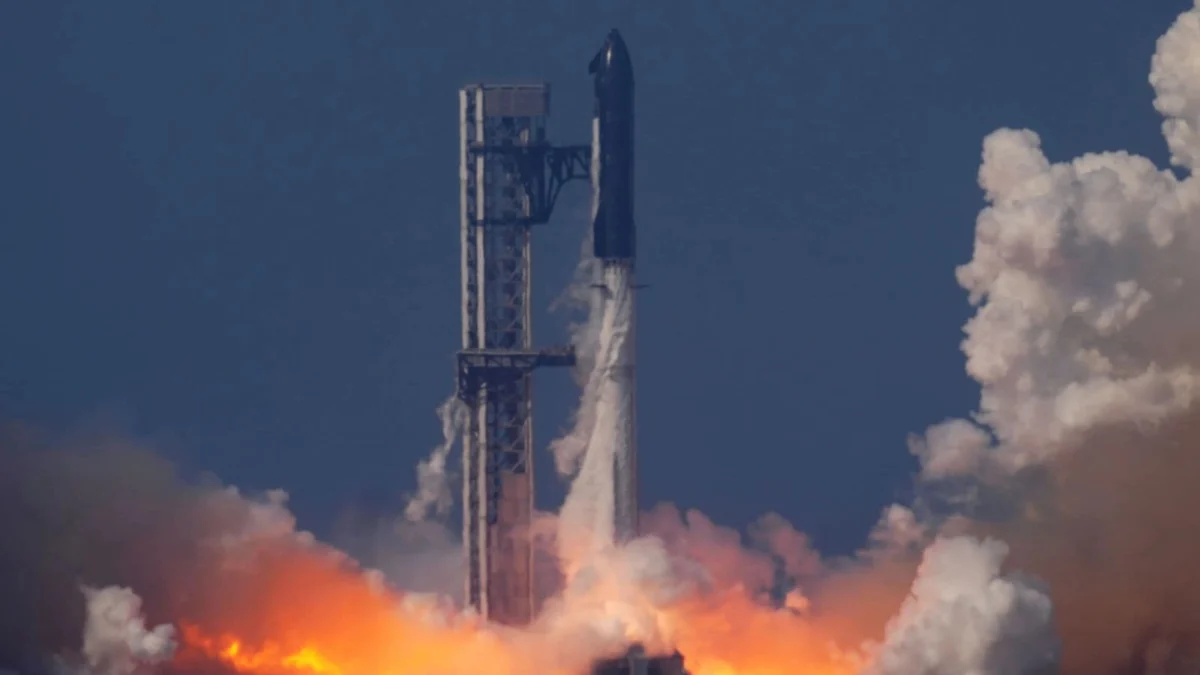
BROWNSVILLE, Texas — In a milestone that merges cutting-edge aerospace engineering with a seismic shift in corporate strategy, SpaceX successfully launched its most advanced Starship iteration to date on Friday. The flight, originating from the company’s "Starbase" facility at the southern tip of Texas, marked the debut of the "Version 3" (V3) mega-rocket—a vehicle that NASA is banking on to return American astronauts to the lunar surface for the first time in over half a century.
The launch follows on the heels of a blockbuster announcement from SpaceX CEO Elon Musk, who revealed earlier this week his intention to take the private spaceflight juggernaut public. The confluence of these two events—a technological leap forward and a transition toward the public markets—signals a new chapter for the company as it seeks to solidify its dominance in the burgeoning space economy.
Main Facts: A New Benchmark in Heavy-Lift Rocketry
The Friday mission, the 12th test flight in the Starship development program, showcased the V3 model, a significantly enhanced version of the stainless-steel spacecraft. Standing at a staggering 407 feet (124 meters), the V3 eclipses its predecessors in both height and raw power. The mission’s primary objectives were twofold: to test the structural integrity and flight dynamics of the redesigned airframe and to demonstrate the deployment of a payload consisting of 20 mock Starlink satellites.
While the spacecraft ultimately met its end in a controlled but fiery impact in the Indian Ocean, SpaceX officials declared the mission a resounding success. The flight achieved several critical "firsts," including the mid-flight release of modified, camera-equipped Starlink satellites that provided unprecedented live views of the spacecraft as it traversed the vacuum of space.
The launch also underscored the intensifying competition for lunar dominance. Under NASA’s Artemis program, SpaceX is under contract to provide a human landing system (HLS). However, the pressure is mounting as Jeff Bezos’ Blue Origin continues to develop its "Blue Moon" lander, creating a high-stakes race between the world’s two wealthiest men to see who will touch down on the lunar South Pole first.
Chronology: From Pad Scrubber to Indian Ocean Impact
The path to Friday’s successful liftoff was not without its hurdles. SpaceX had initially targeted Thursday evening for the launch, but last-minute technical issues on the brand-new launch pad at Starbase forced a 24-hour scrub. Engineers worked through the night to rectify the pad’s support systems, clearing the way for a Friday morning attempt.
Liftoff and Ascent
At the T-minus zero mark, the Super Heavy booster’s 33 Raptor engines ignited, generating a record-breaking 17 million pounds of thrust. The rocket cleared the tower and began its eastward trajectory over the Gulf of Mexico. Observers noted that the ascent appeared remarkably stable, though telemetry later revealed that not all of the booster’s engines performed optimally during the initial phase.
Stage Separation and Payload Deployment
Following a successful "hot-staging" maneuver—where the upper stage engines ignite while still attached to the booster—the Starship spacecraft continued its climb into the fringes of space, reaching an altitude of approximately 120 miles (194 kilometers). Midway through the hour-long flight, the spacecraft opened its payload bay to release 20 mock Starlink satellites. This maneuver was crucial for proving that Starship can function as a commercial workhorse, capable of deploying massive constellations of satellites in a single launch.
Re-entry and Splashdown
As the spacecraft arced halfway around the world, it began its harrowing re-entry into Earth’s atmosphere. Unlike previous tests that ended in mid-air disintegration, the V3 model appeared to maintain control through the peak heating phase. Guided by its oversized grid fins, the spacecraft plummeted toward its target in the Indian Ocean. Upon reaching the water, the vehicle performed a "landing flip" maneuver, hitting the surface upright before toppling over and erupting in a massive fireball—a conclusion SpaceX had predicted as part of the test’s experimental nature.
Supporting Data: The Technical Evolution of V3
The "Version 3" Starship represents more than just a marginal improvement; it is a fundamental redesign aimed at mass production and rapid reusability. Several key technical specifications distinguish the V3 from the "V2" models flown throughout the previous year:
- Height and Thrust: At 124 meters, the V3 is several meters taller than previous versions, allowing for increased propellant capacity. The Raptor engines have been tuned for higher chamber pressures, providing a significant boost in total thrust.
- Refined Steering: The V3 features fewer but significantly larger and more robust "grid fins." These waffle-like structures are essential for steering the massive Super Heavy booster back to the launch site. The new design offers better aerodynamic control while reducing mechanical complexity.
- The "Falcon 9-Sized" Fuel Line: One of the most striking upgrades is a redesigned internal fuel transfer line. This line, which feeds the 33 main engines, is reportedly the same diameter as the entire first stage of a Falcon 9 rocket, allowing for the massive flow rates required to power the world’s largest engine cluster.
- Enhanced Avionics: The spacecraft is outfitted with a vastly expanded suite of high-definition cameras and upgraded navigation computers. This was evidenced by the seamless live-streaming of the Starlink deployment, a feat that required sophisticated relay logic between the spacecraft and the satellite constellation.
- Lunar Readiness: The V3 is the first model to feature integrated docking cones. These are essential for future Artemis missions, where Starship must dock with NASA’s Orion capsule or the planned Lunar Gateway station in orbit around the moon.
Official Responses: "A Goal for Humanity"
The reaction from the aerospace community and leadership was overwhelmingly positive. Elon Musk, who monitored the flight from the Starbase control center, took to his social media platform, X (formerly Twitter), to congratulate his engineers.
"An epic launch and landing," Musk posted. "You scored a goal for humanity today. Starship V3 is the key to making life multi-planetary."
NASA Administrator Bill Nelson, through a statement relayed by mission observer Jared Isaacman, echoed the sentiment of progress. Isaacman, the billionaire commander of the Polaris Dawn mission who was on-site for the launch, noted that "Starship is now one step closer to the moon. The data gathered today is the foundation upon which the Artemis III and IV missions will be built."
However, the excitement of the launch was balanced by the financial gravity of Musk’s earlier announcement regarding an Initial Public Offering (IPO). Analysts suggest that the timing of the IPO news was intended to capitalize on the momentum of the V3 launch. By demonstrating that the rocket is nearing operational status, SpaceX can command a valuation that some experts estimate could exceed $250 billion, making it one of the most valuable companies in the world.
Implications: The Future of Lunar Exploration and Private Spaceflight
The success of the V3 flight has profound implications for the global space race and the future of civilian space travel.
The Artemis Timeline
NASA’s current roadmap for the Artemis program is ambitious. Artemis III, slated for as early as 2026, involves a lunar flyaround and a docking trial in Earth orbit. Astronauts will practice transferring from the Orion capsule to a lunar-optimized Starship. The success of the V3 test confirms that SpaceX is on track to meet the technical requirements for these maneuvers, though the timeline remains subject to the pace of future test flights.
The "Billionaire Space Race"
The rivalry between SpaceX and Blue Origin has moved from the courtroom to the launchpad. While SpaceX has reached space multiple times with Starship, Blue Origin’s "Blue Moon" lander has yet to fly. However, a prototype of the Blue Moon is expected to undergo testing later this year. NASA’s strategy of funding both companies ensures a "safety net," but the V3’s performance puts SpaceX in a commanding lead to be the primary lander for the Artemis IV mission in 2028.
Civilian Mars Missions
Beyond the moon, the V3 flight has reignited interest in private interplanetary travel. Dennis Tito, the first-ever space tourist, remains on the manifest for a future lunar circumnavigation. More recently, Chinese-born Bitcoin investor Chun Wang announced his intention to fly on Starship’s first interplanetary mission to Mars.
Wang, who previously chartered a SpaceX Dragon capsule for a historic polar orbit mission, represents a new class of "super-tourists" who are willing to fund the experimental phases of deep-space exploration. While no date or price has been set for Wang’s Mars journey, the success of the V3 suggests that the hardware required for such a voyage is no longer a matter of science fiction, but of iterative engineering.
Economic Impact
Finally, the impending SpaceX IPO could redefine the aerospace industry. For decades, space exploration was the sole province of governments with bottomless pockets. A public SpaceX would allow retail and institutional investors to bet directly on the colonization of Mars. It also provides Musk with the liquidity needed to fund the massive infrastructure required for a permanent moon base—a goal that requires not just one successful launch, but thousands.
As the smoke clears over the Indian Ocean and the data begins to pour into SpaceX’s servers, the message is clear: the V3 launch was not just a test of a rocket, but a test of a vision. With a larger rocket, a public mandate, and a growing list of private and government clients, SpaceX has moved the goalposts for what is possible in the 21st century.
