
In an era of rapid technological advancement and evolving economic realities, the question of whether an MBA remains a worthwhile investment is more pertinent than ever. While the allure of a prestigious business degree persists, a closer examination of the data reveals a nuanced picture: the MBA is still valuable, but for fewer individuals, at fewer institutions, and for reasons that have significantly shifted from those of just five years ago. This in-depth analysis delves into the financial realities, the impact of emerging institutions and artificial intelligence, the global trends, and offers a predictive outlook for the MBA’s future.
The Shifting Tides of MBA Value: A Stark Reality Check
The landscape of MBA education in India has become increasingly stratified. For graduates of the premier Indian Institutes of Management (IIMs), the financial returns often remain compelling, with median graduates recouping their substantial tuition fees in under a year. However, this success story is not universally replicated. A growing number of newer IIMs are witnessing a concerning trend: stagnant or declining median salaries juxtaposed with escalating tuition costs. This financial disconnect is exacerbated by the quiet yet potent influence of artificial intelligence, which is steadily eroding the entry-level corporate positions that historically served as the initial rung on the career ladder for MBA graduates.
For aspiring MBA candidates currently navigating the rigors of the Common Admission Test (CAT), the existential question – "Is this degree, costing between ₹20 to ₹27 lakh and demanding a two-year commitment, truly worth it?" – likely surfaces during late-night study sessions after a disappointing mock exam. While parents may hesitate to voice these concerns, coaching institutes often steer clear of candid assessments, and the curated successes showcased on LinkedIn offer little objective insight. This report aims to provide that honest appraisal, dissecting the financial implications, the performance of newer IIMs, the actual impact of AI on entry-level jobs, the global standing of the MBA, and a projection of its trajectory by 2031. This is not a sales pitch; it is a data-driven exploration designed to equip prospective students with the information needed for an informed decision.
The Financial Calculus: Where Payback Truly Lies
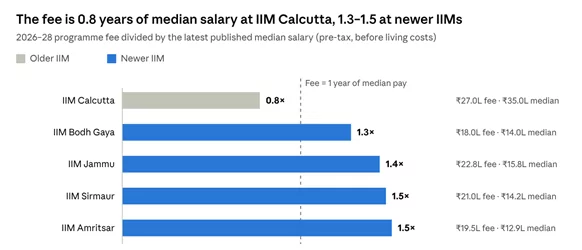
The financial viability of an MBA degree hinges almost entirely on the specific institution. At the apex of the IIM hierarchy, the numbers remain robust. For instance, IIM Calcutta’s tuition for the 2026-28 batch stands at approximately ₹27 lakh. In stark contrast, its graduates from the 2026 batch reported a median salary of ₹35 lakh, indicating a swift return on investment. However, this optimistic scenario is not mirrored across the board. At several newer IIMs, the median salaries for graduates have experienced a downward trend, while fees continue their upward ascent. This disparity means that for graduates of some of these newer institutions, the cost of the MBA can exceed their typical annual salary for over a year.
It is crucial to recognize that even the presented median salary figures offer a flattering, yet incomplete, picture. These numbers typically do not account for crucial expenses such as taxes, the cost of living for two years, and, significantly, the salary forgone by the individual during their period of study. An individual earning ₹10 lakh annually prior to commencing an MBA program effectively sacrifices approximately ₹20 lakh in potential earnings, in addition to the tuition fees. When these factors are factored in, the payback period at a newer IIM can extend considerably, ranging from roughly 18 months to three years or more, depending on the individual’s pre-MBA salary and any financial aid or loans secured.
Despite these financial considerations, pursuing an MBA from a newer IIM is not inherently a poor choice. A median salary of ₹14 to ₹16 lakh still represents a substantial career advancement for a recent graduate or a career switcher transitioning from a job earning ₹5 to ₹7 lakh. However, the decision to enroll must be guided by a realistic assessment of the median outcomes and individual financial circumstances, rather than being swayed by the headline-grabbing highest salary packages.
The Newer IIMs: Unpacking the Unspoken Realities
The question of an MBA’s worth becomes genuinely challenging when examining the newer IIMs. An analysis of National Institutional Ranking Framework (NIRF) data by Careers360 reveals a concerning trend: six out of nine "baby IIMs" reported lower median salaries for their 2025 graduating batch compared to earlier cohorts.
These salary declines are not negligible. For example, IIM Bodh Gaya witnessed a significant drop in its median salary, falling from ₹15.5 lakh to ₹12.12 lakh over two graduating batches, a decrease of approximately 22%. Similarly, IIM Amritsar’s median salary slipped by about 19%, settling at ₹12.9 lakh. While not a universal downturn, IIM Sirmaur bucked this trend with its median salary climbing by approximately 12.6% to ₹14.2 lakh, and IIM Jammu saw a slight increase to ₹15.8 lakh.
Beyond the published figures, the omissions in placement reports often carry more weight than the inclusions. For the 2024-26 batch, IIM Amritsar highlighted a highest Cost to Company (CTC) of ₹43 lakh but conspicuously omitted average or median salary data. IIM Sirmaur’s latest summary provides an average salary but lacks a median figure. IIM Bodh Gaya, while commendable for its audited "MEP" (Management Education Program) basis of reporting, uses a methodology not directly comparable with schools that do not adopt the same rigorous standards. Therefore, before placing complete trust in any institutional brochure, a critical evaluation through the following questions is imperative:
- Is the reported salary figure an average or a median? Medians are generally more representative of the typical graduate experience, especially in institutions with a wide salary distribution.
- Is the data audited? Audited reports provide a higher degree of assurance regarding the accuracy and completeness of the placement statistics.
- What is the placement rate? A high placement rate is crucial, especially for newer institutions where establishing a strong recruitment pipeline is paramount.
- What percentage of students received offers in the highest salary brackets? This helps to discern whether the impressive figures are outliers or indicative of broader success.
Our comprehensive tracker of IIM placement reports meticulously compares median salaries, batch sizes, and audit statuses for every IIM that makes its data publicly available, offering a crucial resource for prospective students.
AI and the Entry-Level Job Market: The Evidence Speaks
The prevailing discourse often paints a dire picture of artificial intelligence decimating jobs. However, the most robust evidence suggests a more nuanced reality: AI is not orchestrating wholesale job destruction but is selectively thinning out the junior ranks of the corporate hierarchy. This is precisely the segment of the workforce that most Indian MBA freshers historically enter.
A seminal study from Stanford’s Digital Economy Lab, which analyzed payroll data from millions of U.S. workers, found that individuals aged 22-25 in occupations most exposed to AI experienced a relative employment decline of 13% since late 2022. In stark contrast, older workers in the same jobs either maintained their employment or saw it increase. A subsequent update in August 2026 revealed that this gap had widened to 19%, yet the study still found no evidence of widespread job displacement across the entire economy.
Two key insights from this research hold significant implications for MBA aspirants. Firstly, jobs where AI serves to augment human capabilities, rather than directly replacing tasks, have demonstrated stable or increasing employment. Secondly, the disparity in AI’s impact narrows considerably when accounting for educational attainment. In simpler terms, the codified and repeatable tasks often performed by junior analysts are vulnerable to AI, whereas roles demanding judgment, client interaction, and the strategic direction of AI remain more resilient.
Employers are echoing these sentiments. A 2026 survey conducted by the Graduate Management Admission Council (GMAC) among 621 recruiters across 39 countries indicated that approximately one in three planned to replace some entry-level roles with AI. Concurrently, 53% of respondents identified proficiency in using AI tools as the most critical capability for the next five years.
The Indian Context: India’s Naukri JobSpeak index for September 2026 illustrated this trend vividly. Overall white-collar hiring saw a modest increase of just 2%, with fresher hiring up by a mere 1%. Meanwhile, roles in Artificial Intelligence and Machine Learning (AI/ML) experienced a significant surge of 20%. Within the IT sector, demand for AI talent was particularly strong among professionals with 8 to 16 years of experience. This indicates a clear employer preference for specialized skills and experience, with a degree of caution regarding generalist freshers.
The consulting sector, a primary recruiter for most top IIMs, exemplifies this shift. McKinsey, after a period of contraction, has signaled a 12% hiring increase for 2026 and has integrated AI components into its final-round interviews in the United States. Boston Consulting Group (BCG) has also been strategically tilting its hiring towards AI and tech specialists, favoring them over generalist MBA graduates. While these firms are indeed hiring again, the profile of the ideal candidate has evolved.
The Unvarnished Truth for Aspirants: AI is fundamentally altering the value proposition of a generic MBA, making a differentiated one even more valuable. If the career plan is to pursue an MBA and then secure a generic analyst role that a well-prompted AI model can partially perform, that strategy now has a significantly shorter shelf life than it did just a few years ago.
The Global MBA Landscape: Sustained Demand with Shifting Preferences
Globally, the demand for MBA degrees remains robust, albeit with a discernible shift in preferences. Prospective students are increasingly targeting fewer, more elite institutions, and there’s a growing inclination towards programs outside North America. GMAC’s latest survey reported a 2% increase in MBA applications for the 2025-26 cycle, building upon a record 13% jump the previous year. Full-time, two-year programs, in particular, saw a 4% growth in applications.
This growth, however, is heavily concentrated at the top tier. Among the most selective 25% of MBA programs, 52% reported an increase in applications, while only 28% of the least selective programs saw similar growth. Conversely, several U.S. business schools have recently paused or discontinued their full-time MBA programs, including the Bauer College at the University of Houston in 2025, and earlier, programs at the Universities of Illinois and Iowa. These institutions are often pivoting towards online, part-time, or one-year formats.
Even the most prestigious business schools have faced challenges. Harvard Business School reported that 23% of its job-seeking Class of 2024 remained without an offer three months post-graduation, a figure more than double the historical norm. The Class of 2025 showed a recovery, with 90% securing offers at the three-month mark and close to 94% by November, with Stanford’s Graduate School of Business also reporting a 90% placement rate. Salary outcomes, however, remained resilient throughout this period.
Crucially, the salary premium associated with an MBA continues to hold. GMAC’s 2026 recruiter survey projects a median starting salary of US$120,000 for new MBA hires in the United States, compared to US$107,500 for experienced professionals recruited directly from industry. Employers are demonstrating a continued willingness to invest in MBA graduates, but they are becoming more discerning about the specific degree and the candidate’s ability to leverage AI effectively.
Five Predictions for the MBA, 2026-2031
Based on the prevailing trends and data, the following predictions are offered, acknowledging that these are informed forecasts rather than immutable facts:
- Increased Specialization within MBA Programs: As AI handles more routine analytical tasks, MBA programs will likely emphasize deeper specialization in areas like digital transformation, sustainable business practices, advanced analytics, and entrepreneurship, where human judgment and innovation remain paramount.
- Rise of Hybrid and Micro-Credentialing: The traditional two-year full-time MBA might see a decline in favor of more flexible, modular learning formats. Hybrid programs, one-year MBAs, and specialized master’s degrees or certificates focusing on specific skill sets will gain prominence.
- Greater Emphasis on Experiential Learning and AI Integration: MBA curricula will increasingly incorporate real-world projects, case studies involving AI-driven decision-making, and hands-on experience with AI tools. The ability to strategically deploy and manage AI will become a core competency.
- Geographical Diversification of Top MBA Programs: While North America will remain a significant hub, business schools in Asia, Europe, and other emerging economies will continue to grow in global stature and attract a larger share of international applicants, driven by their unique market insights and regional expertise.
- Heightened Scrutiny on ROI for Newer Institutions: The financial viability of MBAs from less established institutions will face increased scrutiny. Prospective students will demand greater transparency in placement data and a clearer demonstration of return on investment, leading to potential consolidation or specialization among these schools.
So, Should YOU Pursue an MBA?
The MBA is no longer a monolithic product; its value proposition is increasingly fragmented, necessitating a personalized answer. The following table aims to provide a candid assessment based on individual circumstances:
| Your Situation | Our Honest Take | What to Check First |
|---|---|---|
| 99+ percentile score, aiming for IIM A/B/C/L/K or equivalent. | Still one of the most valuable degrees in India. Rapid payback period and a network that compounds over time. | The specific roles you aspire to, to ensure your two years of study are strategically aligned. |
| Two-plus years of work experience with a clear career switch in mind. | Strong case. The MBA is designed for career transitions, and AI poses the least threat to experienced professionals. | Whether a one-year program can achieve your objectives more efficiently and cost-effectively. |
| Fresher with converts primarily from newer IIMs or tier-2 schools. | Proceed with extreme caution. Fees approaching ₹18-23 lakh against median salaries of ₹12-16 lakh represent a protracted payback period. Fresher roles are the most vulnerable to AI disruption. | The school’s audited median salary figures and its track record in placing fresh graduates. |
| Pursuing an MBA because "everyone in my batch is" or to escape an undesirable job. | It might be prudent to wait. A year of focused skill development, acquiring AI proficiency, or seeking an internal role change could offer a better ROI. | What specific advantages or opportunities you can realistically only obtain through an MBA degree. |
| Planning a significant loan for a non-IIM, non-top-20 program. | Exercise extreme caution. This is where the return on investment narrative most frequently falters. | The projected loan EMI against a realistic, not aspirational, post-MBA salary. |
Ultimately, the decision to pursue an MBA is a significant personal and financial undertaking. By critically evaluating the data, understanding the evolving landscape, and introspectively assessing individual goals and circumstances, prospective candidates can make a more informed and strategic choice about their future.
Connect with alumni and students for insights. Join: CAT 2026 Exam Preparation, Discussion | PaGaLGuY