

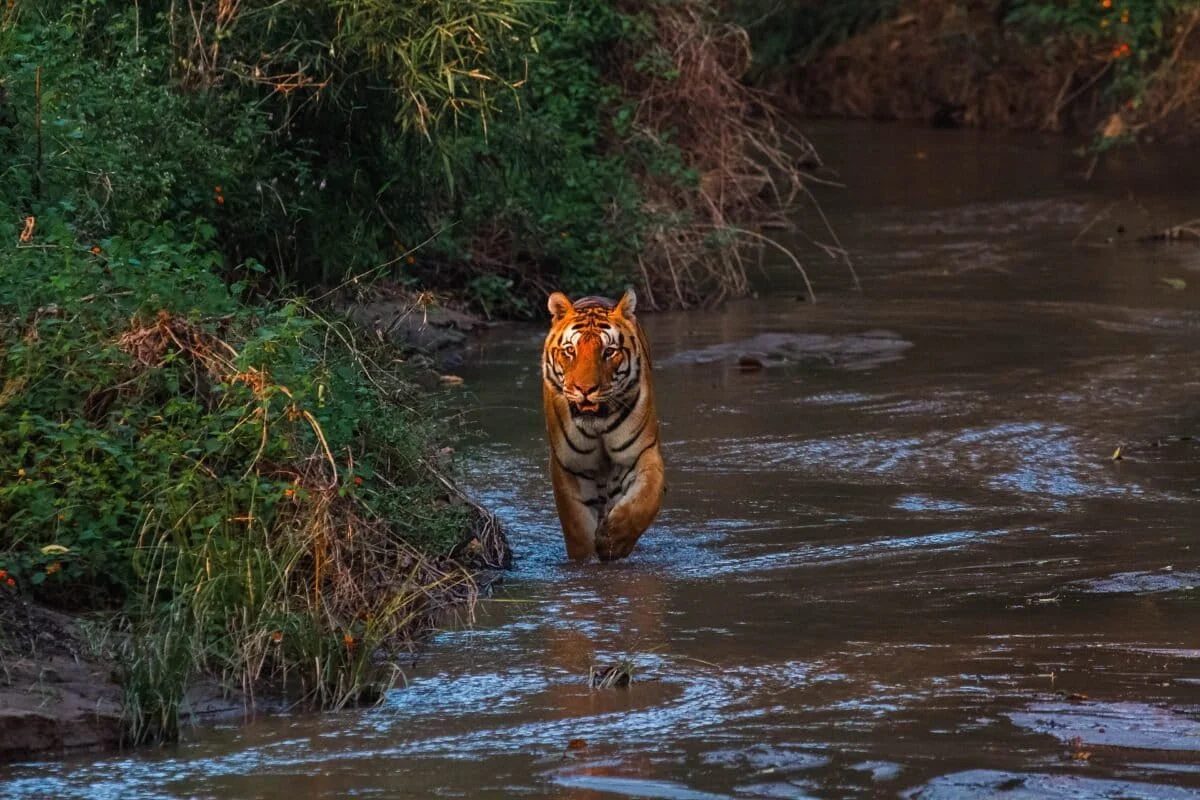
Across the sprawling, teak-dominated forests of Central India, a silent and perilous rite of passage occurs every year. As young tigers reach the age of two or three, the biological clock dictates a necessary, albeit dangerous, exodus. They must leave the protection of their mother’s territory to find their own—a quest for survival, breeding rights, and genetic legacy.
However, the "Jungle Book" landscapes that once offered seamless passage are rapidly vanishing. What used to be a continuous green canopy stretching across the heart of the subcontinent is now a jagged mosaic of agricultural fields, pulsating highways, high-speed rail lines, and expanding human settlements.
A landmark study published in the Journal for Nature Conservation has utilized advanced computational modeling to map this "gauntlet." Conducted by researchers from the Indian Institute of Remote Sensing and the Institute of Integrated Learning in Management (IILM) University, the research moves beyond simple observations of habitat loss. Instead, it employs the complex mathematics of graph theory and game theory to understand how the world’s most iconic predator navigates a landscape increasingly defined by human interference.
Main Facts: A Mathematical Lens on Apex Predators
The study represents a shift in conservation methodology. Traditionally, habitat monitoring relied on static maps of forest cover. The new research, co-authored by Saurabh Shanu, Assistant Dean and Associate Professor at IILM University, focuses on "functional connectivity"—not just where the trees are, but whether a tiger can actually move between them.
The Core Findings
The research highlights a sobering reality: Central India, which houses approximately 40% of the country’s wild tigers (estimated at 3,682 individuals), is becoming a series of "island" reserves. While the tiger population in India has shown an upward trend in recent years, their long-term survival is tethered to their ability to move between protected areas to maintain genetic diversity.

Using satellite data and Geographic Information Systems (GIS), the researchers identified that:
- Suitability Crisis: Only 18% of the studied landscape is classified as "highly suitable" for tigers.
- Hostile Terrain: Roughly 46% of the landscape is now "poorly suited," acting as a barrier rather than a bridge.
- The Fragmentation Gap: Between 2005 and 2015, forest cover in the study area plummeted from 40% to 35%, primarily due to agricultural expansion and infrastructure development.
Innovative Methodology
The study stands out for its use of Graph Theory and Game Theory.
- Graph Theory treats the landscape as a network where forest patches are "nodes" and corridors are "edges." This allows researchers to identify which patches are the "hubs" of the network—if a hub is lost, the entire system collapses.
- Game Theory models the "decision-making" process of the tiger. It treats the tiger as a player in a game where the "payoff" is finding prey and water, and the "cost" is encountering a road, a village, or a railway line.
Chronology: A Decade of Disruption (2005–2015)
The study focuses on a critical decade of Indian economic expansion. To understand the current state of tiger corridors, the researchers looked back at the land-use changes that occurred between 2005 and 2015, a period that saw a massive push for rural connectivity and agricultural intensification.
2005–2010: The Beginning of the Squeeze
During the mid-2000s, the Central Indian landscape—encompassing tiger strongholds like Panna, Pench, and Bandhavgarh—remained relatively permeable. However, the seeds of fragmentation were being sown. The expansion of agricultural land in the Balaghat and Chhattisgarh divisions began to encroach upon the traditional dispersal routes used by young males moving out of the Kanha and Pench ecosystems.
2010–2015: The Infrastructure Boom
By 2015, the study notes that non-forest land accounted for more than half of the region. The expansion of National Highway 44 (NH44), which cuts through the heart of the Pench-Kanha corridor, became a symbolic and literal barrier. During this period, the researchers observed that forest patches were not just shrinking; they were becoming isolated. Small "stepping-stone" forests—tiny patches of green that allow a tiger to hide during a multi-day journey—were being cleared for small-scale settlements and seasonal farming.

2018–Present: Refinement of the Model
Building on an earlier network analysis from 2018, Shanu and his team spent the last several years validating their computational models with ground-level data. They moved from theoretical "basic models" to "real-world validation," comparing their mathematical predictions of tiger movement with actual sightings, pugmarks, and scat found during field surveys.
Supporting Data: Quantifying the Corridor Crisis
The researchers focused on six primary tiger reserves: Panna, Pench, Bandhavgarh, Sanjay-Dhubri, Achanakmar, and Indravati. The data paints a picture of a landscape divided into "haves" and "have-nots" in terms of connectivity.
The Critical Pench-Kanha-Achanakmar Link
The study identified the stretch linking Pench, Kanha, and Achanakmar as the most vital tiger dispersal route in Central India. This corridor acts as the "aorta" of the tiger population’s circulatory system. If this link is severed, the genetic exchange between the tiger populations of Maharashtra, Madhya Pradesh, and Chhattisgarh would essentially cease, leading to "inbreeding depression" and increased vulnerability to disease.
The Isolation of Indravati
Conversely, Indravati Tiger Reserve emerged as a point of concern. The models show that Indravati is becoming increasingly isolated from the rest of the network. This isolation is driven by a combination of distance and "hostile" land use—large swathes of human-dominated territory that a tiger is unlikely to survive crossing.
Prey Dynamics and Habitat Quality
Habitat quality is not just about trees; it is about the "pantry." The study mapped the density of prey species, including:

- Sambar and Chital: The preferred "large" and "medium" meals for tigers.
- Wild Boar and Nilgai (Blue Bull): Species that are more adaptable to human-edge habitats.
The findings showed that while nilgai and chital have managed to persist in fragmented areas, the larger sambar—essential for sustaining a breeding tiger—are largely confined to the 18% of "highly suitable" dense forest. This creates a "prey vacuum" in the corridors, forcing dispersing tigers to either starve or target livestock, which inevitably leads to human-tiger conflict.
Official Responses and Expert Perspectives
Saurabh Shanu and his colleagues emphasize that the traditional "fortress conservation" model—protecting only what is inside the park boundaries—is no longer sufficient for the 21st century.
The "Smart Forest" Concept
In a poignant critique of modern urban-centric development, Shanu noted, "We talk about smart cities, but not smart forests. The tools exist. They just need to be used with the same focus towards the landscapes that the wildlife depend on." The "Smart Forest" approach involves using real-time data, AI-driven predictive modeling, and remote sensing to manage landscapes as dynamic systems rather than static maps.
The Importance of the "In-Between"
Shanu’s research highlights a blind spot in current policy: the land between the reserves. "People talk about habitat patches, but not enough about the land between them," Shanu stated. "Villages, roads, and small forest areas in between are just as important." The study suggests that the "payoff" for a tiger (a term borrowed from game theory) decreases significantly when it encounters anthropogenic disturbances like railways and settlements.
Policy Recommendations
The study calls for a mandatory overhaul of how infrastructure is planned in India:

- Environmental Impact Assessments (EIAs): These should not just look at how many trees are cut, but how the "functional connectivity" of the landscape is altered.
- Wildlife Crossings: In areas like NH44, elevated stretches and underpasses are non-negotiable requirements for any new road or rail project.
- Community Engagement: The researchers argue that local communities in the buffer zones must be "given a role" and incentivized to maintain the permeability of the land, perhaps through eco-tourism or compensation for maintaining forest cover on private lands.
Implications: The Future of the Bengal Tiger
The implications of this study are both a warning and a roadmap. If the current trend of fragmentation continues, the "40% of India’s tigers" living in this region will eventually become genetically stagnant populations.
Genetic Bottlenecks
Without functioning corridors, the "meta-population" structure of Indian tigers collapses. When a population is isolated, inbreeding becomes inevitable. Over several generations, this reduces the fitness of the cubs, making the entire population susceptible to a single outbreak of disease or a shift in climate.
Human-Tiger Conflict
The study’s findings on the "poorly suited" 46% of the landscape explain the rising headlines regarding tigers in villages. As corridors disappear, young tigers dispersing from parks like Bandhavgarh or Pench find themselves in a "trap." They enter a landscape with no prey and no cover, leading them to prey on cattle or seek shelter in sugarcane fields. This brings them into direct, often fatal, contact with humans.
A New Conservation Paradigm
The research proves that the survival of the tiger is no longer just a biological challenge; it is a spatial and mathematical one. To save the tiger, India must move toward "Landscape-Scale Conservation." This means:
- Restoring Degraded Corridors: Using native vegetation to "re-green" the gaps between forest patches.
- Traffic Management: Implementing night-time traffic bans or speed-monitoring systems in critical crossing zones.
- Monitoring Dynamics: Moving from once-every-four-years tiger counts to continuous monitoring of habitat change using the computational models Shanu and his team have developed.
The "long journey" of the young tiger is a metaphor for the species itself. The path forward is fraught with the obstacles of a developing nation, but as this study shows, science has provided the map. The question remains whether policy-makers will follow it before the last corridors are paved over.
