KRAVANH MOUNTAINS, Cambodia — Sat Born, a 56-year-old farmer who now tends to durian and banana groves, still remembers the morning his heart stopped at the edge of the forest. It was 9 a.m. on a humid day in 2001. As he trekked into the rainforests of the Cardamom Mountains to collect rattan, he came face-to-face with a legend.
"Its head was this big," Born says, his eyes widening as he stretches his hands apart to illustrate the girth of the predator. "I was in total shock. I couldn’t tell if the tiger was coming toward me or just watching."

That fleeting encounter was one of the last of its kind. By 2007, Cambodia’s last wild tiger was captured on a camera trap. In 2016, after decades of relentless poaching and habitat loss, the World Wildlife Fund (WWF) and the Cambodian government officially declared the Indochinese tiger (Panthera tigris corbetti) extinct in the country.
Today, a multi-million-dollar plan is underway to bring the roar back to the Cardamoms. Through a historic agreement with India, Cambodia intends to reintroduce a founder population of Bengal tigers (Panthera tigris tigris). However, the ambitious project faces a gauntlet of scientific, ethical, and logistical hurdles that have conservationists divided on whether the forest is truly ready for its king to return.
Main Facts: An International Translocation Plan
The reintroduction project is a centerpiece of Cambodia’s "Tiger Action Plan." Under a Memorandum of Understanding signed in 2022, India—home to the world’s largest tiger population—has agreed to "gift" Cambodia a small group of Bengal tigers.

Key details of the plan include:
- The Founder Population: Estimates vary between officials, but the plan involves translocating between four and eleven tigers (predominantly females) from India to the Kravanh National Park.
- The Budget: The project is estimated to cost approximately US$43 million over its first five years, covering translocation, enclosure construction, prey restoration, and high-tech monitoring.
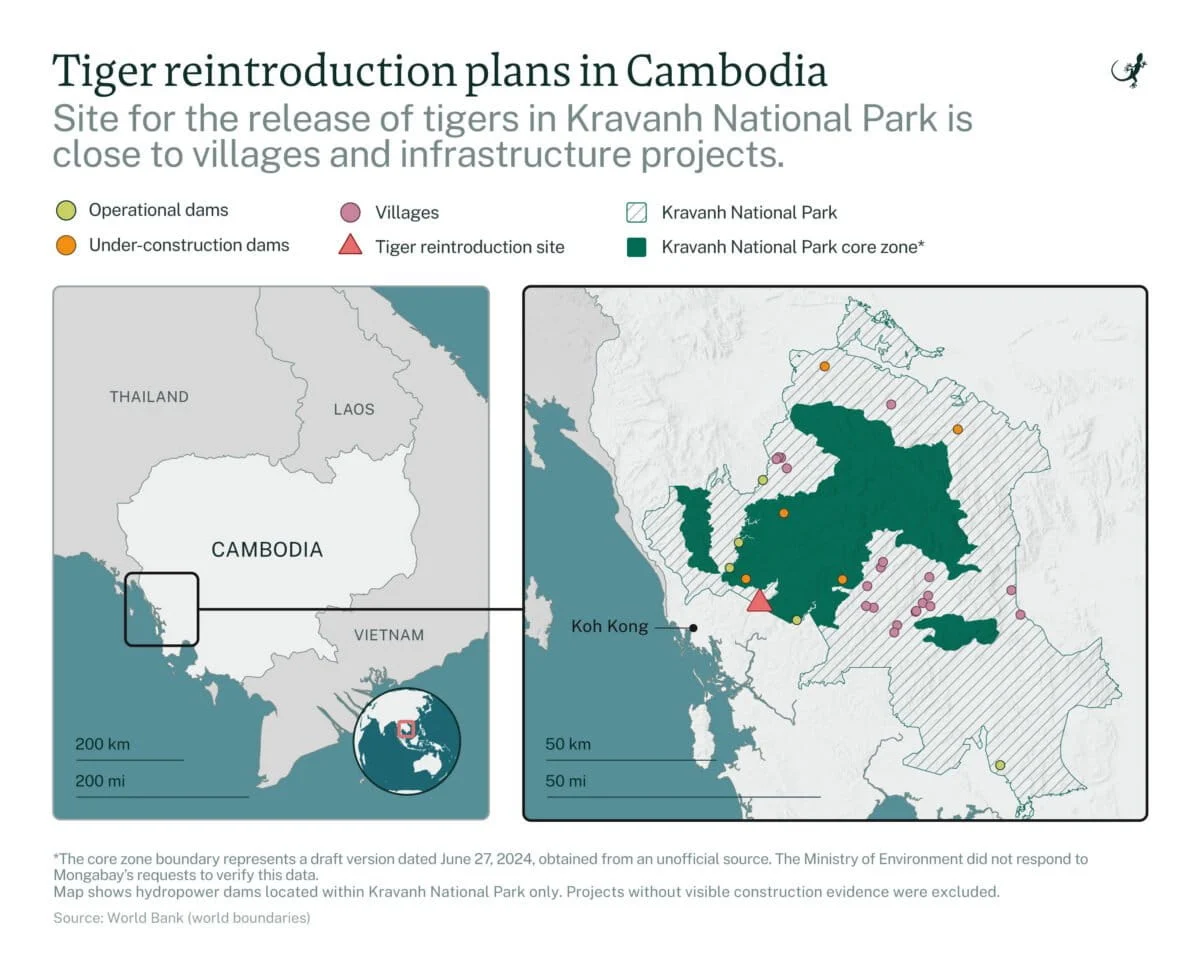
- The Location: The tigers will be released into the 926,123-hectare Kravanh National Park, a rugged expanse within the Cardamom Mountains in southwestern Cambodia.
- The Method: A "soft-release" strategy will be used, where tigers are initially kept in a 40-hectare (100-acre) high-security enclosure to acclimate to the local environment before being released into the wider core zone.
While the plan is a bold attempt at "rewilding," critics argue that Cambodia may be rushing into a disaster. Concerns range from the suitability of the subspecies to the "empty forest syndrome" caused by rampant snaring.
Chronology: From Abundance to Extinction
To understand the weight of this reintroduction, one must look at the rapid collapse of Cambodia’s wildlife.

- The 1960s-1980s: Cambodia was once believed to host hundreds, perhaps thousands, of Indochinese tigers. However, the civil war and the subsequent rise of the Khmer Rouge plunged the country into chaos.
- The 1990s: As the country stabilized, it became a hub for the regional wildlife trade. Tigers were hunted with terrifying efficiency using snares, pit traps, and even leftover land mines from the war.
- 2005: A Cambodian court sentenced Yor Ngun, a notorious hunter, to seven years in prison. He confessed to killing more than 600 animals, including 19 tigers.
- 2007: The last confirmed photograph of a wild tiger in Cambodia is taken.
- 2016: Tigers are declared functionally extinct in Cambodia. The government approves the Tiger Action Plan.
- 2022: India and Cambodia sign the formal agreement for tiger translocation.
- 2023-2024: The Indochinese leopard is declared functionally extinct in Cambodia, highlighting the continued failure to protect large cats.
- 2025: The current target window for the first translocation, though funding and infrastructure delays persist.
Supporting Data: The Ecological and Genetic Debate
The scientific community is locked in a debate over two critical factors: prey density and genetic suitability.
The Prey Deficit
A study published in Conservation Science and Practice (2020) offered a sobering assessment. Researchers found a less than 25% probability that the Cardamom landscape could support a viable population of 25 tigers.
Dr. K. Ullas Karanth, a world-renowned carnivore biologist, explains the math of survival: "An adult tiger needs to kill roughly one deer-sized animal per week. To sustain one tiger, you need a standing crop of about 500 large prey animals." In the Cardamoms, the "big three" prey species—sambar deer, gaur, and banteng—have been decimated by poaching. While wild pigs remain, experts doubt they can sustain a breeding tiger population alone.

Subspecies Controversy
Historically, Cambodia was home to the Indochinese tiger. The Bengal tigers coming from India are a different subspecies, adapted to different climates and terrains.
While some geneticists argue that all mainland Asian tigers should be classified as a single subspecies (P. t. tigris), others, including those published in Current Biology (2018), maintain there are six distinct subspecies.
"Introducing Bengal tigers may work ecologically, but they are not the same as the original tigers of Cambodia," says Uma Ramakrishnan, a molecular biologist at India’s National Centre for Biological Sciences. She warns of potential "genetic mixing" if these tigers ever encounter native Indochinese populations in neighboring Thailand or Myanmar.
The Infrastructure Threat
While the government seeks to protect the forest, it is simultaneously industrializing it. Five new hydropower dams are under construction in the Cardamoms. One project, the Veal Thmor Kambot dam, is located just seven kilometers from the proposed tiger release site. These projects bring roads, which act as "conveyor belts" for poachers and loggers into previously inaccessible core forests.

Official Responses: Government Optimism vs. Expert Skepticism
Cambodian officials remain steadfast. Phan Channa, deputy director of the government office overseeing protected areas, argues that the dams are not a significant threat.
"If we can manage hunting and disease, we can manage the landscape," Channa says. He points to the successful reintroduction of Siamese crocodiles as a blueprint for coexistence. "Before the animals come back, people are very concerned. But when they see that coexistence is possible, the fear fades."
However, international observers are less convinced. Nirmal Ghosh, a trustee of the Corbett Foundation in India, expresses deep concern. "It is ironic that we are sending one of India’s most protected flagship species into a country with one of the worst records of wildlife protection and rampant snaring," Ghosh says. "If these tigers die, there will be a massive backlash in India."

The Wildlife Alliance, the primary NGO partner for the project, has faced its own challenges. The organization is currently under scrutiny regarding "Free, Prior, and Informed Consent" (FPIC) from Indigenous communities in the region. Although they have rejected claims of human rights violations, the controversy has complicated the project’s funding and public image.
Implications: Human-Wildlife Conflict and Cultural Survival
The most immediate impact of the reintroduction will be felt by the people living inside Kravanh National Park. Mongabay’s interviews with 20 residents revealed a stark reality: most have not been formally consulted.
The Fear of the "Man-Eater"
In the late 1990s, the Cardamoms were one of the few places in the world with a documented "man-eating" tiger problem. Dozens of people were killed. For residents like Che Preah, 54, the return of the tiger is a threat to her livelihood.

"If they release tigers, there is no way I would go back to the forest," says Preah, who earns up to $2,000 a year collecting wild fruits. "If we can’t go to the forest, what else can we do?"
Spiritual Significance
Conversely, for the Indigenous Chong people, the tiger is more than a predator; it is a spiritual guardian. Horn Kim Heng, 70, views the tiger as the companion of the neak ta—ancestral spirits.
"Without tigers, without humans, we don’t call it a forest," she says. For her, the return of the tiger is a restoration of the natural and spiritual order, provided the "ancestral spirits" are respected.

Conclusion: A High-Stakes Gamble
The Cambodia tiger reintroduction project is a test of modern conservation’s limits. It asks whether a species can be forced back into a landscape that has been fundamentally altered by human greed and industrial development.
If successful, it could provide a global model for restoring apex predators to lost ranges. If it fails—due to a poacher’s snare, a lack of prey, or a conflict with a local villager—it may result in the tragic loss of some of India’s most precious wildlife and the final closing of the door on Cambodia’s wild heritage.
As the sun sets over the dense canopy of the Cardamoms, the forest remains silent. For now, the only tigers here are the ones in the memories of men like Sat Born. Whether their roar will once again echo through the valleys depends on a $43 million gamble that the world is watching with bated breath.