

New Delhi, India – May 18, 2026 – A decade after Tinder ignited a global revolution in digital romance with its iconic "swipe" mechanism, the multi-billion-dollar dating app industry is facing an unprecedented moment of introspection. After years of explosive, seemingly unstoppable expansion, signs of user fatigue are emerging, challenging the dominance of swipe-based platforms and recalibrating the industry’s growth trajectory. While still a colossal economic force, generating billions and connecting hundreds of millions, the landscape is shifting, signaling a collective "swipe left" from users on the very models that once defined online dating.
This pivotal moment is characterized by a deceleration in revenue growth for established giants like Tinder, coupled with the ascendance of platforms like Hinge, which prioritize meaningful connections over rapid-fire assessments. Industry analysts point to a growing disillusionment among users, weary of superficial interactions, endless swiping, and the often-exorbitant costs associated with premium features. The market, though robust, is evolving, demanding authenticity and substance in an era previously defined by instant gratification.
The Shifting Sands of Digital Romance: An Industry at a Crossroads
The global dating app industry stands as a testament to humanity’s perennial quest for connection, amplified and digitized. In 2025 alone, this colossal market generated over $6 billion in revenue, with Match Group—the parent company of powerhouses like Tinder and Hinge—accounting for a substantial $3.3 billion of that figure. Over 350 million individuals worldwide actively engage with these platforms, with nearly 23 million paying for enhanced features designed to improve their chances of finding a match. Tinder, despite the burgeoning challenges, maintained its position as the most downloaded dating app globally in 2025, closely followed by Bumble.
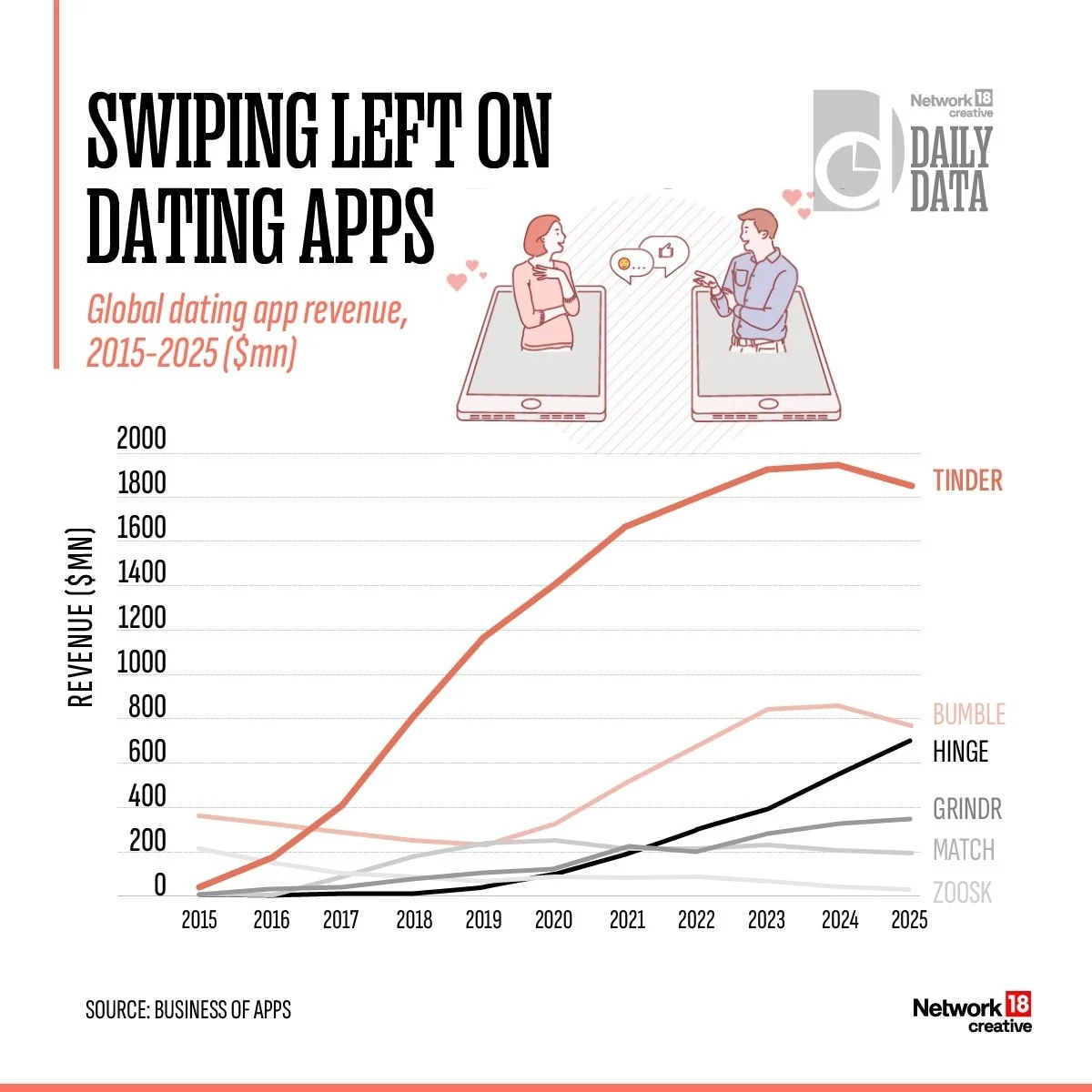
However, these impressive figures belie a deeper narrative of transformation. The seemingly endless upward curve of user engagement and revenue, particularly for the early pioneers, has begun to flatten. Data meticulously compiled by Business of Apps reveals a significant moderation in growth across several leading platforms in recent years. This isn’t a collapse, but rather a maturation, a recalibration, as the industry grapples with changing user expectations and the very psychological impact of its own pervasive design. The era of unbridled, exponential growth may be ceding to one of strategic evolution and differentiation.
The Genesis of a Revolution: Tinder and the Dawn of Swipe Culture
The story of modern digital dating is inextricably linked to one pivotal innovation: the swipe.
2013: The Birth of the Swipe and a Paradigm Shift
Before 2013, online dating was often synonymous with lengthy profiles, exhaustive questionnaires, and complex algorithms attempting to predict compatibility. Platforms like Match.com and OKCupid, though successful, often felt like a chore, demanding significant time investment before a single interaction. Then came Tinder. Launched in 2013 by Hatch Labs and backed by IAC, Tinder introduced a deceptively simple yet profoundly revolutionary feature: the swipe. Users would "swipe right" on a profile if interested, and "swipe left" to pass. A mutual "right swipe" resulted in a match, opening a chat window.
This gamified, mobile-first approach fundamentally transformed the digital dating landscape. It democratized access, reduced the perceived "effort" of online dating, and injected an element of instant gratification and playfulness. No longer confined to desktop computers, dating became a seamless, on-the-go activity, easily integrated into daily life. Tinder rapidly ascended to become the dominant player, quickly eclipsing its older, more text-heavy predecessors, even those under the same IAC umbrella. Its rise wasn’t just a technological triumph; it was a cultural phenomenon, altering how millions approached relationships, self-presentation, and initial romantic encounters, popularizing app-based dating across every demographic. The "swipe right" became a ubiquitous phrase, a shorthand for approval and interest in the digital age.
The Rise of the Challengers: Bumble and Hinge Emerge
As Tinder solidified its market dominance, the very ubiquity of its model began to expose its limitations. The endless swiping, the superficiality often inherent in judging someone solely by a few photos, and the perceived transactional nature of the experience led to a demand for alternatives. This fertile ground gave rise to competing platforms that sought to address these emerging user frustrations by offering distinct models and user experiences.
Bumble, co-founded by former Tinder executive Whitney Wolfe Herd, emerged in 2014 with a clear differentiator: a "women-first" messaging system. In heterosexual matches, only the woman could initiate the conversation within a 24-hour window. This innovative approach aimed to empower women, reduce unwanted advances, and foster a more respectful environment, resonating strongly with a segment of the user base tired of unsolicited messages.
Concurrently, Hinge, initially launched in 2012 but later pivoting significantly in 2017, strategically positioned itself as the "relationship app." Moving away from the anonymous swipe, Hinge encouraged users to connect over specific elements of a profile (photos, prompts, shared interests) and facilitated more in-depth conversations. Its mantra, "designed to be deleted," encapsulated its ambition to foster meaningful, long-term relationships rather than casual encounters. This focus on quality over quantity, and genuine connection over fleeting attraction, would prove to be a prescient move, setting the stage for its remarkable growth in later years. These challengers weren’t just creating new apps; they were offering alternative philosophies of digital dating, directly responding to the evolving desires and discontents of the user base.
A Billion-Dollar Empire Under Scrutiny: Decelerating Growth and Evolving User Demands
While the overall industry figures remain impressive, a closer look at the financial performance of individual platforms reveals a dynamic market undergoing significant shifts. The era of easy, explosive growth is yielding to a more competitive and nuanced landscape.
The Peak and Plateau: Tinder’s Revenue Trajectory
For years, Tinder was synonymous with hyper-growth, continually breaking its own revenue records and expanding its global footprint. However, the latest figures from Business of Apps indicate a significant change in this trajectory. After years of sharp, uninterrupted growth, Tinder’s revenue appears to have stabilized and even experienced a slight decline in 2025. This moderation is not necessarily a sign of failure, but rather a natural progression for a mature product in a crowded market. Sustaining double-digit, year-over-year growth becomes increasingly challenging once a platform has captured a substantial portion of the addressable market.
Industry analysts attribute this slowdown to several factors: market saturation in key regions, increased competition from differentiated apps, and perhaps most importantly, growing user fatigue with the core swipe mechanism. While Tinder continues to innovate with new features, premium tiers, and global expansion efforts, the fundamental appeal of rapid, superficial matching seems to be losing some of its initial luster for a segment of the user base. The challenge for Tinder now is to evolve its offering to retain its vast user base and attract new demographics without alienating its core audience.
Hinge’s Ascendance: A Case Study in Strategic Differentiation
In stark contrast to the leveling-off experienced by some of its competitors, Hinge has emerged as a beacon of growth within the industry. Business of Apps data unequivocally shows Hinge’s revenue climbing sharply after 2021, even as growth across several competing platforms began to slow. This impressive performance underscores the success of its differentiated strategy.
Hinge’s emphasis on detailed profiles, conversation prompts, and a stated goal of fostering long-term relationships has resonated powerfully with users seeking more than just casual encounters. Its design encourages users to engage with specific aspects of a person’s profile, leading to more thoughtful interactions from the outset. By positioning itself as a platform for "serious daters" and actively promoting stories of successful relationships, Hinge has tapped into a growing segment of the market that feels underserved by the fast-paced, often superficial environment of traditional swipe apps. This strategic pivot, focusing on quality over quantity of matches and encouraging deeper engagement, has proven to be a highly effective growth engine in a market increasingly weary of the endless "game" of swiping.
The Broader Financial Landscape: A Robust but Changing Market
Despite these internal shifts, the dating app industry remains an undeniable economic powerhouse. The $6 billion in global revenue generated in 2025, with Match Group leading the charge, illustrates the immense commercial potential of facilitating human connection. A significant portion of this revenue comes from premium features—subscriptions that offer perks like unlimited swipes, profile boosts, advanced filters, and the ability to see who has "liked" you. The fact that nearly 23 million users worldwide are willing to pay for these enhancements highlights the perceived value and the deeply personal investment individuals make in their dating lives.
However, even within this robust financial context, the shift in user behavior is undeniable. While Tinder still boasts the highest download numbers, indicating strong top-of-funnel acquisition, the long-term engagement and monetization strategies are increasingly under scrutiny. The market is maturing, and with maturation comes a demand for more sophisticated, user-centric, and ethically sound business models. The industry is no longer just about getting people to download an app; it’s about fostering sustainable engagement and delivering tangible value that justifies both time and financial investment.
Beyond the Swipe: Understanding User Disenchantment and the Search for Authenticity
The deceleration in growth and the shift towards platforms like Hinge are not merely statistical anomalies; they are symptoms of a deeper cultural shift, reflecting a growing disenchantment among users with the prevailing dating app paradigm.
The Dark Side of Gamification: Swipe Fatigue and Superficiality
When Tinder introduced the swipe, it gamified dating, making it feel less like a chore and more like a game. While initially appealing, the long-term psychological impact of this gamification has proven to be a double-edged sword. Industry analysts and sociologists alike point to "swipe fatigue" as a major contributor to user pullback. The endless scrolling, the constant evaluation of profiles based on fleeting first impressions, and the sheer volume of choices can lead to a sense of exhaustion and overwhelm. Users report feeling commodified, reduced to a collection of photos and a brief bio, rather than being seen as complex individuals.
Moreover, the prevalence of ghosting, unsolicited messages, and the difficulty of translating initial matches into meaningful conversations contribute to a sense of frustration and cynicism. The "paradox of choice"—where an abundance of options leads to indecision and dissatisfaction—is particularly acute in the dating app world. Users spend more time swiping and less time connecting, creating a cycle of superficiality that leaves many feeling unfulfilled and emotionally drained. The promise of endless possibilities often translates into a reality of fleeting connections and a pervasive sense of loneliness, ironically exacerbated by platforms designed to combat it.
The Rise of Niche Platforms: A New Frontier
The growing dissatisfaction with mass-market, swipe-heavy apps has created fertile ground for the emergence and growth of highly specialized, niche platforms. Apps like Pure (for casual, spontaneous encounters), Feeld (for ethically non-monogamous relationships and kink-friendly communities), and Boo (which matches users based on personality types and shared interests) are gaining traction by catering to specific interests, lifestyles, and communities.
These platforms offer a curated experience, allowing users to bypass the broad, often overwhelming general dating pool and connect with individuals who share very specific values, desires, or identities. This move towards specificity reflects a desire for more authentic connections, where users feel understood and accepted for who they are, without the pressure to conform to mainstream dating norms. The success of niche apps signals a fragmentation of the market, where users are actively seeking out communities that align with their personal philosophies, moving away from a one-size-fits-all approach to dating.
The Future of Dating: Towards Deeper Connections and Diverse Models
The implications of these shifts are profound for the future of digital dating. The industry is likely to move towards models that prioritize quality over quantity, authenticity over superficiality, and user well-being over sheer engagement metrics. This could manifest in several ways: enhanced AI-driven matchmaking that goes beyond basic preferences to understand deeper compatibility, greater emphasis on interactive profiles and conversation starters, and an increased integration of offline events and community-building features. The focus will increasingly be on facilitating genuine human connection, recognizing that technology’s role is to aid, not replace, the nuanced process of forming relationships.
Industry Responses and Future Outlook
In the face of these tectonic shifts, the dating app industry is not standing still. Major players are keenly aware of the evolving landscape and are actively strategizing to adapt, innovate, and retain their user bases.
Adapting to the New Reality: Innovation and Retention Strategies
Leading platforms are already responding to the call for deeper connections and more authentic experiences. Expect to see further investment in sophisticated AI algorithms that promise more meaningful matches by analyzing subtle cues and behavioral patterns, moving beyond simple demographic data. There will likely be a greater focus on interactive features that encourage richer conversations before a physical meeting, such as video prompts, shared activity planning, and more comprehensive profile sections that allow for greater self-expression.
Moreover, platforms are increasingly exploring hybrid models that blend online interaction with offline experiences. Organizing curated events, facilitating group activities, or partnering with local businesses for unique date ideas could become more commonplace, bridging the gap between digital discovery and real-world connection. Retention strategies will also likely emphasize user well-being, incorporating tools and resources for healthier dating habits, promoting respect, and actively combating issues like ghosting and harassment. The goal is to create safer, more supportive environments that encourage sustained engagement and positive outcomes.
Regulatory and Ethical Considerations
As the dating app industry matures and becomes further integrated into the fabric of society, it will inevitably face increased scrutiny regarding data privacy, user safety, and ethical algorithm design. With millions of users entrusting these platforms with highly personal information, concerns about data security, the potential for misuse of personal data, and the impact of algorithms on human choice and bias will become more prominent. Future regulations may emerge to ensure greater transparency, accountability, and user protection, particularly concerning how personal data is collected, used, and shared. The industry will need to proactively address these concerns to build lasting trust and maintain its social license to operate.
The Enduring Quest for Connection
Ultimately, the "swipe left" moment for dating apps is not an obituary for the industry, but rather a powerful catalyst for evolution. The fundamental human need for connection, companionship, and love remains an immutable constant. Technology’s role is to facilitate this quest, and as user expectations evolve, so too must the platforms designed to serve them. The next decade of digital dating will likely be characterized by greater diversity in app models, a renewed focus on authenticity and depth, and a more conscious effort to foster genuine human connections in an increasingly digitized world. The era of rapid, superficial swiping may be receding, but the enduring journey of finding meaningful relationships through technology is only just beginning its next, more nuanced chapter.
