

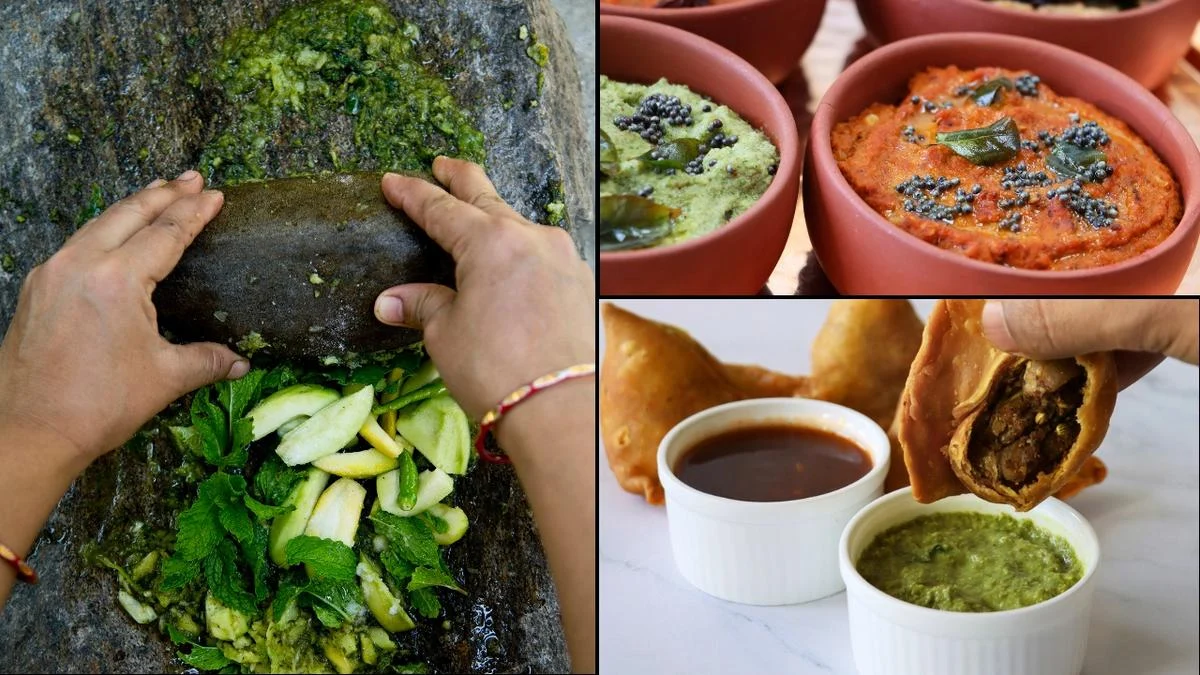
New Delhi, India – Amidst the perennial national discourse, oscillating between debates on anthems and electoral outcomes, a recurring social media phenomenon emerges: the impassioned plea for India to officially designate a national food. While these discussions often devolve into spirited culinary skirmishes between the fervent proponents of biryani and the devoted adherents of khichdi, a compelling argument can be made for a far more ubiquitous and remarkably diverse contender: the chutney. As articulated by Sudha G. Tilak in her insightful new book, Chutney Chronicles, the humble chutney transcends mere condiment status, functioning as a veritable "flavour map" of India, a testament to its rich tapestry of ingredients, histories, and regional identities.
The Case for Chutney: A Culinary Kaleidoscope
Unlike biryani and khichdi, which, at their core, revolve around rice and lentils, chutneys boast an almost boundless variety. Their adaptability is astonishing; from the delicate notes of borage leaves and the subtle bitterness of neem flowers to the vibrant tang of roselle blossoms, virtually any ingredient can be transformed into a chutney. This includes the entire spectrum of mangoes – from the tartness of green mangoes to the sweetness of ripe ones, and even the ephemeral flavour of mango blossoms. For the eco-conscious, a zero-waste mandarin orange peel chutney offers a guilt-free indulgence. Vegans find a veritable smorgasbord of options, while even the most ardent non-vegetarian can find satisfaction in a piquant chicken pachadi or a flavourful Mangalorean dried shrimp chutney. This unparalleled inclusivity makes chutney a dish that truly accommodates all.
The subcontinent’s diverse geography and cultural nuances are vividly encapsulated within its chutneys. Travel across India, and you’ll encounter a constellation of unique flavour profiles. In the north, Kashmiri walnut chutney offers a rich, nutty depth. The remote hills of Nagaland present fermented soybean chutney, a testament to indigenous culinary practices. Gujarat’s dungri ni onion chutney provides a pungent, savory delight, while the classic Kerala-style chammanthi or coconut chutney offers a refreshing, creamy counterpoint. This geographical mapping is so profound that one can almost taste the region through its chutney, a feat few other dishes can achieve with such precision.
A "Pickling of Time": Chutneys as Historical Archives
Beyond their culinary significance, chutneys serve as poignant reflections of India’s intricate history. The presence of red ant chutney and madhuca (mahua flower) chutney, for instance, offers a direct link to the foraging traditions of India’s indigenous forest communities, preserving their ancestral foodways. In stark contrast, an Anglo-Indian green apple chutney carries the distinct echoes of the British Raj, a reminder of colonial influences that have indelibly shaped Indian culture. The very first documented mentions of chutney, according to historical records, trace back to the physicians of Mughal Emperor Shah Jahan, hinting at its ancient lineage and therapeutic applications.
The versatility of chutney extends to its consumption, seamlessly integrating into every mealtime. Breakfast tables are graced with chutneys accompanying idlis, while tea time sees them paired with crispy pakodas. Lunch and dinner are incomplete without their vibrant presence. In essence, chutney embodies the spirit of "unity in diversity" on a plate, a culinary poster child for India’s pluralistic identity. Yet, paradoxically, the absence of comprehensive "chutney maps" of India, akin to the well-established mango or biryani maps, remains a curious oversight.

Marginalized Yet Mighty: The Unsung Ambassador
Despite its profound cultural and culinary significance, the chutney often finds itself relegated to the periphery of the plate, a humble accompaniment rather than a celebrated centerpiece. This marginalization persists, even as it acts as a powerful ambassador for the breadth and depth of Indian cuisine. Nobel laureate Abhijit V. Banerjee, in his foreword to Tilak’s Chutney Chronicles, aptly describes chutneys as "taste-bud openers" that encapsulate the "true complexity" of Indian cuisine. He emphasizes how this complexity arises from the ability to construct meals from an array of diverse tastes and textures. The most compelling argument for chutney, therefore, lies in its ability to preserve this very diversity, refusing to homogenize varied flavours and textures into a singular, undifferentiated whole – a stark contrast to the concept of a "khichdi" of tastes.
The literary world has also recognized the profound metaphorical potential of chutney. Salman Rushdie, in his seminal 1981 novel Midnight’s Children, coined the term "chutnification." He marvelled at the sheer density of India’s population, encapsulated metaphorically within a pickle jar, and extended this concept to history itself: "Every pickle-jar (you will forgive me if I become florid for a moment) contains, therefore, the most exalted of possibilities: the feasibility of the chutnification of history; the grand hope of the pickling of time!" This evocative imagery highlights how the process of blending disparate elements, much like in a chutney, can lead to the creation of something rich, complex, and enduring.
The "Chutnification" of Democracy and Global Identity
The concept of "chutnification" extends beyond culinary metaphors and into the realm of political philosophy. In an essay for the California Review of Books, Brian Tanguay references a discussion on the Past Present Future podcast, where host David Runciman positions Midnight’s Children alongside works like The Handmaid’s Tale as significant political novels. Runciman’s particular fascination lies in the idea of chutnification as a model for understanding the intricate and often messy process of building a democracy. He likens the blending of diverse ingredients into a palatable paste to the painstaking effort of integrating myriad voices, competing interests, historical feuds, schisms, grievances, and hatreds into a coherent national identity.
Historically, the United States, with its "melting pot" ideal, seemed to embody a similar notion, albeit one that might lean more towards a stew than a chutney – a more uniform blending of elements. However, the contemporary political landscape, particularly in the post-Trump era, suggests a definitive departure from this idea. The rise of populist movements and nationalist sentiments across the globe, characterized by stricter border controls and a perception of migration as a threat to local cultures, indicates a move away from embracing diversity in its most unadulterated form. These political forces often champion a more homogenous, perhaps even a "sliced white bread" vision of national identity, seeking to exclude or marginalize "outsiders."
In such a world, the efficacy of the traditional "melting pot" as a unifying symbol may be waning. Perhaps, as the world grapples with increasing polarization and the erosion of inclusive identities, the metaphor of the chutney offers a more relevant and potent model. A chutney, with its inherent ability to be sour, spicy, sweet, or tangy, fundamentally represents something for every taste. It exists on the margins, yet seamlessly integrates into the mainstream, much like a model minority assimilating with ease. Crucially, the "chutnification of history" does not necessitate the flattening of diversity; instead, it celebrates it. The beauty of the chutney lies in its inherent plurality; there is no single chutney to bind them all, just as there is no single narrative to define a truly inclusive nation.

Supporting Data and Emerging Trends
The growing interest in chutney is not merely anecdotal. The proliferation of artisanal chutney brands in gourmet stores, the increasing number of cookbooks dedicated solely to chutneys, and the vibrant online communities sharing recipes and techniques all point to a resurgence of appreciation for this versatile condiment. Food bloggers and culinary historians are increasingly highlighting the regional specificities and historical narratives embedded within different chutneys, elevating them from mere accompaniments to subjects of serious culinary study.
For instance, research into tribal cuisines consistently reveals a rich tradition of utilizing wild ingredients to create unique chutneys, often employing fermentation or sun-drying techniques. These practices, passed down through generations, offer a glimpse into sustainable food systems and a deep understanding of local ecosystems. Simultaneously, academic studies on the evolution of Indian cuisine often cite the chutney as a prime example of how cultural exchange and historical events have shaped culinary practices. The Anglo-Indian chutneys, with their fusion of local ingredients and European techniques, stand as a testament to this dynamic interplay.
Official Responses and The Path Forward
While there has been no official declaration of a national food for India, the ongoing discussions and the burgeoning appreciation for chutney suggest a growing recognition of its unifying potential. Culinary organizations and food festivals are increasingly featuring chutney-centric events, showcasing the diversity and ingenuity of this culinary art form. The inclusion of chutney in national culinary dialogues, even if informal, signifies a shift in perspective.
The book Chutney Chronicles itself can be seen as a significant contribution to this ongoing conversation. By meticulously documenting the history, regional variations, and cultural significance of chutneys, Sudha G. Tilak provides a compelling case for their elevated status. The book’s exploration of chutney as a "flavour map" and a historical archive offers a nuanced understanding that transcends simple culinary appreciation.
Implications for National Identity and Global Representation
The elevation of chutney from a mere condiment to a potential national symbol carries significant implications. It challenges the notion that national foods must be grand, elaborate dishes. Instead, it highlights the power of the humble, the everyday, and the adaptable. In a globalized world where nations are increasingly defined by their ability to embrace diversity, the chutney offers a potent metaphor for a cohesive yet pluralistic identity.

The "chutnification" of national discourse, as proposed by Rushdie and explored by Tanguay, suggests a more inclusive and nuanced approach to nation-building. It implies an understanding that national identity is not a monolithic entity but rather a dynamic blend of diverse elements, each retaining its unique character while contributing to a richer whole. This approach moves beyond the restrictive ideals of assimilation and embraces the beauty of coexistence.
Ultimately, the humble chutney, with its infinite possibilities and profound historical connections, stands as a compelling candidate for a symbol that truly represents the multifaceted spirit of India. Its ability to adapt, to incorporate, and to delight a diverse palate makes it more than just a food; it is a testament to resilience, a celebration of diversity, and a delicious metaphor for a nation that thrives on its own unique blend of flavors and histories. The call for a national food may continue to spark debates, but the argument for chutney as India’s culinary ambassador, and perhaps even its symbolic soul, is increasingly difficult to ignore.
