PUNE/BENGALURU — Shambhu Yadav traveled over 1,400 kilometers from his home in Meerut, Uttar Pradesh, to the bustling streets of Pune, Maharashtra, driven by the simple necessity of survival. Like millions of internal migrants in India, Yadav possessed no formal certification or specialized training. This lack of credentials led him to the one sector that remains the country’s largest unofficial employer: waste management.
Yadav is a kabadiwala—an informal scrap dealer. Every day, he navigates the urban sprawl, collecting discarded remnants of modern life. His haul is a chaotic mix of plastic, paper, and metal, which he segregates by hand before selling it to larger aggregators. While Yadav earns a modest ₹100 to ₹500 per day, he is a vital cog in a massive, lucrative machine. According to market research, India’s waste management industry is valued at approximately ₹1.3 trillion (USD 13.5 billion).
However, since the early 2000s, the nature of his work has shifted. The "trash" has become increasingly complex, dangerous, and valuable. Electronic waste—or e-waste—has flooded the informal stream, landing in the laps of workers who lack the protective gear or technical knowledge to handle it safely.
The Human Cost of "Urban Mining"
Eight hundred kilometers south of Yadav’s beat, in the Padarayanpura neighborhood of Bengaluru, another collector named Sharvan echoes the reality of this hazardous trade. Holding up a handful of bright copper shards stripped manually from discarded electrical wires, Sharvan’s eyes light up.
"This is like gold to us," he says. "The copper sells for ₹1,000 to ₹1,200 per kilogram."

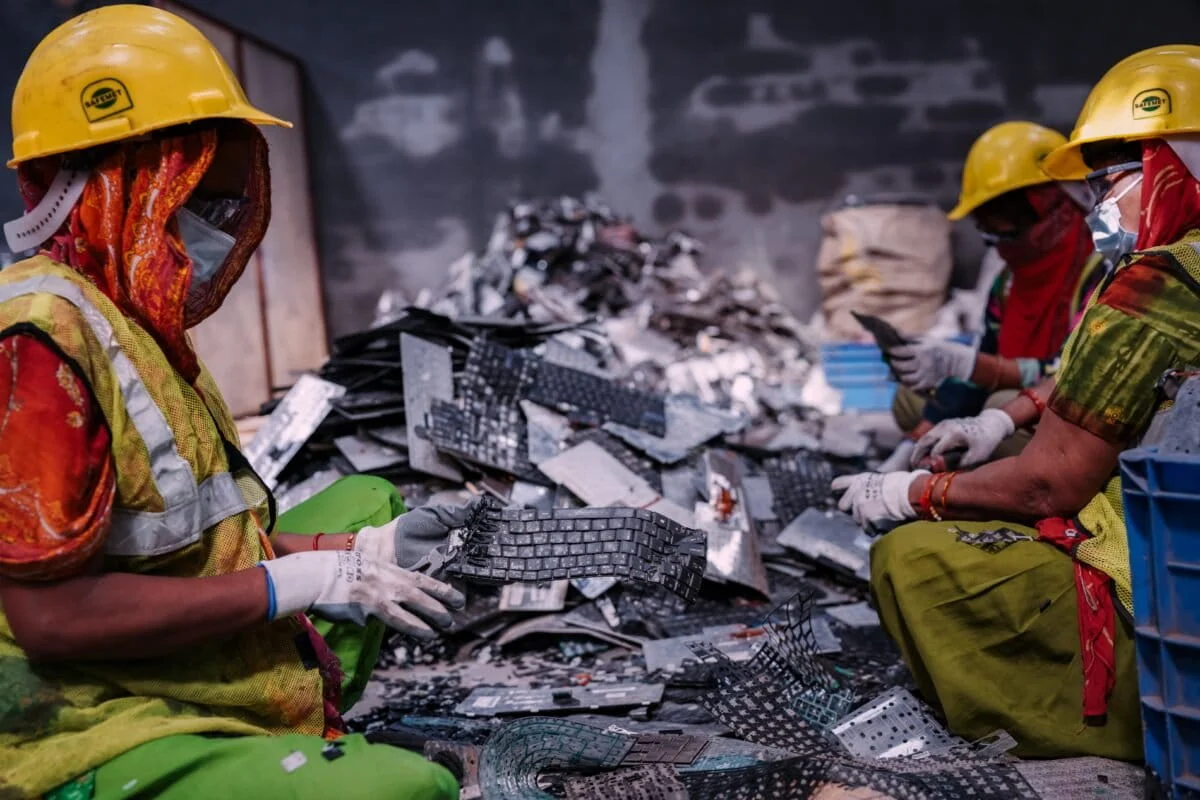
For workers like Sharvan and Yadav, e-waste is a high-stakes gamble. While it offers higher margins than plastic or cardboard, the process of extraction is primitive and perilous. Circuit boards are often burned in open fires to melt away plastic, releasing lead, mercury, and cadmium into the air and soil. Wires are stripped with bare hands or teeth. Despite their outsized role in preventing Indian cities from being buried under discarded tech, these workers exist entirely outside the country’s formal recycling governance framework.
The paradox of India’s e-waste crisis lies in capacity. While the government has introduced stringent regulations, the formal sector simply cannot keep up with the sheer volume of discarded smartphones, laptops, and appliances.
Main Facts: The Disparity Between Policy and Practice
India currently stands as the world’s third-largest producer of e-waste. Official data from the Central Pollution Control Board (CPCB) suggests the country generates roughly 1.4 million tonnes annually, though independent environmental groups and parliamentary reports suggest the figure could be as high as 3.2 million tonnes.
The regulatory landscape is governed by the E-Waste Management Rules, which center on the principle of Extended Producer Responsibility (EPR). Under this framework:
- Registered Producers: There are 7,226 registered producers who manufacture, sell, or import electronic equipment.
- Mandatory Targets: These producers are legally required to meet specific collection and recycling targets, filing compliance returns through a central portal.
- The Formal Infrastructure: India has only 295 official recyclers and 53 authorized refurbishers.
The result is a staggering bottleneck. Combined, these formal facilities process only 5% to 10% of the country’s total e-waste. The remaining 90% is absorbed by the informal sector—the kabadiwalas—who possess a reach and logistical agility that the formal sector cannot replicate.

Chronology: The Evolution of E-Waste Governance
The journey toward regulating e-waste in India has been a decade-long process of trial and error:
- Early 2000s: E-waste begins to enter the informal stream in significant volumes as India’s IT sector booms and mobile phone penetration skyrockets.
- 2011: The first dedicated E-Waste (Management and Handling) Rules are introduced, focusing on the reduction of hazardous substances.
- 2016: The rules are revamped to include Extended Producer Responsibility (EPR), shifting the burden of collection onto the manufacturers.
- 2022: New, more stringent rules are notified, creating a digital marketplace for "E-Waste Recycling Certificates" and expanding the categories of equipment covered.
- Present Day: Despite these legislative milestones, the informal sector remains excluded from the EPR process, creating a "shadow economy" that thrives on cash and anonymity.
Supporting Data: Why the Informal Sector Dominates
The dominance of the informal sector isn’t merely a result of lack of awareness; it is an economic reality. Formal recycling involves a paper trail, banking costs, and the Goods and Services Tax (GST). For a grassroots collector, these are barriers to entry.
Pranshu Singhal, founder of Karo Sambhav, a Producer Responsibility Organization (PRO) based in Gurugram, explains the friction. "Grassroot waste collectors generally avoid digital transactions because their day-to-day procurement is in cash," Singhal notes. "Working outside the system provides operational anonymity and immediate liquidity. There is no GST trail for the collection of waste, which makes the informal route more lucrative for them."
This "cash-and-carry" model allows kabadiwalas to outbid formal collectors. Because they do not invest in safety equipment, environmental audits, or fair wages, their overhead is lower, allowing them to offer better prices to households and small businesses looking to get rid of old electronics.
Official Responses and the NGO Bridge
Recognizing that the formal sector cannot function without the informal network, several non-governmental organizations (NGOs) and social enterprises are attempting to build a bridge.

In Delhi, the Chintan Environmental Research and Action Group has been training waste pickers to become "aggregators." By teaching them how to safely handle e-waste and connecting them with formal recyclers, Chintan has managed to increase the income of these workers by an average of 7%.
Rahim Mandal, who has worked with Chintan for three years, provides a concrete example of the benefits of formalization. "Earlier, I used to sell a mix of e-waste like chargers, keyboards, and bulbs for about ₹40 per kilogram," Mandal says. "Now, through the formal chain, I get ₹65 per kilogram."
Similarly, in Pune, the SWaCH (Solid Waste Collection and Handling) cooperative works in tandem with the municipal corporation. Their 4,000-strong workforce is recognized as formal affiliates of the city’s waste management system.
"We organize e-waste collection drives across the city and divert that waste to recyclers authorized by the Maharashtra Pollution Control Board (MPCB)," says Amogh Bhongale, Outreach Lead at SWaCH. "This recognition gives the workers the formal right to sell dry waste for extra income while ensuring the hazardous components don’t end up in a landfill."
However, experts argue that these successes are localized. Rohan Massey, Associate Director at Saahas Zero Waste, emphasizes that state-backed support is the missing link. "For many, this is a generational family practice. Incentives like state-backed identity cards, development programs for entrepreneurs, and inclusion in minimum wage schemes are necessary to bring them into the fold," Massey says.

Implications: E-Waste as a Strategic Resource
The push for formalization isn’t just about environmental protection or social justice; it is increasingly a matter of national economic security.
As the world transitions to green energy, the demand for critical minerals—lithium, cobalt, copper, and rare earth elements—is surging. These minerals are essential for electric vehicle (EV) batteries and renewable energy systems. E-waste is a concentrated "urban mine" of these materials. Estimates suggest that India’s annual e-waste contains precious metals and critical minerals worth approximately $4.9 billion (₹470 billion).
When e-waste is dismantled in the informal sector, these minerals are often lost. Crude extraction methods focus only on high-value metals like copper and gold, while lithium and cobalt are often discarded or destroyed in the process.
To address this, the Indian government recently launched a Critical Mineral Mission with an outlay of ₹650 crore (₹6.5 million). The mission aims to incentivize the extraction of minerals from e-waste. Integrating the informal sector into this mission could be a game-changer. By skilling kabadiwalas to identify and safely extract high-tech components, India could significantly boost its domestic supply of minerals required for the energy transition.
The Path Forward: Integration, Not Elimination
The consensus among environmentalists and industry leaders is that the "informal" label must be shed in favor of "integrated."

"The EPR rules should recognize the contribution of informal e-waste collectors as official collection agents," says Pranshu Singhal. "This would strengthen the system and provide the traceability and accountability that is currently missing."
For Shambhu Yadav in Pune and Sharvan in Bengaluru, the future remains uncertain. They continue to provide a service that the state and private corporations cannot, yet they do so at the cost of their health and without the protection of the law.
The transition to a truly circular economy in India will depend on whether the government can transform the kabadiwala from a shadow figure into a recognized entrepreneur. Until then, the "gold" found in India’s discarded wires will continue to be extracted at a price that doesn’t show up on a balance sheet: the well-being of the country’s most vulnerable workers.