

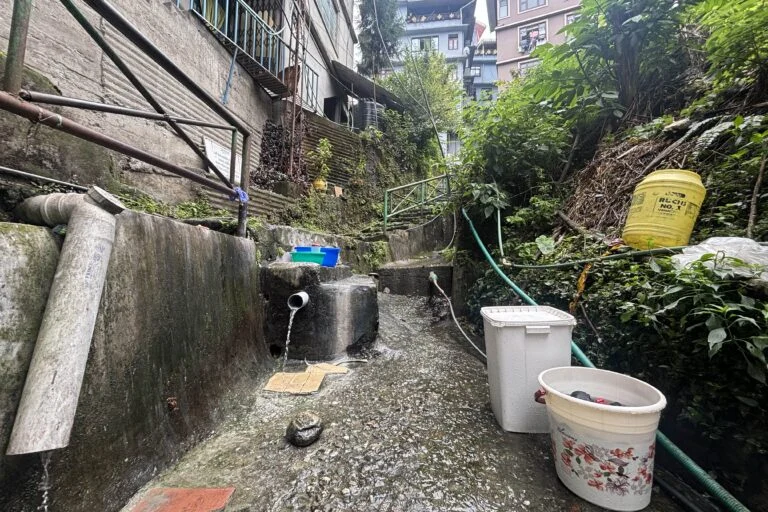
GANGTOK, SIKKIM — In the shadow of the Eastern Himalayas, the capital city of Gangtok is grappling with a paradox. Despite being situated in one of the world’s most ecologically vibrant and water-rich regions, the city’s taps frequently run dry. Between November 2025 and February 2026, the city descended into a period of acute water scarcity that exposed the structural vulnerabilities of its modern infrastructure. As the centralized system faltered, a traditional, often overlooked network of freshwater springs—known locally as dharas—emerged not just as a backup, but as the city’s primary lifeline.
New research and recent events suggest that the future of Gangtok’s water security may lie not in massive engineering projects, but in the restoration and protection of these ancient subterranean networks.
I. Main Facts: The Anatomy of a Modern Water Crisis
The water crisis that paralyzed Gangtok in the winter of 2025-2026 was the result of a "perfect storm" of climatic shifts and infrastructural limitations. Historically, Gangtok has relied on a centralized water supply system sourced primarily from the Ratey Chu River. However, this system has proven increasingly fragile.
![Overlooked urban springs can strengthen water security in Himalayan cities [Commentary]](https://imgs.mongabay.com/wp-content/uploads/sites/30/2026/05/11095320/Photo_1-1200x800.jpg)
The crisis was triggered after September 2025, when seasonal rainfall almost completely ceased. By early 2026, the discharge from the Ratey Chu River had plummeted by nearly 50%. This drop in volume meant that the Public Health Engineering Department (PHED) could no longer meet the demands of a city that has seen its population and tourist footprint explode over the last decade.
Key Drivers of Scarcity:
- Source Vulnerability: The Ratey Chu source is highly susceptible to both winter droughts and monsoon-induced landslides that frequently sever intake pipelines.
- Urban Expansion: Rapid, unplanned construction has increased the demand for water while simultaneously reducing the ground area available for rainwater to recharge local aquifers.
- Tourism Strain: As a premier Himalayan destination, Gangtok’s water consumption peaks during tourist seasons, often outstripping the capacity of municipal reservoirs.
- The "Invisible" Solution: Amidst this failure, the city’s 56 identified natural springs provided the only consistent source of water for thousands of residents.
II. Chronology: From Rainfall Cessation to Rationing (2025–2026)
The timeline of the crisis illustrates how quickly a mountain city can move from surplus to emergency when relying on a single, centralized source.
- September 2025: The monsoon withdraws abruptly. Rainfall, which typically continues in lighter "post-monsoon" showers, stops almost entirely, preventing the natural "topping up" of river levels before the dry winter months.
- November 2025 – January 2026: As the dry spell persists, the Ratey Chu River’s flow begins to dwindle. The PHED starts receiving reports of low pressure and dry taps in higher-altitude wards.
- February 11, 2026: The situation reaches a breaking point. The Government of Sikkim issues an official public notification. Municipal water is rationed to once a day. Strict warnings are issued against the use of water for non-essential purposes, such as car washing or construction.
- March 2026: Despite the rationing, the "ground reality" remains grim. Many residents report that even the scheduled once-a-day supply is erratic, lasting only 20 to 30 minutes.
- April 2026: Five months into the crisis, the arrival of pre-monsoon showers offers slight relief, but the underlying issue persists. The city realizes that the centralized system cannot be the sole guarantor of water security.
III. Supporting Data: The Hidden Power of the Dharas
While the formal infrastructure struggled, an assessment conducted by the Ashoka Trust for Research in Ecology and the Environment (ATREE) revealed the staggering importance of Gangtok’s natural springs. The study, which covered all 19 municipal wards, challenged the long-held perception that springs are merely a peripheral or "rural" water source.
![Overlooked urban springs can strengthen water security in Himalayan cities [Commentary]](https://imgs.mongabay.com/wp-content/uploads/sites/30/2026/05/11100202/Photo-4-e1778473950106-768x512.jpeg)
The ATREE Findings:
- Quantity and Resilience: Researchers mapped 56 active springs within the city limits. Remarkably, 73% of these were found to be perennial. Even during the peak of the February 2025 drought—when recharge was at its lowest—these springs maintained a moderate discharge sufficient for household needs.
- Universal Access: Although 58% of these springs are located on private land, the study found a "commons" culture. Ownership boundaries are largely ignored; neighbors share water freely, reflecting a deep-seated social contract centered on water.
- Cultural and Spiritual Significance: Approximately 87% of Gangtok’s springs are considered sacred. Many are dedicated to the Naag (serpent deities), and their maintenance is often tied to religious rituals. This "sacred" status has historically protected the springs from pollution and encroachment.
- Usage Patterns: The springs are not just for emergencies. Residents use them daily for drinking (citing better taste and quality than treated municipal water), bathing, and washing.
Spatial Overlap:
The study noted a significant correlation between settlement patterns and spring locations. Over 52% of the mapped springs occur directly within densely built-up areas. This suggests that the city grew around these water sources, yet modern planning has largely ignored their presence in favor of concrete expansion.
IV. Official Responses and Institutional Frameworks
The 2026 crisis has forced a shift in how the Sikkim government and national bodies view mountain water management. The traditional reliance on "grey infrastructure" (pipes and dams) is being supplemented by "green infrastructure" (springshed management).
The Dhara Vikas Legacy
Sikkim is already a global leader in rural spring revival. The Dhara Vikas initiative, launched in 2008, successfully revived dying springs in rural areas through scientific groundwater recharge and contour trenching. The challenge now is adapting this rural success to the urban density of Gangtok.
![Overlooked urban springs can strengthen water security in Himalayan cities [Commentary]](https://imgs.mongabay.com/wp-content/uploads/sites/30/2026/05/11100535/Photo-5-1200x900.jpg)
National Initiatives:
- NITI Aayog’s Springshed Management: The national think tank has proposed a six-step strategic framework for the Indian Himalayan Region. This includes mapping, data monitoring, and community-led governance to restore the "aquifers" that feed these springs.
- NAQUIM 2.0: Under the National Aquifer Mapping and Management Program, the Central Ground Water Board (CGWB), in collaboration with Sikkim Manipal University, has initiated the first comprehensive Aquifer Management Plan for Gangtok. This provides a scientific roadmap for understanding how the city’s geology interacts with its water supply.
- Jal Jeevan Mission & Sujalam Bharat: These national missions are increasingly focusing on "source sustainability." The Ministry of Jal Shakti’s "Vision for Sujalam Bharat" emphasizes that piped water is only as reliable as the source it draws from.
V. Implications: The Path Toward Urban Water Resilience
The persistence of the crisis into April 2026 serves as a warning for other Himalayan cities like Shimla, Darjeeling, and Mussoorie. The implications of Gangtok’s struggle suggest a need for a radical departure from current urban planning models.
1. The Threat of "Concrete Capping"
The primary threat to Gangtok’s springs is the city’s own growth. As more land is covered by concrete, rainwater cannot seep into the ground to recharge the aquifers. This "slope cutting" and "concrete capping" turn life-giving rain into destructive runoff, leading to flash floods while simultaneously starving the springs of water.
2. Integration into Municipal Governance
For decades, springs existed in a policy vacuum. They were managed by communities but ignored by city planners. Moving forward, springs must be integrated into the municipal building bylaws. Protecting "recharge zones"—the specific areas of land where water enters the ground—is as critical as maintaining the pipes that deliver it.
![Overlooked urban springs can strengthen water security in Himalayan cities [Commentary]](https://imgs.mongabay.com/wp-content/uploads/sites/30/2026/05/11101217/Photo-3jpeg-768x512.jpg)
3. Climate Change Adaptation
With Himalayan rainfall patterns becoming increasingly erratic—characterized by long dry spells followed by intense, short-duration cloudbursts—centralized river-fed systems will become more unreliable. Springs, which act as natural underground storage tanks, offer a much higher degree of climate resilience.
4. Community Stewardship
The ATREE study highlighted that the survival of these springs is largely due to local residents cleaning sources and maintaining paths. Formalizing this stewardship through "Water Committees" or "Spring Health Clubs" could ensure these sources remain uncontaminated by urban sewage.
Conclusion: A Lesson from the Underground
Gangtok’s 2025-2026 water crisis was a moment of reckoning. It proved that in the face of climatic volatility, the most high-tech systems can fail, while the simplest, most ancient sources can endure.
![Overlooked urban springs can strengthen water security in Himalayan cities [Commentary]](https://imgs.mongabay.com/wp-content/uploads/sites/30/2026/05/11100913/Photo2-720x512.jpeg)
The dharas of Gangtok are more than just geological features; they are a testament to a time when urban life was lived in harmony with the mountain’s natural plumbing. As the city looks toward a future of increasing urban pressure and climate uncertainty, its survival may depend on its ability to protect the invisible rivers flowing beneath its streets. The "Sujalam Bharat" vision cannot be achieved through mega-projects alone; it must be won one spring at a time.
About the Contributors:
This report incorporates findings from a study by Sailendra Dewan, a Fellow in Residence at the Ashoka Trust for Research in Ecology and the Environment (ATREE), and Niharika Bindal. Their work focuses on biodiversity conservation and resilient urban landscapes in the Himalayan Initiative.
