

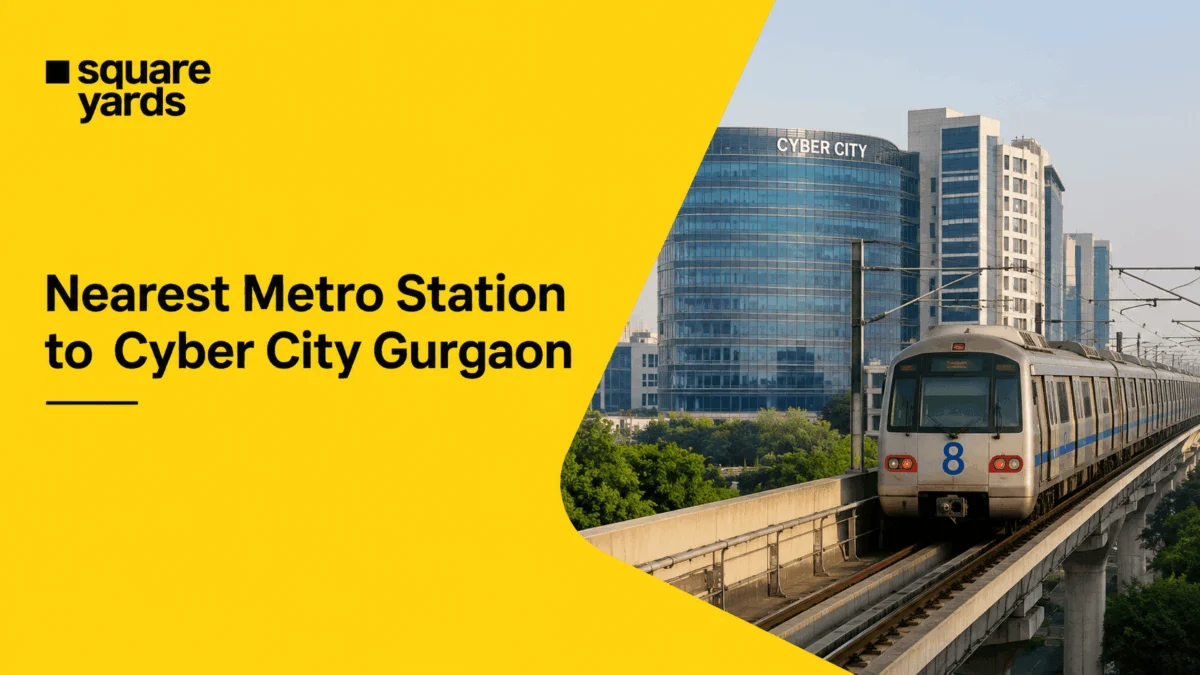
DLF Cyber City in Gurgaon stands as a testament to India’s corporate evolution, a 125-acre powerhouse of Grade-A office spaces that houses the regional headquarters of Fortune 500 giants and the vibrant social fabric of Cyber Hub. However, the true architect of its success is not just the glass-and-steel architecture, but its seamless integration with the Rapid Metro network. Unlike many Indian business districts where public transport was an afterthought, Cyber City was designed as a Transit-Oriented Development (TOD), placing the metro station at the literal doorstep of the workforce.
This article provides an in-depth analysis of the Cyber City metro infrastructure, the chronology of its development, the supporting economic data, and the long-term implications for Gurgaon’s urban landscape.
1. Main Facts: The Triple-Station Strategy
The most common misconception for first-time visitors is that there is only one "Cyber City" station. In reality, the DLF Cyber City complex is served by a triumvirate of Rapid Metro stations, each strategically placed to serve specific clusters of the 125-acre campus.
The Rapid Metro vs. Delhi Metro Distinction
Before navigating the geography, one must understand the operational distinction. The Rapid Metro is a light rail system. While it is currently operated by the Delhi Metro Rail Corporation (DMRC), it remains a distinct entity from the Delhi Metro Yellow Line. The two systems converge at the Sikanderpur interchange. A single smart card works for both, but the physical trains and platforms are separate, designed for the tighter turns and specific frequency requirements of a corporate hub.
The Connectivity Matrix
| Metro Station | Primary Purpose | Walking Distance | Key Landmarks Served |
|---|---|---|---|
| IndusInd Bank Cyber City | Central Hub | 250m (2-3 min) | Building 8, 14, Ericsson, KPMG |
| Belvedere Towers | Western Cluster | 240m-500m (2-5 min) | DLF Square, DLF Atria, Building 10 |
| Phase 3 | Leisure & Greenery | 240m (2-3 min) | Cyber Hub, Cyber Greens, Building 5 |
| Sikanderpur | Regional Interchange | 2.5km (Non-walkable) | Connection to South/Central Delhi |
The "Two-Minute" Commute
The hallmark of Cyber City’s design is the elevated walkway system. Most office-goers do not view the walk from the platform to their desk as a "commute" in the traditional sense. The infrastructure allows for a climate-controlled or sheltered transition from the train to the office lobby, a rarity in the Indian urban context where "last-mile connectivity" usually involves navigating chaotic traffic and uneven sidewalks.
2. Chronology: From Private Ambition to Public Utility
The history of the Cyber City metro connection is a saga of private-sector initiative meeting public-sector necessity.
- 2008-2010: The Vision: Recognizing that the NH-48 (then NH-8) was becoming a bottleneck that threatened the viability of Cyber City, DLF partnered with IL&FS to conceptualize India’s first fully privately funded metro.
- November 2013: Phase 1 Launch: The Rapid Metro began operations, connecting Sikanderpur to Cyber City. This 5.1 km loop changed the "address value" of Gurgaon overnight.
- 2017: Phase 2 Expansion: The line was extended further into Gurgaon, reaching Sector 55-56 via Golf Course Road, making Cyber City accessible to the city’s most affluent residential corridors.
- 2019: The DMRC Takeover: Due to financial instabilities within the private concessionaire (IL&FS), the Haryana Mass Rapid Transport Corporation (HMRTC) stepped in. In October 2019, the DMRC took over operations and maintenance, ensuring that the lifeline of Cyber City remained functional under a stable, public-sector umbrella.
- 2023-Present: Integration and Expansion: Plans for the "Gurgaon Metro" (a 28.5 km loop) were approved, which will eventually link the existing Rapid Metro/Cyber City network to Old Gurgaon and the Dwarka Expressway, further cementing Cyber City as the epicenter of the NCR’s transit network.
3. Supporting Data: Economic and Transit Metrics
The efficiency of the Cyber City metro stations is backed by staggering numbers that reflect its importance to the regional economy.
Commuter Volume and Frequency
During peak morning (8:30 AM – 10:30 AM) and evening (5:30 PM – 7:30 PM) hours, trains run at a frequency of approximately every 4 to 6 minutes. It is estimated that over 60,000 professionals utilize the Rapid Metro daily to reach Cyber City, significantly reducing the carbon footprint by keeping thousands of private cars off the Delhi-Gurgaon Expressway.
Real Estate Impact: Commercial vs. Residential
The presence of the metro has created a distinct "value premium" for properties within a 1-kilometer radius of the Cyber City stations.
| Locality | Approx. Price (Per Sq. Ft.) | Connectivity Factor |
|---|---|---|
| DLF Cyber City (Commercial) | ₹14,000 – ₹18,000 | Direct Metro Access |
| Golf Course Road (Residential) | ₹15,000 – ₹30,000 | 10-15 mins via Rapid Metro |
| Sushant Lok I | ₹15,000 – ₹30,000 | Proximity to Yellow Line/Rapid Metro |
| Sector 24 (Residential) | ₹12,400 | Walking distance to Cyber City |
Travel Time Comparisons
The "Metro Advantage" is most visible during the monsoon or peak rush hours.
- Cyber City to Huda City Centre: 12 minutes (Metro) vs. 45 minutes (Road).
- Cyber City to Golf Course Road: 10 minutes (Metro) vs. 35 minutes (Road).
- Cyber City to South Delhi (Malviya Nagar): 35 minutes (Metro) vs. 70+ minutes (Road).
4. Official Responses and Infrastructure Policy
The Haryana Government and the DMRC have consistently highlighted Cyber City as the benchmark for future urban planning in India.
The HMRTC Perspective:
Official statements from the Haryana Mass Rapid Transport Corporation emphasize that the "Sikanderpur Interchange" is one of the most critical transit nodes in Northern India. By linking a state-run light rail (Rapid Metro) with a central-run heavy rail (Delhi Metro), the government successfully bridged the gap between a corporate island and a mega-metropolis.
The DMRC Operational Strategy:
Since taking over in 2019, the DMRC has focused on "seamlessness." An official spokesperson noted that the goal was to ensure a "zero-friction" experience where a commuter from Noida or North Delhi could reach their desk in Cyber City using a single ticket and minimal walking. The introduction of "Last Mile" feeder buses and E-rickshaw zones at Cyber City stations is part of this ongoing official strategy to eliminate private vehicle dependence.
Environmental Mandate:
The Haryana government has also leveraged the Cyber City metro model to argue for higher Floor Area Ratio (FAR) for developers who build near metro corridors. This policy encourages high-density development, which is only sustainable because of the high-capacity metro stations nearby.
5. Implications: The Future of the "Corporate Campus"
The success of the metro connectivity in Cyber City carries profound implications for the future of Indian urbanism and real estate investment.
For Investors and Businesses
Cyber City remains a "safe haven" for commercial real estate investment. The primary reason is the Low Vacancy Rate. Even during the post-pandemic shift toward hybrid work, Cyber City maintained higher occupancy levels than peripheral areas like Sohna Road or New Gurgaon. Companies prioritize "commutable offices" to attract top talent who are increasingly reluctant to spend hours in traffic.
For Urban Planning
Cyber City serves as a "Proof of Concept" for Integrated Transit. It proves that when the private sector (DLF) and the public sector (DMRC/HMRTC) align their interests, it is possible to create a pedestrian-friendly environment in the heart of a car-centric city. The implication is that future hubs, such as the Global City in Gurgaon or the various "Smart Cities" across India, will likely mimic this hub-and-spoke metro model.
For the Quality of Life
Beyond the economics, the metro has a social implication. The "Phase 3" station has democratized access to Cyber Hub. It is no longer just an enclave for those with private cars; students and residents from across Delhi can access the city’s premier dining and nightlife strip via a ₹30-₹50 metro ride. This "social permeability" is essential for a vibrant, inclusive city.
6. Frequently Asked Questions (FAQ)
1. What is the most efficient way to reach Cyber City from the Delhi Airport?
The fastest route is taking the Airport Express Line to New Delhi Station, switching to the Yellow Line toward Huda City Centre, and finally interchanging at Sikanderpur for the Rapid Metro. While it involves two switches, it is the only way to bypass the unpredictable traffic of the NH-48.
2. Does the Rapid Metro operate on the same timings as the Delhi Metro?
Generally, yes. Trains start at approximately 6:00 AM and run until midnight. However, during the last hour of operation, the frequency of the Rapid Metro can decrease to 10-12 minutes, so it is advisable to use the DMRC app for real-time tracking.
3. Is there a dedicated station for the DLF Building 10 and DLF Square area?
Yes, Belvedere Towers is the designated station for the western edge of the campus. It is often less crowded than the main Cyber City station.
4. Can I use my Delhi Metro Smart Card on the Rapid Metro?
Yes. Since the DMRC takeover in 2019, there is full integration of the ticketing system. You do not need a separate card or token.
5. How far is Cyber Hub from the nearest metro?
Cyber Hub is most accessible from the Phase 3 Rapid Metro station. The entrance to the food and retail strip is a mere 200-250 meters from the station exit, making it a 3-minute walk.
Conclusion
The Cyber City metro ecosystem is more than just a series of stations; it is the skeletal structure that supports the economic weight of Gurgaon. By solving the "last-mile" problem through direct campus integration, Cyber City has set a standard that remains unmatched in most Indian business districts. For the professional, it offers a predictable commute; for the investor, it offers sustained value; and for the city, it offers a blueprint for a more sustainable, less congested future. As Gurgaon continues to expand, the Cyber City model will remain the gold standard of how transit and commerce should coexist.
