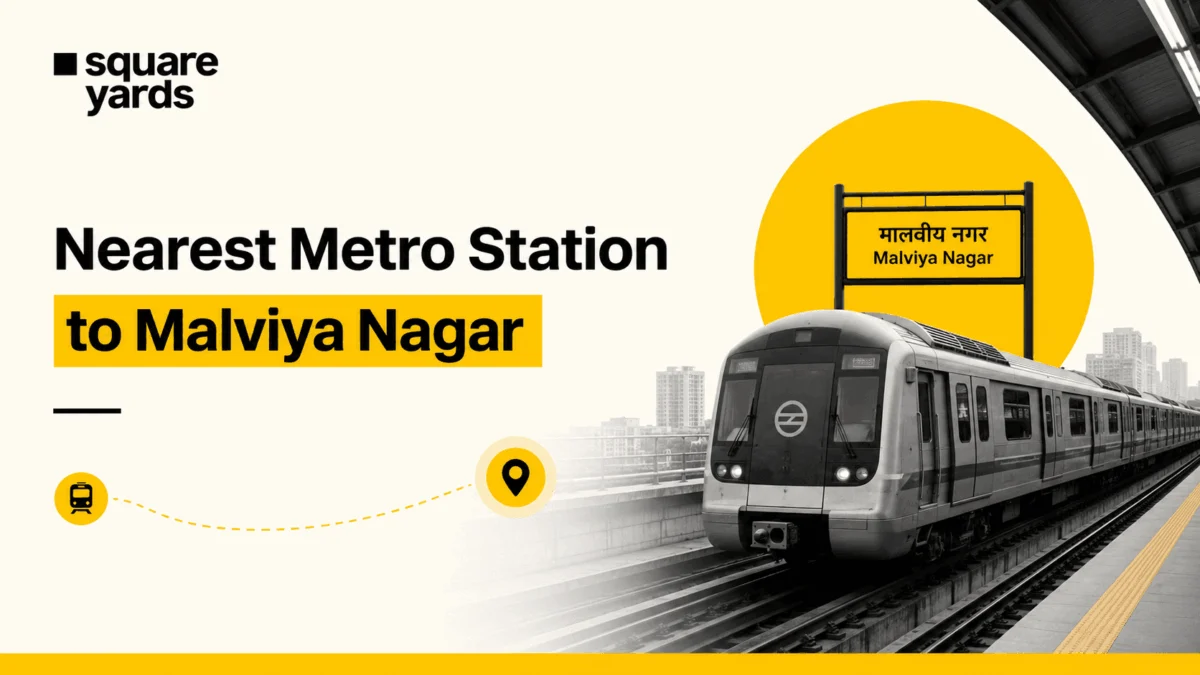
In the sprawling urban tapestry of South Delhi, few neighborhoods strike as delicate a balance between residential serenity and commercial vibrancy as Malviya Nagar. Named after the venerable scholar and freedom fighter Pandit Madan Mohan Malviya, the locality has evolved from a quiet post-partition settlement into one of the most sought-after residential hubs in the National Capital Territory. Central to this evolution is its robust transit infrastructure. While many Delhi neighborhoods struggle with "last-mile connectivity," Malviya Nagar benefits from a strategic positioning that places it at the intersection of two of the Delhi Metro’s most critical corridors: the Yellow and Magenta Lines.
For residents and visitors alike, the search for the nearest metro station to Malviya Nagar is rarely a matter of finding a station, but rather determining which of the five surrounding stations offers the most efficient path to their destination.
1. Main Facts: The Centrality of Malviya Nagar Metro Station
The primary transit artery for the locality is the Malviya Nagar Metro Station, situated directly on the Yellow Line. Located on Press Enclave Road, the station serves as the neighborhood’s front door. Unlike many "satellite" stations that require a secondary commute, this station is physically embedded within the locality, making it a "walking station" for a significant portion of the population.
However, Malviya Nagar’s geographic footprint is expansive. It encompasses various sub-localities including Shivalik Colony, Geetanjali Enclave, Sarvodaya Enclave, and the dense residential pockets of Khirki Extension. Because of this spread, the "nearest" station fluctuates. A resident of Sarvodaya Enclave might find themselves mere steps from the Malviya Nagar station, while someone residing in the eastern stretches of Khirki Extension might find the Magenta Line’s Panchsheel Park or Chirag Delhi stations more accessible.
The Metro Station Hierarchy
- Malviya Nagar (Yellow Line): The internal hub.
- Hauz Khas (Yellow/Magenta Interchange): The gateway to Noida and West Delhi.
- Saket (Yellow Line): The shopping and lifestyle gateway.
- Panchsheel Park (Magenta Line): The alternative for eastern blocks.
- Chirag Delhi (Magenta Line): The secondary option for Khirki and beyond.
2. Chronology: From Refugee Colony to Transit-Oriented Development
To understand the current transit landscape, one must look at the historical trajectory of Malviya Nagar. Established in the 1950s to rehabilitate displaced persons following the partition of India, the area was designed with a block-based residential layout. For decades, it remained a self-contained community, relying on the Outer Ring Road and Aurobindo Marg for bus-based connectivity.
The true "transit revolution" began in the mid-2000s with the expansion of the Delhi Metro Rail Corporation (DMRC) Phase II. The inauguration of the Yellow Line elevated Malviya Nagar from a purely residential pocket to a strategically connected urban center.
The second major chronological shift occurred in 2018 with the opening of the Magenta Line. This transformed the northern and eastern fringes of the neighborhood. Before 2018, a trip to Noida or the Indira Gandhi International Airport required a tedious interchange at Rajiv Chowk or a long road journey. The introduction of the Magenta Line via Hauz Khas and Panchsheel Park effectively halved travel times to the eastern and western suburbs, cementing Malviya Nagar’s status as a premier transit-oriented development (TOD) zone.
3. Supporting Data: Connectivity and Logistics
For the daily commuter, the choice of station is often dictated by data: distance, time, and frequency. The following tables provide a granular look at the logistics of navigating Malviya Nagar’s metro network.
Table 1: Comparative Proximity and Access
| Metro Station | Line | Location Context | Walking Time (Approx) |
|---|---|---|---|
| Malviya Nagar | Yellow | Press Enclave Road (Internal) | 2–10 minutes |
| Panchsheel Park | Magenta | Outer Ring Road (North-East) | 12–15 minutes |
| Hauz Khas | Yellow/Magenta | Aurobindo Marg (North) | 18–20 minutes |
| Saket | Yellow | Mehrauli-Badarpur Rd (South) | 18–20 minutes |
| Chirag Delhi | Magenta | Outer Ring Road (East) | 15–18 minutes |
Table 2: Operational Timings (Standard Weekday)
| Direction | First Train | Last Train | Frequency (Peak) |
|---|---|---|---|
| Toward Samaypur Badli (North) | 05:35 AM | 11:32 PM | 3–4 Minutes |
| Toward Millennium City Centre (South) | 05:30 AM | 11:35 PM | 3–4 Minutes |
Note: Timings are subject to DMRC operational adjustments, particularly on Sundays and public holidays.
Last-Mile Connectivity Solutions
While walking is feasible for many, the "last mile" is serviced by a tiered transport system:
- E-Rickshaws: Operating primarily between the Malviya Nagar Main Market and the metro station (Fare: ₹10–₹20).
- Auto-Rickshaws: Available at all exit gates for point-to-point drops to Shivalik or Khirki (Fare: ₹30–₹80).
- DTC Bus Routes: Frequent services along Aurobindo Marg and Press Enclave Road (Routes 427, 522, and 534 are popular).
4. Expert Analysis: The "Interchange" Advantage
Urban planners often highlight Malviya Nagar as a prime example of a "network-resilient" locality. Unlike neighborhoods that depend on a single line, Malviya Nagar residents can pivot between the Yellow and Magenta lines based on real-time traffic or metro delays.
The Hauz Khas Factor:
As an interchange station, Hauz Khas is one of the deepest and most sophisticated stations in the DMRC network. For a Malviya Nagar resident, this station serves as a portal to the "Knowledge Corridor" (IIT Delhi, JNU) and the "Business Corridor" (Nehru Place, Okhla, Noida). Analysts suggest that the proximity to this interchange has increased the "commuter catchment area" of Malviya Nagar, making it a preferred residence for professionals working in disparate parts of the NCR.
The Shopping Synergy:
One stop south of Malviya Nagar lies Saket. While Malviya Nagar has its own robust "Main Market," the Saket Metro station provides immediate access to the premium retail district comprising Select Citywalk, DLF Avenue, and DLF South Court. This proximity creates a unique lifestyle dynamic where high-street shopping and mall-culture are both within a five-minute metro ride.
5. Implications: Impact on Real Estate and Urban Growth
The most profound implication of this metro density is seen in the local real estate market. Property values in Malviya Nagar have shown remarkable resilience and growth, largely attributed to transit accessibility.
The Real Estate Value Proposition
Malviya Nagar occupies a unique "middle-market" niche in South Delhi. It is more affordable than the ultra-luxury enclaves of Panchsheel Park or Hauz Khas, yet it offers better connectivity than many parts of Greater Kailash or Chittaranjan Park.
Price Trends per Square Foot:
- Malviya Nagar: ₹19,000 – ₹26,000
- Saket: ₹16,000 – ₹20,000
- Hauz Khas: ₹20,000 – ₹33,000
- Panchsheel Park: ₹28,000 – ₹32,000
The presence of the metro has led to a surge in the construction of "Builder Floors"—modern, multi-story apartments that replace older independent houses. For investors, the rental yield in Malviya Nagar is particularly attractive. The area is a magnet for young professionals and students due to its proximity to the Yellow Line (connecting to North Campus/Hauz Khas) and the Magenta Line (connecting to Noida/IIT).
Lifestyle and Commercial Evolution
The ease of access has also transformed the Malviya Nagar Main Market. Once a local grocery hub, it has evolved into a diverse ecosystem of cafes, designer boutiques, and healthcare facilities. The "metro effect" has brought in footfall from across Delhi, turning the neighborhood into a destination rather than just a transit point.
6. Navigating the NCR: Strategic Routes
For those traveling to Malviya Nagar from other parts of the region, the DMRC network offers several streamlined paths:
- From IGI Airport: Passengers can take the Airport Express Line to New Delhi Station and then switch to the Yellow Line (Southbound). Total travel time is approximately 50 minutes.
- From Gurugram: A direct ride on the Yellow Line from Millennium City Centre (formerly HUDA City Centre) takes about 45 minutes, making Malviya Nagar a popular residence for those working in Cyber City or Udyog Vihar.
- From Noida: The Magenta Line provides a direct link from Botanical Garden or Noida Sector 18 to Hauz Khas or Panchsheel Park, bypassing the congested central Delhi interchanges.
- From North Delhi: A direct Yellow Line commute from Kashmere Gate or Vishwavidyalaya ensures that students and government employees have a seamless journey.
Conclusion
Malviya Nagar represents the modern face of South Delhi—a locality where history meets high-speed transit. The abundance of metro options—Malviya Nagar, Hauz Khas, Saket, and Panchsheel Park—has effectively "shrunk" the city for its residents. Whether it is the convenience of a 5-minute walk to the Yellow Line or the strategic advantage of the Magenta Line for cross-town travel, the neighborhood’s connectivity remains its greatest asset.
As Delhi continues to expand, the importance of such transit-rich pockets will only grow. For the homebuyer, the investor, or the daily commuter, Malviya Nagar isn’t just a place on the map; it is a perfectly positioned node in the lifeblood of the capital. If you are searching for the nearest metro station to Malviya Nagar, the answer is simple: you are likely already standing in the middle of a transit goldmine.
Frequently Asked Questions
1. Is Malviya Nagar Metro Station safe at night?
Yes, the station is located on a busy main road (Press Enclave Road) with significant police presence and constant movement of people and vehicles. However, as with any urban area, caution is advised in the less-lit lanes of Khirki Extension late at night.
2. Which exit is best for the Malviya Nagar Main Market?
Exit Gate No. 3 and 4 are generally the most convenient for reaching the heart of the Main Market and the residential blocks of B, C, and D.
3. Can I get a direct metro from Malviya Nagar to Noida?
Not directly from the Malviya Nagar station. You must travel one stop north to Hauz Khas and switch to the Magenta Line, which goes directly to Noida. Alternatively, if you live near Khirki, you can go directly to the Panchsheel Park station on the Magenta Line.
4. How far is the Max Super Speciality Hospital from the metro?
The hospital is approximately 1 km from the Malviya Nagar Metro Station, easily reachable via a 5-minute auto-rickshaw ride or a 12-minute walk.