

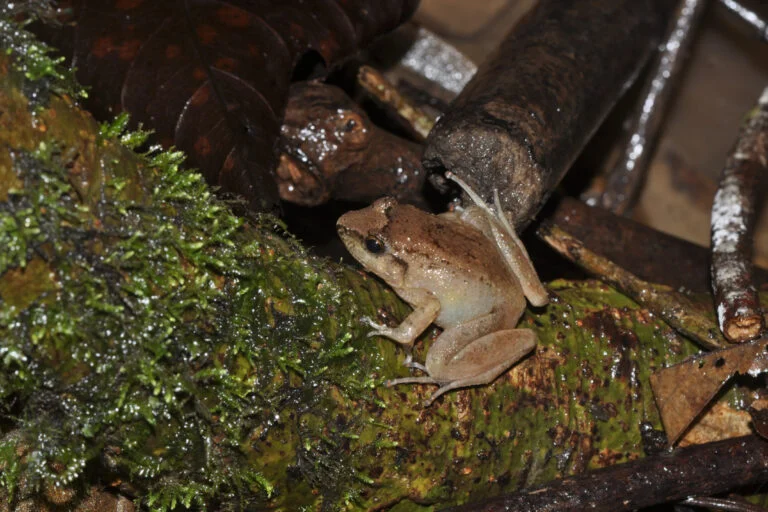
NAMDAPHA TIGER RESERVE, ARUNACHAL PRADESH — In the dense, pre-monsoon shadows of the Eastern Himalayas, a team of dedicated researchers has unveiled a biological mystery hidden beneath the forest floor. The discovery of Limnonectes motijheel, a new species of fanged frog, not only adds a new member to India’s rich amphibian inventory but also reveals a specialized reproductive behavior never before documented in the country.
The discovery, spearheaded by scientists from the Wildlife Institute of India (WII), was the culmination of a four-year odyssey through the rugged terrain of the Namdapha Tiger Reserve. The findings, published in the prestigious taxonomic journal Zootaxa in April 2026, highlight the critical importance of the Indo-Burma biodiversity hotspot and the role of bioacoustics in modern conservation.
Main Facts: A Predator in Miniature
The newly described Limnonectes motijheel belongs to a fascinating group of amphibians known as "fanged frogs." Unlike most frogs, which possess small, needle-like teeth or none at all, members of the Limnonectes genus are characterized by odontoid processes—bony, tooth-like projections on their lower jaws. These "fangs" are not used for venom delivery but are believed to be instruments of combat.

Key Characteristics of Limnonectes motijheel
- Distinctive Call: A sharp, rhythmic "Quaaak" that resonates from beneath the earth.
- Unique Nesting: It is the first Indian species known to construct cup-shaped nests entirely concealed under thick layers of leaf litter.
- Sexual Dimorphism: Unlike the majority of anurans where females are larger, the males of this species are larger than the females, a trait likely linked to territorial defense and male-to-male combat using their fangs.
- Habitat: Primarily found in the evergreen rainforests of the Kamala Valley within the Namdapha Tiger Reserve.
According to Abhijit Das, a senior scientist at the Wildlife Institute of India and the study’s corresponding author, the species is a master of camouflage. "This is a small, brown frog that has evolved to exist in the shadows," Das noted. "Its discovery opens a new research dimension into how these animals utilize the forest floor, not just for survival, but for complex reproductive rituals."
Chronology: From a Mysterious Sound to a Scientific Description
The journey to identify Limnonectes motijheel began in April 2022. While navigating a forest trail in the Namdapha Tiger Reserve as the pre-monsoon rains began to threaten, Das and his team were halted by an unfamiliar sound. It was a subterranean "Quaaak" that seemed to move as they approached.
"We were exactly on the call," Das recalled. "But every time we moved the leaf litter, the sound would stop. It was as if the forest itself was playing a game of hide-and-seek."

The Timeline of Discovery
- April 2022: Initial detection of the unique acoustic signature in the Kamala Valley.
- May 2022: The first physical specimens were collected. Researchers N.V. Rajiv and Sourav Dutta spent hours lying prone on the damp forest floor, meticulously removing leaves one by one until they located a calling male hidden in a mud depression.
- June 2022 – May 2023: Multiple follow-up surveys were conducted. During the fourth sampling survey in May 2023, the team successfully recorded the frog’s natural call using specialized equipment and red-light torches to avoid disturbing the animal’s behavior.
- Late 2023 – 2025: Laboratory phase. The team conducted rigorous morphological measurements and genetic sequencing at the WII labs in Dehradun.
- April 2026: Formal publication in Zootaxa, officially introducing Limnonectes motijheel to the scientific community.
The species was named after Motijheel, a small but vital wetland within the reserve. This site was identified as a critical breeding ground for at least ten different amphibian species, emphasizing the interconnectedness of the reserve’s aquatic and terrestrial ecosystems.
Supporting Data: Genetic Divergence and Morphological Warfare
The classification of L. motijheel required a multi-faceted approach, combining traditional taxonomy with modern molecular biology. The researchers utilized "three lines of evidence"—morphology, genetics, and bioacoustics—to confirm the species’ novelty.
The L. limborgi Species Complex
For decades, many small fanged frogs in Southeast Asia were lumped together under the name Limnonectes limborgi. However, a 2021 study by Kohler et al. suggested that this was actually a "complex" of many distinct species that looked nearly identical to the naked eye.

The WII team compared the DNA of the Namdapha specimens against all available global sequences. Their analysis confirmed that L. motijheel is a distinct lineage within this complex. Of the nine potential lineages identified in 2021, L. motijheel becomes only the third to be formally described.
Territorial Evolution
The presence of "fangs" in the males points toward an aggressive social structure. In the world of Limnonectes, males fight for prime nesting real estate and access to mates. This evolutionary pressure has resulted in males being larger and more robust than females, reversing the standard size ratio found in most frog families.
A Secondary Discovery
During the same survey period, the team recorded another significant find: the presence of Limnonectes longchuanensis. This larger fanged frog was previously known only from China and Myanmar. Its discovery in Namdapha marks the first official record of the species in India, bringing the total number of fanged frog species in the country to six. Interestingly, five of these species are found south of the Brahmaputra River, suggesting the massive waterway acts as a "biogeographic barrier" that prevents species dispersal.

Official Responses and Expert Insights
The discovery has been met with acclaim from the herpetological community, though experts warn that it also highlights how much we have yet to learn.
Bitupan Boruah, the study’s lead author and a Ph.D. student at WII, emphasized the precarious nature of undocumented biodiversity. "Amphibians are the world’s most threatened vertebrate class," Boruah said. "There is a very real possibility that species are going extinct before we even know they exist. Finding L. motijheel is a win, but it’s also a reminder of the clock ticking against us."
Gururaja K.V., a renowned batrachologist and professor at the Srishti Manipal Institute of Art Design and Technology, who was not involved in the study, praised the team’s taxonomic precision. "It is excellent that this taxonomy is resolved," Gururaja said. "The authors have used proper morphological and genetic data to ascertain this as a new species, validating the earlier hypotheses that this group was more diverse than previously thought."

Abhijit Das added that the discovery is just the beginning. "Now that the species has been discovered, we need to know what function it is playing in the ecosystem," he said. "We have found a unique breeding habitat, but the specifics of their life cycle remain a mystery."
Implications: Conservation and the Future of Bioacoustics
The discovery of Limnonectes motijheel has profound implications for the management of India’s protected areas and the methodologies used to study them.
Specialized Reproductive Strategies
The most striking aspect of L. motijheel is its nesting behavior. The "cup-shaped" mud nest under layers of leaf litter provides what Das calls "two-way protection."

- Predator Avoidance: By nesting away from open water, the eggs and tadpoles are safe from aquatic predators like fish and larger amphibians.
- Environmental Stability: The thick leaf litter (sometimes 10-12 leaves deep) maintains a humid microclimate, preventing the eggs from desiccation.
The researchers hypothesize that the species may exhibit advanced parental care. In related species in Borneo, such as L. palavanensis, males have been observed carrying tadpoles on their backs to water sources once they reach a certain stage of development. "We strongly presume that very strong parental care exists within this species," Das noted, calling for further long-term monitoring.
The Unexplored Heights of Namdapha
Namdapha Tiger Reserve is famous for its "four big cats" (Tiger, Leopard, Snow Leopard, and Clouded Leopard), but this discovery underscores that its true richness may lie in its smaller inhabitants. Das pointed out that his team has discovered 15 new-to-science species in the last five years by exploring only the lower elevations of the park. "Areas beyond the 2,000-meter elevation mark are completely unexplored," he warned. "We are likely only seeing the tip of the iceberg."
Bioacoustics as a Conservation Tool
The fact that L. motijheel was first detected by its call rather than its appearance highlights the potential for bioacoustic monitoring. The researchers recommend:

- Developing comprehensive "call libraries" for all Indian amphibians.
- Training forest staff to use acoustic recording devices.
- Implementing a "citizen science" approach where locals and tourists can contribute to wildlife monitoring by recording sounds in the forest.
As climate change and habitat loss continue to threaten the Eastern Himalayas, the "subterranean quack" of Limnonectes motijheel serves as both a scientific marvel and a call to action. It is a reminder that even in the 21st century, the earth still holds secrets—provided we are quiet enough to listen.
