

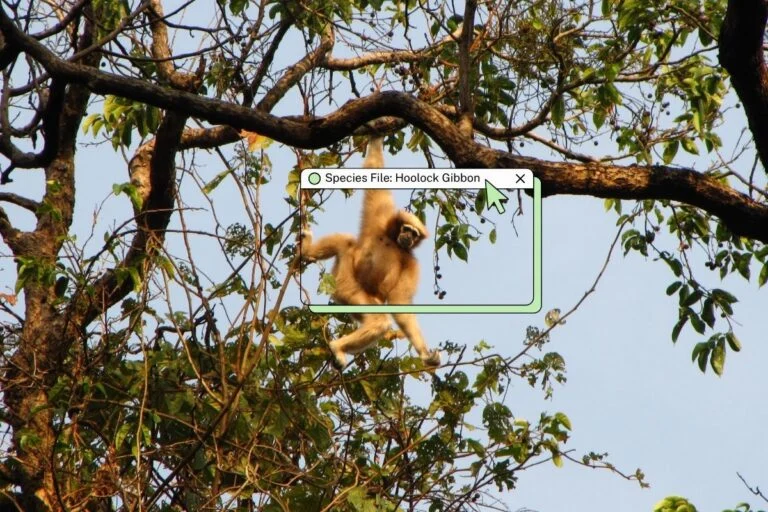
In the mist-laden canopy of Northeast India’s tropical rainforests, the day begins not with the mechanical alarm of a clock, but with a haunting, rhythmic symphony. This is the "duet" of the western hoolock gibbon (Hoolock hoolock), a melodious crescendo of whoops and hoots that serves as both a territorial claim and a reaffirmation of family bonds. For centuries, this song has been the heartbeat of the region’s biodiversity. Today, however, that anthem is growing quieter.
As India’s only ape, the western hoolock gibbon occupies a unique evolutionary and ecological niche. Yet, despite its charismatic presence and legal protection, the species is teetering on the brink of an existential crisis. With a staggering 90% of its global population lost over the last three decades, the survival of this "forest singer" is now a race against time, habitat fragmentation, and human encroachment.
Main Facts: Understanding India’s Lone Ape
The western hoolock gibbon is one of three species of hoolock gibbons found globally, alongside the eastern hoolock gibbon (Hoolock leuconedys) and the Gaoligong hoolock gibbon (Hoolock tianxing). While its cousins are primarily found in Myanmar and China, the western species is the pride of India’s Northeast, spanning the states of Assam, Arunachal Pradesh, Meghalaya, Manipur, Mizoram, Nagaland, and Tripura.
Physical and Social Characteristics
The species is noted for its striking sexual dimorphism. Adult males are draped in a coat of deep, velvety black, accented by white brow streaks that give them a perpetually surprised or inquisitive expression. In contrast, females transition from black to a beautiful buff or golden-brown coat upon reaching maturity.
Unlike monkeys, gibbons are "lesser apes." They lack tails and possess incredibly long, powerful arms designed for brachiation—a method of locomotion where they swing from branch to branch with fluid, acrobatic grace. They are exclusively arboreal, meaning they rarely, if ever, descend to the forest floor. This total reliance on the canopy makes them "sentinels of the forest," as their health is directly tied to the health of the trees.
Ecological Importance
The hoolock gibbon is often referred to as the "gardener of the forest." Their diet consists primarily of ripe fruits, supplemented by leaves, shoots, and the occasional insect. By consuming vast quantities of fruit and traveling across large territories, they act as vital seed dispersers. Many tree species in the Indo-Burma biodiversity hotspot rely almost exclusively on gibbons to spread their seeds, ensuring forest regeneration and the maintenance of a diverse ecosystem.
Chronology: Three Decades of Decline
The story of the western hoolock gibbon over the last 30 years is one of rapid retreat. To understand the current crisis, one must look at the timeline of its dwindling numbers and the shifting landscape of Northeast India.
- The 1990s: The Beginning of the Slide: As industrialization and agricultural expansion accelerated in Northeast India, large tracts of contiguous forest were cleared for tea plantations, ginger farming, and timber. During this period, the gibbon population was still robust, but the seeds of fragmentation were sown.
- 2000–2010: The Fragmented Reality: By the turn of the millennium, primatologists began noticing a disturbing trend. Gibbon families were being "marooned" in small patches of forest surrounded by human settlements or monoculture plantations. The 2008 IUCN assessment officially listed the western hoolock gibbon as Endangered, reflecting a population crash of more than 50% over the preceding 40 years.
- 2019–Present: The Genetic Bottleneck: Recent years have seen the emergence of a new threat: genetic isolation. As populations become trapped in "habitat islands," the lack of new mates leads to inbreeding. In 2019, experts warned that the current generation of gibbons in isolated fragments might be the last, as reproductive fitness declines sharply in these confined groups.
Supporting Data: The Numbers Behind the Crisis
The statistics surrounding the western hoolock gibbon are a sobering reminder of the impact of human activity on specialized species.
Population Statistics
- Global Population: Approximately 3,000 individuals remain in the wild across India, Bangladesh, and Myanmar.
- India’s Stronghold: India is home to the largest remaining population, estimated at roughly 2,600 individuals.
- Rate of Loss: An estimated 90% of the global population has vanished since the early 1990s.
The Threat of Fragmentation
The western hoolock gibbon is uniquely susceptible to habitat loss because of its refusal to travel on the ground. Research indicates that the loss of even a single "connecting tree" can isolate a family group. In Assam, many gibbon groups are restricted to fragments smaller than 10 hectares, which is insufficient to provide the dietary diversity required for long-term survival.
Primatologist Narayan Sharma of Cotton University, Assam, highlights the biological consequences of this isolation: "When a contiguous habitat is reduced to scattered smaller fragments, they become ‘habitat islands’ in an inhospitable sea of degraded habitat. This results in inbreeding, where offspring are often weak, sterile, or possess little reproductive fitness."
Legal Status
To combat these falling numbers, the Indian government has afforded the western hoolock gibbon the highest level of legal protection. It is listed under Schedule I of the Wildlife (Protection) Act, 1972. This status makes hunting or capturing the animal a severe criminal offense, punishable by heavy fines and imprisonment.

Official Responses and Conservation Efforts
Recognizing the gravity of the situation, various governmental and non-governmental bodies have launched initiatives aimed at reconnecting the broken canopy.
Infrastructure Interventions
One of the most innovative solutions implemented in recent years is the construction of "canopy bridges." In the Hoollongapar Gibbon Sanctuary in Assam, a railway line traditionally bisected the gibbon habitat, leading to tragic accidents and preventing movement. In response, the Forest Department and conservationists installed natural and artificial tree bridges to allow gibbons to cross the tracks safely. These "bridges of trees" have proven successful, with cameras capturing families using them to access new foraging grounds.
Community-Led Conservation
Conservationists have realized that the gibbons cannot be saved through legislation alone; the involvement of local communities is paramount. In states like Meghalaya and Arunachal Pradesh, indigenous communities have historically shared a deep cultural bond with the gibbons.
- The Idu Mishmi Model: In Arunachal Pradesh, local taboos against hunting gibbons have created a natural sanctuary for the species.
- Village Reserves: In some parts of Northeast India, villages have set aside community forests, voluntarily restricting timber extraction to preserve the gibbons’ singing grounds.
Translocation and Habitat Restoration
There are ongoing discussions regarding the "translocation" of marooned gibbons—moving them from isolated, non-viable fragments to larger, protected forests. However, this is a high-risk strategy, as gibbons are highly territorial and sensitive to stress. Consequently, the primary focus remains on "re-greening" corridors to allow the animals to move on their own terms.
Implications: The Cost of Silence
The potential extinction of the western hoolock gibbon carries implications that extend far beyond the loss of a single species.
Ecological Collapse
As primary seed dispersers, the loss of gibbons would lead to a "thinning" of the forest over several decades. Certain tree species would fail to propagate, leading to a loss of floral diversity. This, in turn, would affect other wildlife, from insects to birds, that depend on those specific trees for survival.
Loss of Cultural Heritage
For the people of Northeast India, the hoolock gibbon is a cultural icon. Its song is woven into local folklore and identity. The silence of the canopy would represent a profound loss of the region’s natural heritage and the "spirit" of the forest.
A Warning for Global Biodiversity
The plight of the hoolock gibbon serves as a microcosm of the global biodiversity crisis. It illustrates how specialized species—those that require specific conditions to thrive—are the first to fall when human activity disrupts the balance of nature. If India cannot save its only ape despite having the legal framework and scientific knowledge to do so, it raises troubling questions about the future of other endangered species across the subcontinent.
The Path Forward
The survival of the western hoolock gibbon depends on a three-pronged approach:
- Protecting Contiguous Forests: Halting further fragmentation by preventing the construction of new roads or power lines through critical habitats.
- Reforestation: Planting native fruit-bearing trees to bridge existing gaps in the canopy.
- Sustainable Development: Working with local industries, such as tea and ginger farming, to ensure that economic growth does not come at the cost of the region’s most famous inhabitant.
The morning song of the hoolock gibbon is a reminder of the wildness that still remains in India’s Northeast. Whether that song continues to echo through the trees or fades into a memory depends entirely on the actions taken in the current decade. As the "Species File" of India’s biodiversity continues to grow, the hoolock gibbon stands as a testament to both the beauty of the natural world and the fragility of its existence.
