

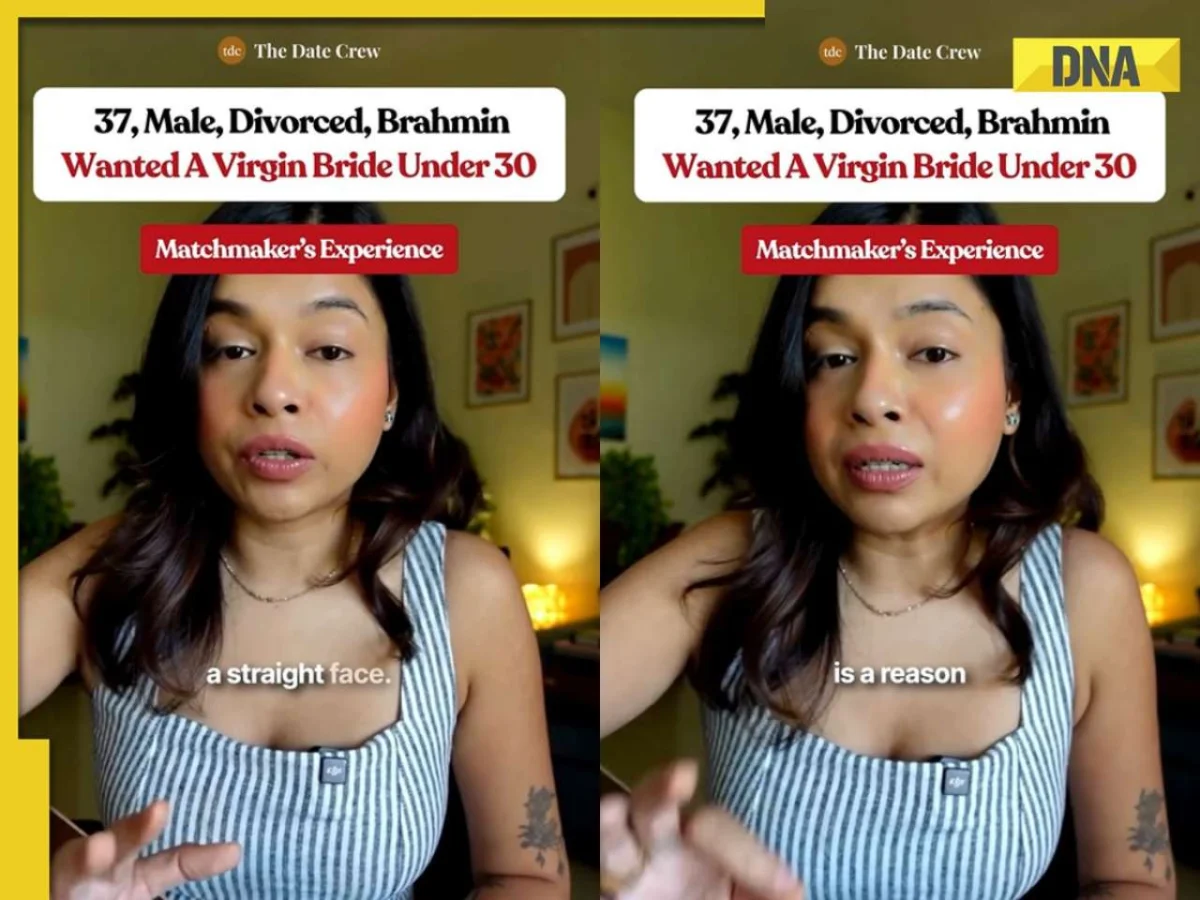
Mumbai, India – A recent social media firestorm has erupted around the highly specific and controversial marriage demands of a divorced, 37-year-old IIT graduate, as shared by renowned matchmaker and dating coach Oendrila Kapoor. The post, which detailed the man’s insistence on a bride under 30, from the Brahmin community, with no prior romantic relationships or sexual history, has ignited a passionate debate across digital platforms, highlighting deep-seated societal expectations and the persistent issue of gendered double standards in the realm of matrimony.
Kapoor, a respected figure in the Indian matchmaking circuit, took to her social media channels to recount her interaction with the affluent and well-educated client. The man, who holds a senior corporate position as a director at a billion-dollar company, presented his criteria with an unwavering rigidity that immediately raised red flags for Kapoor. The stark contrast between his own divorced status and his stringent expectations for a potential partner has become the focal point of widespread criticism and introspection.
)
The Unveiling of Stringent Criteria: A Demand for "Purity"
The core of the controversy lies in the precise stipulations laid out by the 37-year-old IIT alumnus. According to Oendrila Kapoor’s account, the man explicitly sought a bride who met the following criteria:

- Age: Under 30 years old.
- Community: Belonging to the Brahmin community.
- Relationship History: No prior romantic relationships.
- Sexual History: No past sexual encounters.
Kapoor emphasized that these demands were presented as non-negotiable, a testament to the client’s seemingly inflexible mindset. The fact that the man himself was divorced, having experienced the dissolution of a marriage, added a significant layer of irony and hypocrisy to his demands. This juxtaposition immediately drew sharp rebukes from netizens who questioned the fairness of expecting a woman to be entirely "untouched" when the man had already navigated the complexities of a marital relationship.
)
A Flawed Justification: "Research" and the Male Privilege Defense
When questioned by Kapoor about the rationale behind his seemingly unattainable standards, the man reportedly cited "research" as his justification. He claimed that, according to his findings, women with multiple past relationships were statistically more prone to infidelity. This assertion, presented without any verifiable source or context, was immediately met with skepticism by Kapoor, who rightly questioned the validity and impartiality of such claims.
)
The conversation took a more revealing and controversial turn when Kapoor pressed him on whether the same logic should apply to him, given his own divorced status. The man’s response was telling. He allegedly dismissed the comparison, asserting that his situation was "not equivalent." When further pressed for clarification, he is reported to have uttered a statement that has become the linchpin of the online backlash: "Because I am a man."
)
This stark admission of a belief in inherent male privilege, where a man’s past marital status is deemed acceptable while a woman’s is a disqualifier, has resonated deeply with many, sparking outrage and reinforcing perceptions of a patriarchal mindset. The statement, more than anything else, encapsulates the deeply ingrained societal biases that continue to plague relationship expectations in India and beyond.
)
The Matchmaker’s Stance: Refusal and a Statement on Compatibility
Oendrila Kapoor, a professional dedicated to fostering healthy and compatible relationships, ultimately made the decision to decline the man as a client. Her rationale was clear and principled: she believed his mindset was driven by a desire for control rather than a genuine pursuit of partnership and mutual respect.
)
"His expectations were unrealistic and rooted in bias rather than genuine partnership goals," Kapoor stated, as per the news report. She further elaborated that such rigid demands often stem from a place of insecurity and a desire to project an image of control, rather than a willingness to build a relationship based on shared values and emotional connection.
)
Kapoor also astutely pointed out the potential disconnect between the man’s expectations and the reality of finding a partner who would meet his stringent criteria. She suggested that a woman adhering to such a traditional and sheltered background might find it difficult to accept a divorced partner with such demanding and seemingly backward views on relationships. This highlights the inherent paradox in his approach, where he seeks an "unblemished" partner while himself carrying the mark of a past marriage.
)
The Social Media Deluge: Outrage, Solidarity, and a Call for Change
The viral post by Oendrila Kapoor quickly transformed into a digital battleground, with social media users from all walks of life chiming in with their opinions and experiences. The overwhelming sentiment has been one of criticism, condemnation, and a fervent call for a re-evaluation of societal norms surrounding relationships and marriage.
)
Key themes that emerged from the online discourse include:
)
- Hypocrisy and Double Standards: The most prominent critique centered on the blatant hypocrisy of a divorced man demanding a virgin bride. Users vehemently pointed out the unfairness of applying different rules based on gender, labeling the man’s demands as "outdated," "regressive," and "disgraceful."
- "Untouched" Bride Trope: Many users lamented the continued societal pressure on women to remain "pure" and "untouched," while men are often given a pass for their past experiences. The phrase "Young Brahmin Virgin" itself became a symbol of this regressive expectation, drawing ire for its commodification of women and their sexuality.
- Irony of Education: The fact that the man was an IIT graduate, an institution often associated with progressive thinking and intellectualism, added another layer of irony. This led to discussions about how education does not always translate into equitable or modern social attitudes, and how deeply ingrained patriarchal beliefs can persist even among the educated elite.
- Shared Experiences: A significant number of users shared their own encounters with similar, albeit sometimes less extreme, demands in the context of arranged marriage discussions. This solidarity underscored the prevalence of such problematic expectations within Indian society, prompting a collective sigh of recognition and a shared desire for change.
- Critique of "Research": The man’s reliance on unsubstantiated "research" to justify his discriminatory criteria was widely mocked and dismissed. Users questioned the source of such information and highlighted the tendency to twist data or personal biases to support pre-conceived notions.
- The "Because I am a Man" Phenomenon: The man’s justification for the differential treatment based on gender became a viral soundbite, emblematic of a broader societal issue. It resonated with countless women who have experienced similar dismissals or justifications for unequal treatment.
The online discourse also extended to broader conversations about:
)
- Gender Norms and Patriarchy: The incident served as a stark reminder of the enduring influence of patriarchal structures and the need for continuous efforts to dismantle them.
- Evolving Relationship Expectations: Many users emphasized the importance of modern relationships being built on mutual respect, equality, and understanding, rather than archaic notions of purity and control.
- The Role of Matchmakers: Kapoor’s principled stance was lauded by many, sparking discussions about the responsibility of matchmakers in challenging and reframing problematic client expectations.
Broader Implications: A Societal Reckoning in Progress
The controversy surrounding the divorced IITian’s demands is not an isolated incident but rather a symptom of a larger societal issue that continues to plague India and many other cultures. While arranged marriages are a deeply ingrained tradition, the expectations associated with them are increasingly coming under scrutiny in the face of evolving social dynamics and feminist discourse.
)
The implications of this viral debate are far-reaching:
)
- Increased Awareness: The widespread dissemination of Oendrila Kapoor’s post has undeniably amplified awareness around the issue of gendered double standards in marriage. This increased visibility is a crucial first step towards challenging and changing deeply entrenched beliefs.
- Empowerment of Women: The outpouring of support for Kapoor and the critical reactions towards the man’s demands have served as a form of empowerment for women who have faced similar pressures and judgments. It validates their experiences and encourages them to question and reject unfair expectations.
- Challenge to Traditional Notions: The incident has provided a platform to challenge traditional notions of female purity and male privilege. It encourages a dialogue about what constitutes a healthy and equitable partnership in the 21st century.
- Rethinking Matrimonial Practices: The debate has prompted a critical examination of how matrimonial platforms and matchmakers operate. There is a growing expectation for professionals in this field to be more proactive in addressing and challenging discriminatory demands.
- Intergenerational Dialogue: The widespread discussion has likely spurred conversations within families, encouraging younger generations to question the beliefs and biases of older generations.
- Legal and Social Reform: While the immediate impact is social, such widespread public discourse can, over time, contribute to broader shifts in societal attitudes that may eventually influence legal frameworks and social policies related to marriage and relationships.
In conclusion, the viral post by Oendrila Kapoor has transcended a mere anecdote about a demanding client. It has become a catalyst for a crucial societal reckoning, forcing a collective introspection on the persistent inequalities and double standards that continue to shape relationship expectations in India. As the debate rages on, it underscores the urgent need for a paradigm shift towards partnerships built on genuine respect, equality, and mutual understanding, moving beyond the confines of archaic and discriminatory demands. The conversation ignited by this divorced IITian’s rigid expectations is a testament to the ongoing, and vital, evolution of societal norms.
