

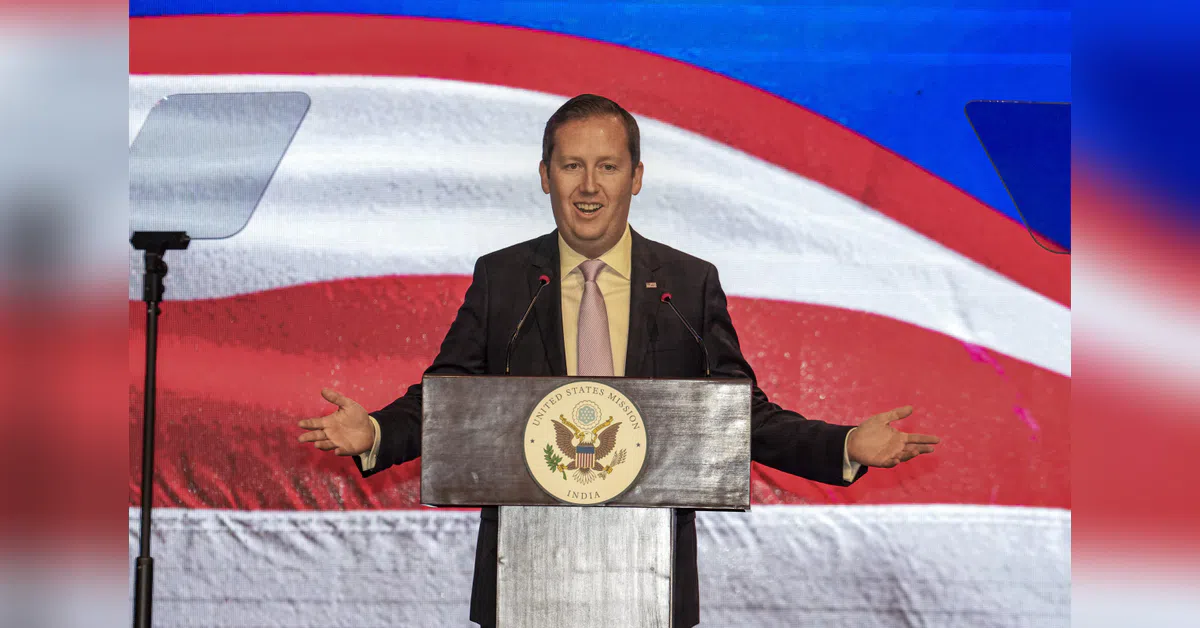
New Delhi, India – Negotiations on the long-anticipated bilateral trade deal between the United States and India are reaching their final stages, with senior trade teams from both nations converging in New Delhi this week. The optimistic pronouncements from Sergio Gor, US Ambassador to India and Special Presidential Envoy to South and Central Asia, suggest that the agreement is on the cusp of completion, with an impressive 99 percent of the deal already hammered out. The remaining "last one percent" is now the focus of intense discussions, culminating in a scheduled meeting with India’s Commerce and Industry Minister Piyush Goyal on Thursday.
Ambassador Gor, addressing the Citi Annual India Conference in Mumbai on Wednesday, exuded confidence regarding the swift resolution of the lingering issues. "Just this morning, before I flew out to Mumbai, I met with the trade team that is visiting us right now in New Delhi. Last week, they were in Washington DC. This week, we sent our team to New Delhi. Tomorrow, they are going to be meeting with Minister Goyal. We are on the last 1 per cent. 99 per cent of this deal is in place. That last per cent we will figure out sooner than later," Gor affirmed, underscoring the high-level engagement and momentum driving the talks.
This impending trade pact is not merely an isolated economic agreement; it is intrinsically linked to what Ambassador Gor emphatically described as "without question the most consequential global partnership of the century." This assertion positions the bilateral trade deal as a cornerstone in a rapidly evolving strategic alliance that spans economic, technological, and geopolitical dimensions, aimed at delivering tangible results for the populations of both democratic giants.
On the Cusp of a Landmark Agreement
The journey toward a comprehensive US-India trade deal has been protracted, marked by complex negotiations reflecting the diverse economic interests and regulatory frameworks of two of the world’s largest democracies. Gor’s revelation that 99 percent of the agreement is already in place signals a significant breakthrough, indicating that the foundational elements, including market access, tariff reductions, and regulatory cooperation across numerous sectors, have largely been reconciled.
The ‘Last One Percent’: Bridging the Gap
The remaining one percent, while seemingly minor, often represents the most challenging and politically sensitive aspects of any major trade agreement. Ambassador Gor clarified that these final hurdles are largely "technicalities," involving intricate legal language and the precise timing of implementation for certain provisions. While he did not delve into specific details, such final points typically encompass critical areas like:
- Specific Tariff Lines: Detailed negotiations on particular goods where one side seeks greater market access or protection. This often involves agricultural products, automotive components, or specific manufactured goods.
- Non-Tariff Barriers: Addressing regulatory differences, standards, and certification processes that can impede trade even with low tariffs.
- Rules of Origin: Defining the criteria for determining the national source of a product, crucial for preferential tariff treatment and preventing circumvention.
- Intellectual Property Rights (IPR): While broader frameworks might be in place, final clauses on enforcement, data protection, and specific industry concerns can be contentious.
- Digital Trade: Evolving discussions around data localization, cross-border data flows, and digital service taxes.
- Dispute Settlement Mechanisms: Fine-tuning the processes for resolving trade disagreements between the two nations.
The meticulous nature of these final details underscores the commitment of both Washington and New Delhi to forge an agreement that is not only robust but also equitable and enduring. The involvement of Minister Goyal, a seasoned negotiator with a deep understanding of India’s economic priorities, in the final stages highlights the strategic importance attached to sealing this deal.
A History of Deliberation, Not Delay
Responding to criticisms regarding the perceived slowness of the US-India trade negotiations, Ambassador Gor offered a historical perspective, contrasting it with the 19 years it took for the European Union to finalize its trade deal with India. This comparison served to highlight the inherent complexities of negotiating with India, a nation known for its rigorous and astute negotiating teams.
"In these negotiations, each side has to give something, because that’s what defines a win-win situation," Gor explained. "I will say, to India’s credit, you have incredible negotiators. One of the reasons this deal is tough is because, for many years, India held the line on so many items that the United States was not able to get through. That’s why it took 19 years for the European Union to crack that trade deal."
This acknowledgment of India’s negotiating strength is significant. It implies that India has effectively safeguarded its strategic interests, ensuring that any concessions made are part of a mutually beneficial framework. The deliberate pace, therefore, is not a sign of stagnation but rather a testament to the comprehensive and intricate nature of establishing a fair and balanced agreement between two economic powerhouses. The US, Gor emphasized, remains "very hopeful about that last 1 per cent," confident that the remaining technical and legal aspects will be resolved expeditiously.
A Broader Strategic Canvas: The Defining Partnership of the 21st Century
The bilateral trade deal, while a significant milestone in itself, is framed within a much grander vision for the US-India relationship. Ambassador Gor articulated his aspiration to elevate this partnership to "the defining strategic partnership of the 21st century," a vision that extends far beyond traditional trade metrics to encompass geopolitical alignment, technological collaboration, and shared values.
From Trade to Strategic Alliance
The evolution of the US-India relationship over the past two decades is nothing short of remarkable. From a modest foundation, bilateral merchandise and services trade has soared from $20 billion to an astounding $220 billion, an 11-fold increase. This exponential growth reflects not only increased market integration but also a deepening of trust and strategic convergence.
Initially, the trade relationship was often characterized by transactional exchanges, with a focus on goods and services. However, as Gor highlighted, the partnership is now "being driven by innovation and high-value sectors." This shift signifies a maturation, moving towards areas like advanced technology, digital services, renewable energy, defense, and space exploration – sectors that are pivotal to global economic leadership and national security in the modern era.
The ambition to make the US-India relationship the "most consequential global partnership of the century" is rooted in several fundamental factors:
- Shared Democratic Values: Both nations are vibrant democracies committed to rule of law, individual liberties, and open societies, providing a strong ideological foundation for cooperation.
- Geopolitical Alignment: In an increasingly complex global landscape, both the US and India recognize the importance of stability, a rules-based international order, and counterbalancing rising challenges, particularly in the Indo-Pacific region.
- Economic Complementarities: The US, as a leader in innovation and capital, finds a natural partner in India, with its vast and growing market, burgeoning technological talent, and robust manufacturing capabilities.
- Diaspora Linkages: The influential Indian diaspora in the United States acts as a powerful bridge, fostering cultural understanding, economic ties, and political advocacy.
The Personal Diplomacy of Leaders: Trump and Modi
A unique aspect of the US-India strategic partnership, as revealed by Ambassador Gor, is the personal warmth and rapport shared between former President Donald Trump and Prime Minister Narendra Modi. This personal connection, often underestimated in traditional diplomacy, has played a significant role in fostering trust and facilitating high-level engagement.
Gor recounted how President Trump called into the embassy’s ‘Freedom 250’ event in New Delhi last week, demonstrating his continued interest and engagement with India. More strikingly, Gor disclosed the contents of a recent phone call between the two leaders, where Trump conveyed a profound compliment to Modi: "The president ended the phone call with, ‘I hope the people of India realise how lucky they are to have you and the stability of experience that you bring to India.’"
This statement is not just a personal encomium; it carries diplomatic weight, signaling continued respect and recognition of Modi’s leadership. Gor further elaborated on Modi’s unique approach during Trump’s period out of office, noting, "Not everyone around the world was on the same pathway as your prime minister. Your prime minister not only never criticised the president, he stayed in touch during those four years the president was out. And that’s something the president remembers." This steadfastness and diplomatic consistency on Modi’s part underscore a strategic foresight, maintaining crucial relationships irrespective of political transitions. Such personal rapport can often pave the way for smoother negotiations and stronger commitments at the official level, even during challenging periods.
Economic Pillars of Partnership: Investment and Innovation
The robust growth in bilateral trade is being further propelled by significant commitments from American corporate giants, signaling deep confidence in India’s economic trajectory and its potential as a global hub for innovation and manufacturing. These investments are crucial not only for capital infusion but also for technology transfer, job creation, and integrating India into global value chains.
Digital Transformation and Investment Flows
Ambassador Gor specifically highlighted several landmark corporate commitments:
- Amazon: An anticipated investment of $35 billion into India by 2030. This colossal commitment spans various sectors, including e-commerce, cloud services (AWS), logistics, and digital payments, reinforcing India’s digital economy and consumer market.
- Microsoft: An announced outlay of $17.5 billion, which includes substantial investment in hyperscale cloud infrastructure. This investment is critical for India’s burgeoning digital transformation, supporting businesses, government services, and the growing developer ecosystem.
- Google: A recently announced $15 billion artificial intelligence (AI) hub. This initiative positions India at the forefront of AI development and research, leveraging its vast pool of tech talent and fostering innovation in critical future technologies.
These investments collectively represent a vote of confidence in India’s economic resilience, its rapidly expanding digital infrastructure, and its demographic dividend. They are instrumental in solidifying India’s position as a global technology and innovation hub, attracting further foreign direct investment and fostering a dynamic ecosystem for startups and established enterprises alike. The focus on AI, cloud computing, and digital services aligns perfectly with the "high-value sectors" driving the evolving US-India partnership.
Geopolitical Imperatives and Trusted Networks
Beyond economics, the US-India partnership is increasingly defined by its strategic imperative to build resilient, secure, and trusted supply chains, particularly in critical sectors. This focus is a direct response to global vulnerabilities exposed by recent geopolitical events and a shared commitment to ensuring technological and economic security.
Securing Critical Supply Chains: The Minerals Framework
A significant step in this direction was the formal signing of the US-India Critical Minerals Framework last week, an event witnessed by US Secretary of State Marco Rubio and India’s External Affairs Minister S Jaishankar. Ambassador Gor hailed this as a "massive milestone," emphasizing its role in bolstering supply chain resilience.
Critical minerals such as lithium, cobalt, rare earth elements, and graphite are indispensable for modern technologies, including electric vehicles, renewable energy systems, advanced electronics, and defense applications. The global supply chains for these minerals are often concentrated in a few countries, raising concerns about geopolitical leverage and supply disruptions. The framework aims to:
- Diversify Sources: Identify new sources and promote joint exploration and development of critical mineral reserves.
- Process and Refine: Encourage investment in processing and refining capabilities in trusted partner countries.
- Recycle: Promote recycling and circular economy principles for critical minerals.
- Ensure Foundational Elements: As Gor stated, it will "help to ensure the foundational elements required to prevent technology and energy are available within trusted networks." This is crucial for preventing reliance on potentially adversarial nations and safeguarding strategic technologies.
This collaboration is a clear manifestation of both nations’ commitment to de-risking global supply chains and building a more secure and resilient technological future, aligning with broader initiatives like the Quad and the Indo-Pacific Economic Framework for Prosperity (IPEF).
Intellectual Property and Trust: A Cornerstone of Collaboration
A perennial concern for American companies operating globally has been the protection of proprietary technology and research, particularly in the face of repeated intellectual property (IP) theft and R&D infringements experienced in other countries. Ambassador Gor directly addressed this apprehension, assuring American businesses that India is a country they can trust with their intellectual assets.
This assurance is vital for fostering deeper technological collaboration and encouraging high-value investments. Robust IP protection is a cornerstone of innovation, enabling companies to invest in research and development with confidence that their creations will be safeguarded. India has made strides in strengthening its IP regime, and Gor’s statement signals a recognition of these efforts and a commitment to further enhancing trust in this critical area.
India as the ‘Pharmacy of the World’ and US Reliance
Another powerful testament to the trust reposed in India by the United States is its reliance on Indian pharmaceuticals. Gor noted that the US currently imports close to 40 percent of its generic pharmaceuticals from India. This statistic is not merely an economic figure; it represents a fundamental aspect of US healthcare security.
"That’s because we trust this place. That’s because we want to work with this place. That’s a massive life-saving ingredient to our country," Gor emphasized. India’s reputation as the "pharmacy of the world" is built on its robust manufacturing capabilities, cost-effectiveness, and adherence to international quality standards for a vast array of generic drugs. This interdependence highlights India’s critical role in global public health and underscores the strategic importance of maintaining a secure and reliable pharmaceutical supply chain between the two nations.
The TRUST Initiative: Forging Future Resilience
Looking ahead, Ambassador Gor elaborated on the "TRUST (Transforming Relationship Utilising Strategic Technologies)" initiative, which was launched in February 2025 by President Donald Trump and Prime Minister Narendra Modi. This forward-looking initiative formalizes and expands cooperation in several cutting-edge and strategically vital areas:
- Artificial Intelligence Development: Fostering joint research, development, and ethical deployment of AI technologies, crucial for economic growth, national security, and addressing societal challenges.
- Strengthening Trusted Supply Chains for Active Pharmaceutical Ingredients (APIs): Building on the existing pharmaceutical partnership, this focuses on securing the foundational raw materials for drug manufacturing, reducing reliance on potentially vulnerable sources, and enhancing health security.
- Critical Minerals: Reinforcing the Critical Minerals Framework by committing to deeper collaboration across the entire value chain, from extraction and processing to recycling.
The TRUST initiative embodies the forward-looking nature of the US-India partnership, moving beyond conventional trade to address the challenges and opportunities of the 21st century. It positions both nations as leaders in shaping global norms and developing resilient ecosystems for critical technologies and essential goods.
Looking Ahead: The Path to a Defining Partnership
The imminent conclusion of the US-India bilateral trade deal marks a significant achievement, but it is merely one component of a much larger, evolving strategic narrative. The pronouncements from Ambassador Sergio Gor paint a vivid picture of a relationship characterized by deepening economic interdependence, technological synergy, and robust geopolitical alignment.
The "last one percent" of the trade deal, though requiring meticulous attention, is expected to be resolved swiftly, paving the way for a more streamlined and preferential trade environment. This agreement will undoubtedly unlock new opportunities for businesses in both countries, foster greater investment, and enhance economic growth.
More profoundly, the overarching vision of making the US-India relationship the "defining strategic partnership of the 21st century" reflects a shared recognition of their collective potential to shape the global order. From fortifying critical supply chains and advancing AI to securing democratic values and promoting innovation, Washington and New Delhi are increasingly intertwined in their pursuit of a more prosperous, secure, and resilient future. The personal rapport between leaders, the massive corporate investments, and the strategic initiatives like the Critical Minerals Framework and the TRUST initiative all underscore the multi-faceted and robust nature of this partnership, signaling a new era of collaboration between the world’s oldest and largest democracies. The stage is set for this partnership to deliver not just economic gains, but also profound strategic dividends for both nations and the broader international community.
