

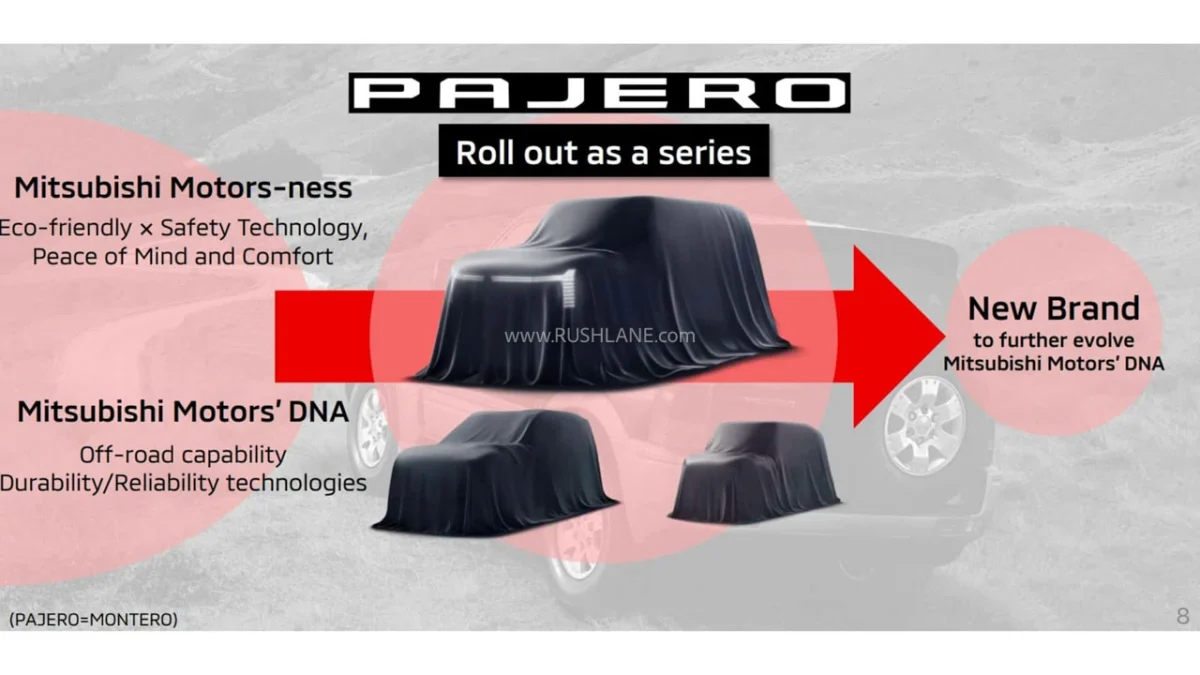
The automotive landscape is set for a seismic shift as Mitsubishi Motors Corporation officially confirms the resurrection of its most storied nameplate: the Pajero. In a strategic pivot that aims to restore the Japanese automaker to its former glory, the company has announced that the Pajero—also known as the Montero in specific international markets—will return not merely as a single flagship model, but as an entire series of off-road-capable vehicles.
This announcement comes as part of Mitsubishi’s ambitious mid-to-long-term business plan, which outlines a roadmap for 13 new vehicle launches by 2031. By leveraging its heritage in the Dakar Rally and its reputation for bulletproof reliability, Mitsubishi seeks to challenge the dominance of established rivals like the Toyota Land Cruiser and the Range Rover family.
Main Facts: The Multi-Tiered Pajero Strategy
Mitsubishi’s decision to revive the Pajero nameplate is more than a nostalgic nod to the past; it is a calculated brand-extension strategy. Instead of a singular "one-size-fits-all" SUV, the company is developing a "Pajero Series." This approach mirrors the success seen by competitors who have turned iconic model names into sub-brands.
A Three-Pronged SUV Approach
According to the official roadmap revealed by Mitsubishi, the Pajero brand will encompass three distinct SUV segments:
- The Flagship Pajero: A large, premium SUV designed to reclaim the "Big Daddy" status. This model will likely serve as the spiritual successor to the fourth-generation Pajero that was discontinued in 2021.
- The Compact Pajero: Positioning itself in the highly competitive 4.2m to 4.5m segment, this vehicle will target urban adventurers who require a balance of daily drivability and weekend off-road capability.
- The Small Pajero: A compact, "Punch-sized" mini SUV (likely under 4 meters) designed to rival the likes of the Suzuki Jimny. This model is expected to be a major volume driver in developing nations and emerging markets.
The Rugged Minivan Wildcard
In a move that has surprised industry analysts, Mitsubishi’s off-road product group slide also featured a silhouette of a rugged minivan. Categorized alongside the Pajero SUVs, this vehicle appears to be an MPV with high ground clearance, four-wheel-drive (4WD) capability, and sliding doors. While it may eventually carry the "Delica" name in some markets, its placement within the Pajero strategy suggests it will share the same "DNA" of durability and go-anywhere performance.
The Montero Branding
For markets such as North America and Spain, the "Montero" nameplate will be revived. Mitsubishi remains sensitive to the linguistic nuances of the word "Pajero" in Spanish-speaking territories, ensuring that the brand’s global rollout is culturally aligned while maintaining a unified product identity.

Chronology: From Dakar Dominance to the 2031 Vision
To understand the weight of this revival, one must look at the timeline of the Pajero’s evolution and the strategic vacuum its departure created.
- 1982 – The Birth of an Icon: The first Mitsubishi Pajero debuted, revolutionizing the 4×4 market by offering a vehicle that was as comfortable on the highway as it was capable in the mud.
- 1985–2007 – The Dakar Years: Mitsubishi’s "Pajero Evolution" became the most successful vehicle in Dakar Rally history, securing 12 victories. This era cemented the brand’s reputation for indestructible engineering.
- 2006–2021 – The Long Goodbye: The fourth generation of the Pajero remained in production for 15 years with only minor updates. As emissions regulations tightened and the platform aged, Mitsubishi struggled to justify the investment in a successor.
- 2021 – Discontinuation: The "Final Edition" Pajero rolled off the assembly line in Japan, marking the end of an era and leaving a void in Mitsubishi’s lineup.
- 2023–2024 – The Strategic Pivot: Mitsubishi announced its "Challenge 2025" and subsequent long-term roadmaps. Internal whispers of a Pajero comeback began to circulate as the company stabilized its finances within the Renault-Nissan-Mitsubishi Alliance.
- Present Day – Official Confirmation: Mitsubishi confirms the Pajero’s return as the centerpiece of a 13-car offensive scheduled for completion by 2031.
Supporting Data: Engineering and Market Positioning
The revival of the Pajero is not happening in isolation. It is backed by significant engineering shifts and a realignment of the company’s manufacturing footprint.
Platform Synergy
The upcoming flagship Pajero is widely expected to utilize a heavily modified version of the ladder-frame chassis found in the new Mitsubishi Triton (L200) pickup truck. Unlike the Triton, however, the Pajero will feature a dedicated cabin design, a more sophisticated multi-link rear suspension for improved ride quality, and a focus on premium interior materials.
"Mitsubishi Motor-ness"
The company has defined its future product development around four pillars, which they term "Mitsubishi Motor-ness":
- Eco-friendliness: Integration of Plug-in Hybrid (PHEV) and Battery Electric (BEV) powertrains across the Pajero series.
- Safety Technology: Advanced Driver Assistance Systems (ADAS) tailored for both highway and off-road environments.
- Peace of Mind: Enhanced structural integrity and durability.
- Comfort: A shift toward "lifestyle" SUV interiors, moving away from the utilitarian aesthetic of the past.
Market Opportunity
The global SUV market is currently divided into two booming sub-sectors: the ultra-luxury segment and the "rugged-lite" lifestyle segment. Mitsubishi aims to occupy the space between these two. Data suggests that there is a growing demand for "authentic" off-roaders—vehicles that look rugged and possess genuine 4WD capability—rather than "soft-roaders" or crossovers that merely look the part. By offering a Pajero in three different sizes, Mitsubishi can capture diverse demographics, from young urbanites in India and Southeast Asia to affluent families in Australia and the Middle East.
Official Responses: Restoring the Brand DNA
While Mitsubishi executives have been careful not to reveal specific engine displacements or launch dates, their official communications emphasize a return to the brand’s core values.

In the mid-to-long-term strategy presentation, Mitsubishi leadership stated:
"Our goal is to provide vehicles that embody the Mitsubishi Motors DNA—reliability, durability, and off-road capability—while meeting the modern demands for carbon neutrality and digital integration. The Pajero is not just a name; it is a promise of performance to our customers."
Industry insiders suggest that the decision to expand the Pajero into a series was driven by the realization that the brand name is more valuable than any individual product. By creating a "Pajero Family," Mitsubishi can maximize the ROI (Return on Investment) of the brand’s marketing while utilizing shared platforms across the Renault-Nissan-Mitsubishi Alliance to keep development costs manageable.
Implications: A New Era for Mitsubishi and the SUV Market
The return of the Pajero has profound implications for the global automotive market and the future of Mitsubishi Motors.
Challenging the Status Quo
For the past several years, Toyota has held a near-monopoly on the "rugged flagship" segment with the Land Cruiser 300 and the new Land Cruiser Prado (250 Series). Ford has also seen massive success with the Everest. Mitsubishi’s re-entry provides a much-needed alternative for consumers who have remained loyal to the brand but were forced to look elsewhere when the Pajero was discontinued.
The Electrification Hurdle
One of the most significant challenges for the new Pajero series will be balancing off-road weight with battery requirements. Mitsubishi is a pioneer in PHEV technology (as seen in the Outlander PHEV), and it is expected that the flagship Pajero will feature a high-output hybrid system. This would allow the vehicle to offer the high torque required for rock crawling while meeting stringent Euro 7 and global emission standards.
Impact on Emerging Markets
The "Small Pajero" (the Jimny rival) could be a game-changer in markets like India, Thailand, and South Africa. In these regions, high-clearance vehicles are a necessity due to infrastructure conditions, but full-sized SUVs are often too expensive for the mass market. A Pajero-branded mini SUV would offer the prestige of the nameplate at an accessible price point, potentially destabilizing the current market leaders in the sub-compact SUV space.

Revitalizing the Brand Image
For a decade, Mitsubishi was often perceived as a "value brand" focusing on budget-friendly crossovers. The Pajero revival signals a shift back toward being a "technology and adventure" brand. This move is essential for Mitsubishi to differentiate itself within the Alliance, where Nissan focuses on tech-heavy road cars and Renault on European compacts.
Conclusion
The confirmation of the Mitsubishi Pajero’s comeback is a bold declaration of intent. By transforming an iconic model into a versatile series of SUVs and even a rugged minivan, Mitsubishi is playing to its historical strengths while addressing the demands of a modern, eco-conscious market.
As the first of these 13 new vehicles begin to break cover in the coming years, the automotive world will be watching closely to see if the "Big Daddy" can reclaim its throne. For enthusiasts and off-roaders alike, the message is clear: the legend is no longer just a memory; it is the future of Mitsubishi.
