

The transformation of the Indian landscape from a "sea of forests" into fragmented "islands of cultivation" is not merely a tale of environmental loss, but a complex narrative of shifting power, economic greed, and cultural resilience. In the recently published volume India’s Forests: Revisiting Nature and History, edited by Arupjyoti Saikia and Mahesh Rangarajan, eleven scholars embark on a multidisciplinary journey to decode how India’s relationship with its woodlands has evolved from the third millennium BCE to the modern era.
This comprehensive work serves as a critical expansion of the foundations laid by environmental historians like Ramchandra Guha. It moves beyond the binary of "colonial vs. indigenous" to explore how forests have been managed, exploited, and worshipped across different epochs and geographies—from the deodar-scented slopes of the Himalayas to the pepper-rich coasts of the Western Ghats.
Main Facts: A Multidisciplinary Re-evaluation
India’s Forests is a collection of essays that bridges archaeology, ancient literature, and modern ecology. The contributors, ranging from field experts to university professors, provide a regionalized view of forestry that includes the western Himalayan foothills, central Indian highlands, Rajasthan, Jharkhand, the Deccan, and the Western Ghats.
The book’s central premise is that forests have never been "wild" in the sense of being empty. Instead, they have always been inhabited, contested, and integrated into the political economy. Key highlights include:
- Ancient Resource Management: Archaeological evidence of timber trade dating back to the Harappan civilization.
- The Political Economy of Nature: Insights from the Arthashastra on how ancient states taxed forest products and controlled "dangerous" forest dwellers.
- Global Trade Integration: The role of India’s forests in the Roman Empire’s economy and the subsequent European "pepper craze."
- Conservation Successes and Failures: Detailed case studies on the Asiatic lion and the one-horned rhinoceros, highlighting both the triumph of population recovery and the looming threat of genetic isolation.
Chronology: The Evolution of Forest Management
The Ancient Era: Resource Procurement and State Control
The story begins in the third millennium BCE. Scholar Shibani Bose presents evidence of long-distance procurement of deodar wood from the Himalayas to Harappan sites. By the 10th century BCE, bhojpatra (birch bark) was being transported to the Ganga river basin.
![The importance and exploitation of Indian forests down the ages [Book Review]](https://imgs.mongabay.com/wp-content/uploads/sites/30/2026/05/27135518/AP22340443783720-1200x800.jpg)
By the 3rd century BCE, as Kumkum Roy notes, the Arthashastra codified the state’s relationship with the forest. It categorized forests not just as wilderness, but as strategic assets. There were gaja vana (elephant forests) essential for military might, and mriga vana (deer forests) preserved for royal pleasure. Even then, the forest was a source of revenue, with taxes levied on meat, hides, tusks, and timber.
The Medieval and Early Modern Period: Trade and Sovereignty
Between 1400 and 1700, India’s forests became inextricably linked to the global economy. Meera Anna Oommen and Kathleen Morrison highlight how the "Pepper Coast" of Kerala fueled the demands of Rome, Iran, and Egypt. The hill chiefs (Velir) controlled these high-elevation forest tracks, acting as gatekeepers to the spices that would eventually draw Vasco da Gama to Calicut.
During this period, Mayank Kumar argues, the landscape was still dominated by forests. However, agrarian expansion began to nibble at the edges of these "monsoon ecologies." Forests also served a political purpose; they were havens for rebels and "recalcitrant elements," prompting the state to keep a vigilant eye on the forest line, much like a military border.
The Colonial and Post-Colonial Era: The Shift to Exploitation
The arrival of British colonial policies marked a seismic shift. The focus turned toward large-scale exploitation for the industrial era, treating forests as renewable resources to be harvested for timber and revenue. This era saw the erosion of "peasant-pastoral wisdom," as Shekhar Pathak describes it.
Post-independence India inherited this bureaucratic structure. While movements like Chipko sought to re-establish the balance between "need and greed," the pressure of a growing population and the demand for economic gains from global corporations have continued to threaten the integrity of forest commons.
![The importance and exploitation of Indian forests down the ages [Book Review]](https://imgs.mongabay.com/wp-content/uploads/sites/30/2026/05/27133647/33180657348_18e91b5201_o-768x512.jpg)
Supporting Data: Wildlife Recovery and the Numbers of Conservation
The book provides a sobering yet hopeful look at India’s "megafauna"—specifically the Asiatic lion and the one-horned rhinoceros. Wildlife expert Divyabhanusinh Chavda details the survival of these species:
- The Asiatic Lion: Once ranging from the Arabian Peninsula to India, the subspecies was hunted to the brink of extinction. Protection efforts by the Nawabs of Junagadh and later the Indian government saw the population rise from 284 in 1990 to 674 in 2020. These lions now occupy an area of 30,000 sq km in and around the Gir forest.
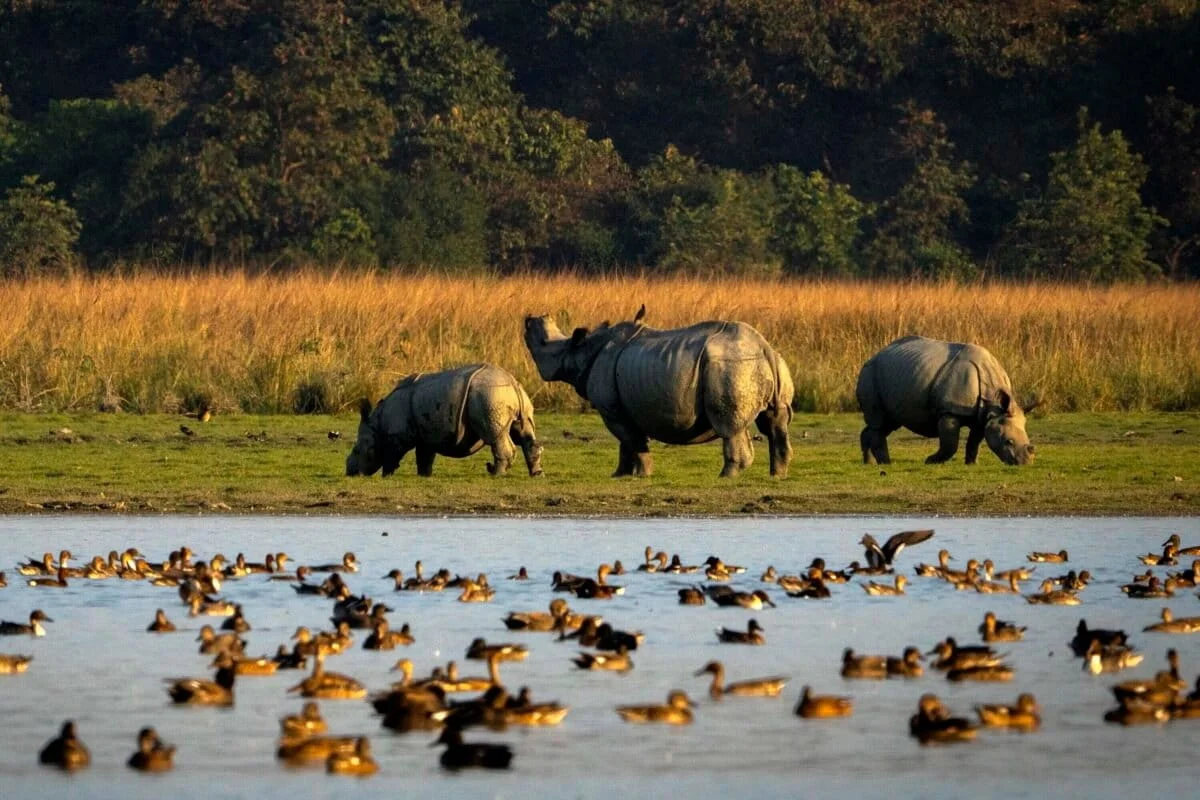
- The One-Horned Rhinoceros: Despite being hunted for sport—notably by Maharaja Nripendra Narain Bhup Bahadur, who shot 207 rhinos—the species found a sanctuary in Kaziranga. In 1954, the population was a mere 600 across India and Nepal. By 2022, India’s population reached 3,270, while Nepal reported 752 in 2021.
However, the data also points to a "genetic bottleneck." Geneticist Stephen J. O’Brien has recorded signs of inbreeding in Gir lions, including reduced manes and lower sperm counts, emphasizing the urgent need for translocation to other habitats.
Expert Perspectives: Sacred Groves and the Politics of "Asmita"
The contributors do not shy away from the socio-political complexities of modern conservation.
The Myth of the Pristine Sacred Grove
Mukul Sharma’s research in Jharkhand challenges the romanticized view of "sacred groves" (Sarna). While traditionally seen as undisturbed pockets of biodiversity, Sharma points out that many are now depleted of trees and reflect the prevailing social hierarchies of gender and caste. The tribal religion itself has shifted, and the sacredness of these groves is often caught in the crossfire of regional political dynamics.
The Bottleneck of Regional Pride
A recurring theme in the book is the concept of asmita (regional pride). Both Gujarat and Assam have shown reluctance to share their iconic species—lions and rhinos, respectively—with other states. This political stance, while rooted in local identity, poses a biological risk. By confining these animals to single geographic clusters, the states risk losing entire populations to a single epidemic or natural disaster.
![The importance and exploitation of Indian forests down the ages [Book Review]](https://imgs.mongabay.com/wp-content/uploads/sites/30/2026/05/27135839/38805167805_ecfdf5e58a_b-e1779870558811-768x512.jpg)
Implications: Forests in the Era of Climate Change
The concluding arguments of India’s Forests emphasize that while our direct economic dependence on wood for fuel may have decreased due to alternative energy, the ecological role of forests has never been more vital.
1. Forests as Carbon Sinks
In an era defined by the climate crisis, forests are no longer just sources of timber; they are essential carbon sinks. The preservation of the "green glaciers" of the Himalayas is not just a local concern but a necessity for the survival of the civilization in the northern plains.
2. The Civilizational Link
As Shekhar Pathak notes in his foreword, forests are deeply embedded in India’s cultural memory. They are the dwelling places of deities, ancestors, and myths. To lose the forest is to lose a part of the Indian identity. The transition from "greed-based" exploitation to "need-based" conservation is the only path forward.
3. The Need for Scientific Translocation
The book serves as a call to action for policymakers to prioritize biological safety over regional politics. The survival of the lion and the rhino depends on creating secondary homes for these species to ensure genetic diversity and resilience against disease.
India’s Forests: Revisiting Nature and History is more than a historical record; it is a warning and a guide. It reminds us that the "islands of cultivation" we inhabit are still dependent on the "sea of forests" that once defined the subcontinent. Saving the soil, the wildlife, and the water systems requires a return to the harmony that characterized India’s pre-industrial relationship with nature.
