

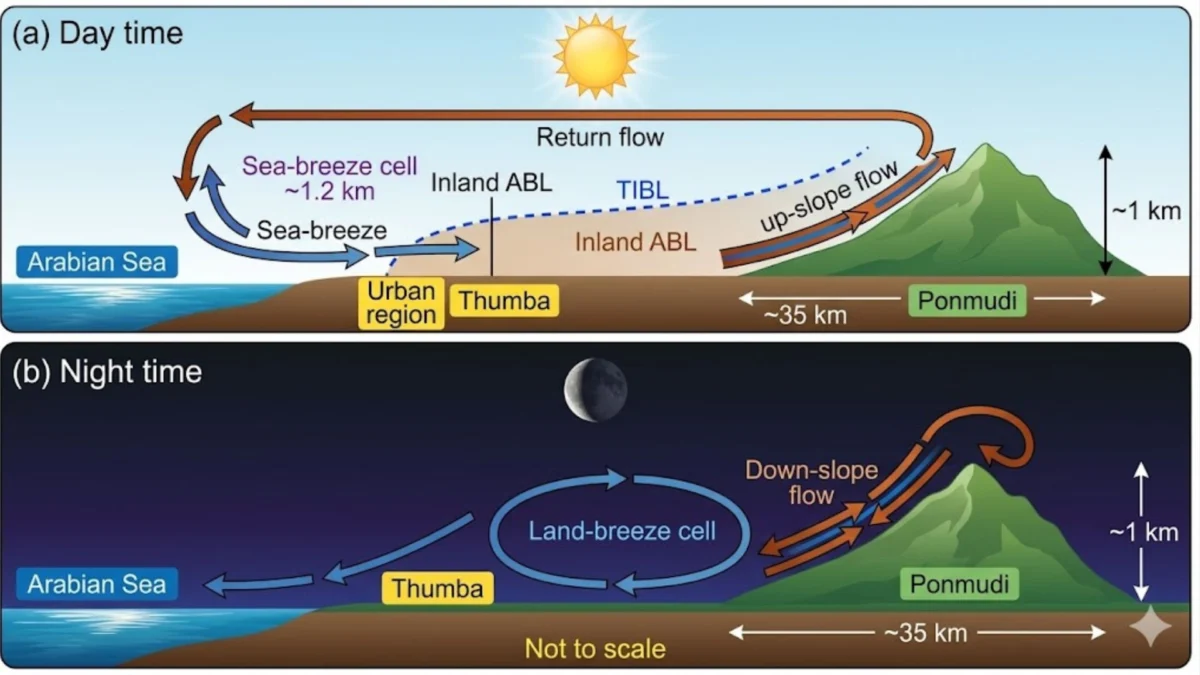
THIRUVANANTHAPURAM — In the delicate balance of Earth’s climate, the Western Ghats have long been regarded as a sanctuary of biodiversity and a vital "carbon sink" for the Indian subcontinent. However, a landmark study conducted by scientists from the Vikram Sarabhai Space Centre (VSSC-ISRO) and the Cochin University of Science and Technology (CUSAT) has revealed a troubling atmospheric phenomenon. Research now shows that local meteorological forces—specifically the interplay between ocean breezes and mountain thermal winds—are acting as a vertical "escalator," lifting harmful black carbon aerosols from bustling coastal cities and depositing them into high-altitude, pristine environments.
The study, which analyzed data spanning nearly half a decade, provides a granular look at how human-induced pollution in Thiruvananthapuram does not simply dissipate over the Arabian Sea but is instead systematically funneled toward the peaks of the Western Ghats. This discovery has significant implications for regional climate modeling, public health, and the conservation of fragile mountain ecosystems.
1. Main Facts: The "Handover" Mechanism
The core of the research revolves around a phenomenon known as the "handover" process. While it is well-understood that winds carry pollution, the specific interaction between the sea breeze and the mountainous topography of Southern India creates a unique delivery system for soot.
The Invisible Culprit: Black Carbon
Black carbon, commonly referred to as soot, is a fine particulate matter (PM2.5) produced by the incomplete combustion of fossil fuels, biofuels, and biomass. Unlike carbon dioxide, which lingers in the atmosphere for centuries, black carbon is a "short-lived climate forcer." However, its impact is disproportionately intense. It is exceptionally efficient at absorbing solar energy, which warms the surrounding air. When deposited on mountain slopes or glaciers, it darkens the surface, reducing the "albedo effect" (reflectivity) and accelerating localized warming.
The Geographical Laboratory
The researchers focused on two distinct but geographically linked locations in the state of Kerala:

- Thumba: A coastal, semi-urban site housing the VSSC, characterized by sea-level elevation and proximity to the Arabian Sea.
- Ponmudi: A rural hill station in the Western Ghats, located roughly 35 kilometers inland and sitting at an altitude of approximately one kilometer above sea level.
By monitoring these two sites simultaneously, the team was able to track the three-dimensional movement of pollution as it traveled from the urbanized coast to the ecological heart of the mountains.
2. Chronology: Five Years of Atmospheric Tracking
The study was not a mere snapshot but a longitudinal investigation. Between 2015 and 2019, researchers maintained a continuous monitoring program to capture the seasonal and daily rhythms of aerosol movement.
Phase 1: Data Collection (2015–2017)
In the initial years, the focus remained on establishing a baseline. Scientists deployed aethalometers—sophisticated instruments that draw in ambient air and pass it through a filter. By measuring the attenuation of light through these filters, the team could calculate the precise mass concentration of black carbon in the air at any given minute.
Phase 2: Identifying Patterns (2017–2018)
As the data accumulated, a clear temporal disconnect emerged between the two sites. While Thumba saw spikes in the morning and late evening (aligned with traffic and domestic activities), Ponmudi’s peak concentrations occurred in the mid-to-late afternoon. This discrepancy became the catalyst for the "handover" hypothesis.
Phase 3: Modeling and Validation (2018–2019)
To confirm their observations, the researchers employed the WRF-Chem (Weather Research and Forecasting with Chemistry) model. This computer simulation allowed them to recreate the atmospheric chemistry and wind vectors of the region. By overlaying the physical data from the aethalometers with the simulated wind patterns, the team successfully visualized the "conveyor belt" effect of the sea-mountain breeze system.

3. Supporting Data: The Daily Rhythm of Pollution
The findings of the VSSC-CUSAT study highlight a sophisticated daily cycle that explains how pollutants overcome gravity and distance.
The Coastal Cycle (Thumba)
At the coastal site, black carbon concentrations follow a "bimodal" distribution:
- The Morning Peak: Between 6:00 AM and 9:00 AM, local traffic and domestic fires release soot. At this hour, the "boundary layer"—the lowest part of the atmosphere—is shallow and stable, trapping pollutants near the ground.
- The Midday Dip: As the sun heats the Earth, the boundary layer expands upward, diluting the pollution. Simultaneously, the sea breeze kicks in, pushing the air inland.
The Mountain Peak (Ponmudi)
At the high-altitude site, the pattern is entirely different:
- The Afternoon Surge: While the coast clears out, Ponmudi experiences its highest pollution levels between 1:00 PM and 4:00 PM.
- The Mechanism: The researchers found that as the sea breeze carries coastal pollution inland, the sun-drenched mountain slopes create "valley breezes"—upward-moving thermal currents. These two systems meet at the base of the Ghats. The valley breeze then "takes the baton" from the sea breeze, lofting the soot particles high into the atmosphere and over the ridges of Ponmudi.
Discrepancies in Modeling
While the WRF-Chem model was highly effective at identifying the transport pathways, the study noted that simulations often underestimated the intensity of the morning spikes at the coast. This suggests that the "micro-turbulence" at the ocean-land interface is even more complex than current mathematical models can fully grasp. The researchers emphasized that future studies would require even higher-resolution modeling to account for these localized "bursts" of pollution.
4. Official Perspectives and Scientific Context
The research, published in the journal Journal of Earth System Science, represents a collaborative effort between India’s premier space agency and leading academic institutions.

The ISRO-VSSC Perspective
Scientists from VSSC pointed out that while large-scale weather patterns—such as the Indian Monsoon—govern the total volume of aerosols over the subcontinent, it is the local "mesoscale" winds that determine the distribution of that pollution. "Understanding the local topography’s role is non-negotiable if we want to protect our high-altitude ecosystems," the study notes.
The Role of National Policy
The findings align with the objectives of India’s National Clean Air Programme (NCAP), which seeks to reduce particulate matter concentration across the country. However, this study adds a new layer of urgency for "non-attainment cities" (cities that do not meet national air quality standards) located near mountain ranges. It suggests that urban pollution is not just an urban problem; it is a regional ecological threat.
5. Implications: Climate, Weather, and Policy
The discovery that black carbon is being systematically delivered to the Western Ghats has far-reaching consequences for the environment and policy-making.
Impact on the Indian Monsoon
The Western Ghats play a pivotal role in triggering the orographic rainfall that constitutes the Indian Monsoon. Black carbon particles in the atmosphere can act as "cloud condensation nuclei," altering the size and number of droplets in clouds. Furthermore, by heating the atmospheric layers above the mountains, these aerosols can change the pressure gradients that drive monsoon winds, potentially leading to erratic rainfall patterns.
Ecological Vulnerability
The Western Ghats are home to thousands of species of flora and fauna, many of which are found nowhere else on Earth. High-altitude "shola" forests and grasslands are particularly sensitive to temperature changes. The localized warming caused by black carbon deposits could shift the delicate thermal balance required for these species to survive, leading to a "migration" of species to higher (and eventually non-existent) altitudes.

Health and Agriculture
While the focus of the study was atmospheric transport, the implications for human health in rural mountain communities cannot be ignored. Residents of supposedly "clean" hill stations may be breathing air that is significantly more polluted than previously thought, particularly during the afternoon hours. Additionally, soot deposition on crops can interfere with photosynthesis, potentially impacting the yields of high-altitude plantations like tea and coffee.
A Call for Targeted Management
The study concludes with a clear message for policymakers: air quality management cannot be confined to city limits.
- Regional Strategies: Pollution control measures in Thiruvananthapuram must account for their impact on the surrounding Ghats.
- Emission Controls: Reducing the source of black carbon—such as transitioning to electric public transport and reducing biomass burning—is the only way to break the "escalator" of pollution.
- High-Altitude Monitoring: There is an urgent need for more permanent monitoring stations across the Western Ghats to track long-term trends in aerosol deposition.
By shedding light on the "handover" process, the researchers from VSSC and CUSAT have provided a critical piece of the puzzle in India’s fight against climate change. As the nation strives for a greener future, the winds of the Western Ghats serve as a reminder that in the atmosphere, everything is connected.
