

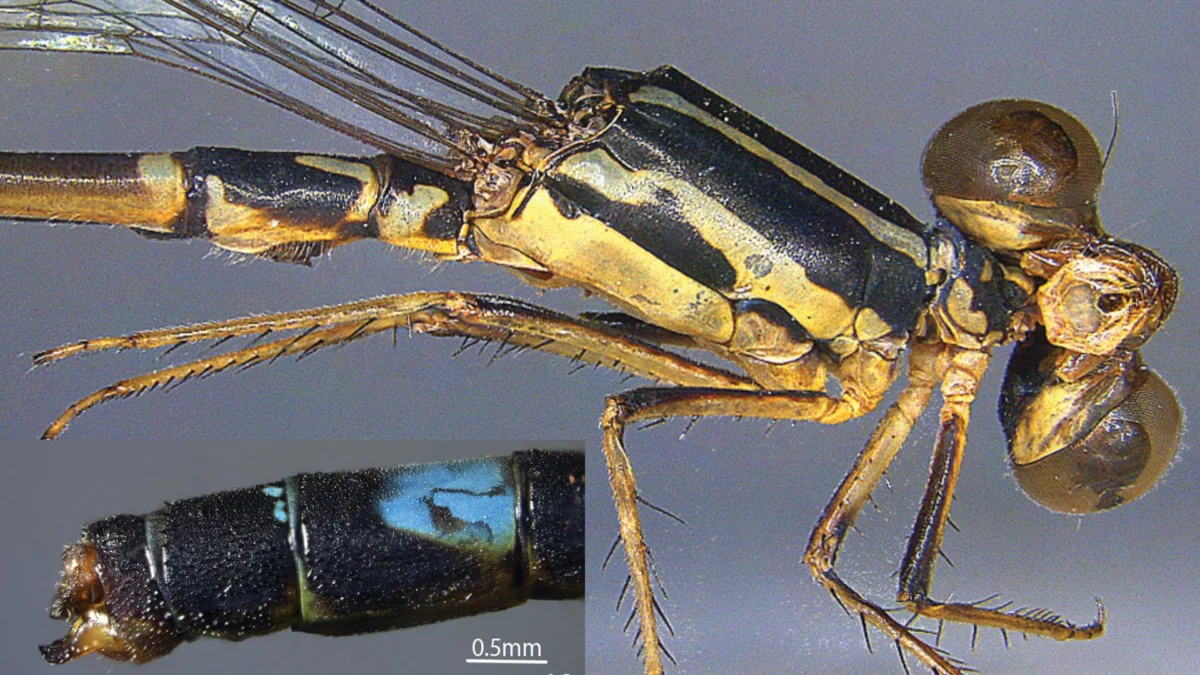
ANDAMAN AND NICOBAR ISLANDS – In the dense, humid thickets of the Andaman and Nicobar archipelago, a world often described as a "living laboratory" of evolution, scientists have unearthed a new secret. A collaborative effort between the Zoological Survey of India (ZSI) and the University of Madras has led to the discovery of a previously unknown species of damselfly. Named Mortonagrion santha, this vibrant, blue-spotted insect offers a window into the complex ecosystems of the Indo-Burma biodiversity hotspot and underscores the critical importance of continued taxonomic research in India’s remote territories.
The discovery, spearheaded by researchers John I. Christopher, Rajappa Babu, and Kumarapuram A. Subramanian, marks a significant milestone in odonatology—the study of dragonflies and damselflies. Found darting among the shadows of a rural farm pond, the Mortonagrion santha serves as a reminder that even in human-altered landscapes, the mysteries of the natural world remain vast and largely unexplored.
Main Facts: A Jewel in the Undergrowth
The Mortonagrion santha is a member of the Coenagrionidae family, a group of slender-bodied damselflies often referred to as "narrow-winged damselflies" or "pond damselflies." This new species is characterized by its diminutive size and secretive nature, a trait common to the Mortonagrion genus. Unlike their more boisterous cousins, the dragonflies, these damselflies are master practitioners of camouflage, often blending seamlessly into the shaded, littoral vegetation of coastal regions.
The key identifying features of M. santha include:
- Postocular Spots: Distinctive pale-blue, crescent-shaped spots located immediately behind the eyes.
- Abdominal Coloration: A striking, bright-blue "splash" on the ninth abdominal segment, which serves as a beacon in the dim light of the understory.
- Morphological Uniqueness: A three-lobed prothorax (collar) and specific proportions in the male mating appendages that distinguish it from its closest relatives in Southeast Asia.
The discovery was made in Dasarathpur, located within the Rangat tehsil of the Middle Andaman Island. The habitat—a small farm pond adjacent to a coconut plantation—is particularly noteworthy. It suggests that the species can persist in "mosaic" environments where human agriculture meets tropical wilderness.

Chronology: From First Sighting to Scientific Recognition
The journey to identifying Mortonagrion santha was not an overnight success but a meticulous process spanning nearly a decade of field research and laboratory analysis.
2017: The Initial Encounter
The story began in 2017 during a routine entomological survey of the Middle Andaman Islands. While sweeping aerial insect nets near a stagnant farm pond in Dasarathpur, the research team captured several specimens of a small, dark damselfly with unusual blue markings. While the researchers immediately suspected they had found something unique, the rigorous standards of modern taxonomy required further evidence.
2019: Confirmation and Collection
To ensure the findings were not an anomaly or a localized variant of an existing species, a follow-up expedition was conducted in 2019. During this period, additional specimens were collected under varying environmental conditions. These specimens allowed the team to study the variations in color and morphology across a broader sample size, confirming that the physical traits were consistent and distinct from other known species in the region.
2020–2025: Taxonomic Analysis and Peer Review
Following the field collections, the specimens underwent intensive microscopic examination at the Zoological Survey of India. The researchers compared the Andaman specimens with holotypes of other Mortonagrion species stored in international museums and private collections. After years of comparative study and DNA considerations, the findings were compiled into a formal descriptive paper.
June 12, 2026: Official Announcement
The discovery was officially published and recognized by the scientific community in June 2026. The species was formally named Mortonagrion santha, honoring the field contributions of P. Santhakumar, whose expertise in netting elusive insects was instrumental to the project’s success.

Supporting Data: Distinguishing the Species
Taxonomy is a science of minute differences. To the untrained eye, many damselflies look identical, but for the team from the ZSI and the University of Madras, the devil was in the details.
Comparative Morphology
The researchers focused heavily on comparing M. santha with its closest morphological relative, Mortonagrion arthuri. M. arthuri is predominantly found further east, stretching across Southeast Asia into regions like Malaysia and Indonesia.
While they share a similar silhouette, M. santha exhibits several "divergent traits":
- The Prothorax: Under high-magnification microscopy, the M. santha reveals a uniquely shaped, three-lobed collar area. This structure is vital in damselfly biology, as it often plays a role in the "lock-and-key" mechanism during mating.
- Anal Appendages: In the world of Odonata, the shape of the male’s tail-like appendages is a primary diagnostic tool. In M. santha, the superior (upper) appendages are approximately half the length of the inferior (lower) ones, a ratio that differs significantly from M. arthuri.
- Color Patterns: While both species feature blue markings, the specific crescent shape of the postocular spots in M. santha provides a reliable field identification marker.
Habitat Specifics
The study noted that M. santha prefers stagnant or very slow-moving water bodies shaded by overhanging vegetation. The specific site in Dasarathpur provided a canopy of coconut palms and tropical shrubs, creating a micro-climate of high humidity and low light—ideal for a genus known for its "secrecy."
Official Responses: A Tribute to Fieldwork
The naming of the species, Mortonagrion santha, carries significant weight within the Indian scientific community. It is a tribute to P. Santhakumar, a dedicated field entomologist whose labor-intensive work often goes unnoticed in the shadow of high-level academic publishing.

"This discovery is a testament to the importance of ‘boots on the ground’ science," noted a spokesperson associated with the project. "Without the tireless efforts of field experts like Santhakumar, who are willing to wade into swamps and trek through dense plantations, our understanding of India’s biodiversity would be significantly diminished."
Representatives from the Zoological Survey of India emphasized that this discovery highlights the "taxonomic gap" in the Andaman and Nicobar Islands. While the islands are famous for their megafauna, such as the Dugong or the Nicobar Megapode, the "micro-fauna"—including insects, spiders, and soil organisms—remains largely uncatalogued. The ZSI has called for increased funding and more "systematic wildlife surveys" to map these remote ecosystems before they are further impacted by climate change or development.
Implications: Why a Tiny Damselfly Matters
The discovery of Mortonagrion santha is more than just an addition to a scientific checklist; it has profound implications for conservation and ecological understanding.
Indicators of Ecosystem Health
Damselflies are widely regarded as "bio-indicators." Because their larval stage is aquatic and highly sensitive to water quality, the presence of a healthy population of M. santha suggests that the local water bodies in Rangat are relatively free from heavy chemical pollutants. Their role as mid-level predators—consuming mosquito larvae and other small insects—makes them essential for natural pest control in agricultural settings.
The Value of Human-Altered Landscapes
Perhaps the most surprising aspect of the discovery is that it occurred next to a farm pond in a coconut plantation. This challenges the traditional notion that new species are only found in "untouched" virgin forests. It suggests that rural landscapes in the Andamans still harbor significant biodiversity. This realization shifts the conservation narrative toward "reconciliation ecology," where human utility and wildlife preservation coexist.

Strengthening the Indo-Burma Hotspot
The Andaman and Nicobar Islands are a crucial component of the Indo-Burma biodiversity hotspot, one of the most biologically rich yet threatened regions on Earth. Every new species discovered strengthens the case for international protection and highlights the evolutionary links between the Indian subcontinent and Southeast Asia. M. santha serves as a biological bridge, showing how species have diverged and adapted across the Bay of Bengal.
Conclusion: The Future of Discovery in the Emerald Isles
The discovery of Mortonagrion santha by the team from the ZSI and the University of Madras is a triumph of persistence and precision. It serves as a poignant reminder that we are still in the "Age of Discovery" regarding our planet’s biodiversity.
As the researchers hope, this "tiny winged predator" will inspire a new generation of Indian entomologists to look closer at the world around them. In the quiet shadows of a coconut grove in the Andamans, a blue-spotted sentinel continues to fly, a small but vital piece of the intricate puzzle of life on Earth. The task now remains to ensure that the habitat of M. santha—and the countless other species yet to be named—is preserved for generations to come.
