

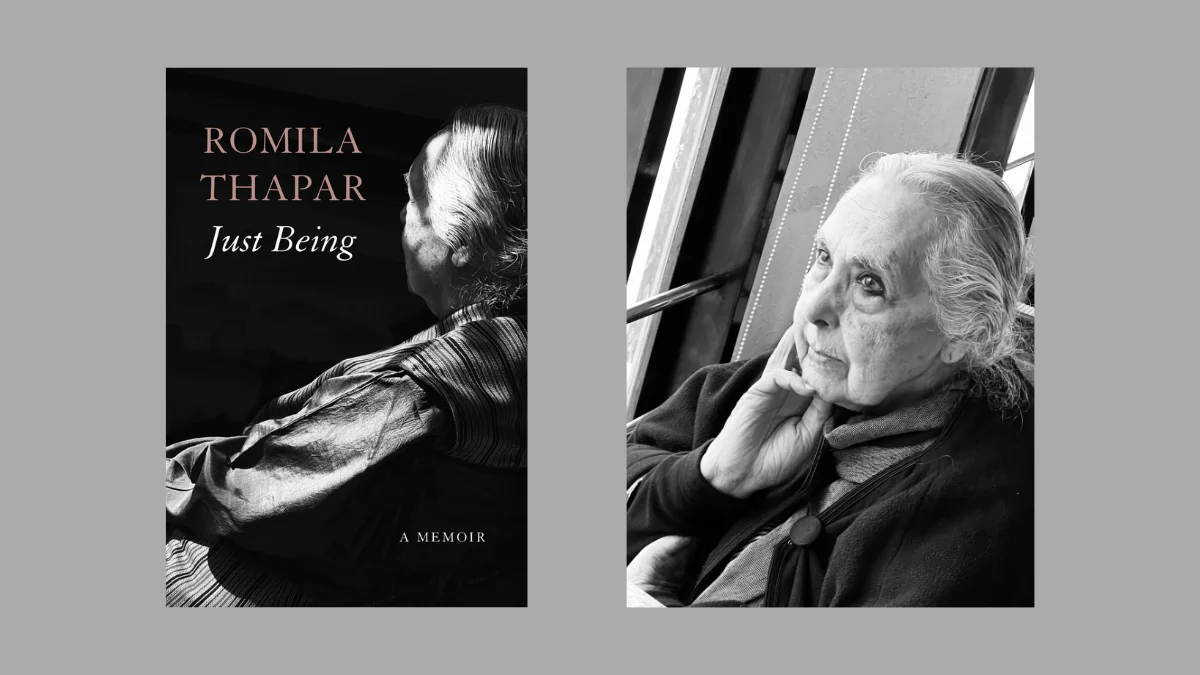
NEW DELHI — In the landscape of Indian historiography, few figures loom as large as Professor Romila Thapar. For over six decades, her work has dismantled colonial myths and challenged the monochromatic interpretations of India’s ancient past. With the release of her latest memoir, Just Being (Seagull Books), Thapar moves from the clinical distance of the historian to the intimate reflections of a witness.
In a comprehensive dialogue at her New Delhi residence, Thapar reflects on the intersection of personal memory and national history. Her memoir is not merely a collection of anecdotes but a "historical understanding of a time," seeking to analyze the meaning of events rather than simply describing them. From the dawn of independence in 1947 to the current climate of academic dissent, Thapar provides a rigorous defense of secularism and a critique of the historical constructs that underpin modern communalism.
I. Main Facts: The Memoir and the Historian’s Lens
Romila Thapar’s Just Being arrives at a pivotal moment in Indian public discourse. While most memoirs prioritize the narrative arc of an individual life, Thapar approaches her own story as a historian. She argues that a historical memoir must place the individual within the "wider context of the particular time," requiring a level of analysis that transcends simple description.
The core of her current intervention lies in the rejection of the popular "revenge of the subaltern" narrative. This theory suggests that the rise of Hindutva is a direct reaction to the perceived failures of a "Nehruvian elite" who supposedly ignored the religious sentiments of the masses. Thapar firmly disagrees. She asserts that the rise of Hindutva is not a failure of secularism but the result of specific historical agencies and the survival of colonial-era ideologies that were never fully excised from the Indian psyche.
II. Chronology: From Subjects to Citizens (1920–Present)
Thapar’s reflections trace a century of ideological development, marking several key transitions in the Indian identity.
The Colonial Roots (1920s)
Thapar traces the ideological foundations of Hindutva back to the 1920s. Far from being an anti-colonial movement, she argues it was rooted in the "wish for the continuation of colonial practices." It was during this period that the concepts of pitribhumi (fatherland) and punyabhumi (holy land) were formalized, drawing on 19th-century European ideas of race and territory.
The Transition of 1947
A defining moment in the memoir is August 1, 1947, when a 15-year-old Thapar was chosen to raise the Indian flag at her school. This moment symbolized the transition from being "subjects of empire to citizens of a nation-state." At the time, nationalism was viewed as an inherently secular ideology. The religious nationalisms (Hindu and Muslim) were seen as marginal forces rather than the primary drivers of the new state.
The Emergency (1975–1977)
Thapar draws parallels and contrasts between different eras of state control. During the Emergency declared by Indira Gandhi, there was a strict clampdown on free speech. However, Thapar notes a unique "concern to explain" the state’s actions to the international community—a gesture that, while superficial, acknowledged a global standard of democratic norms.
The Contemporary Era (2014–Present)
The historian views the current period as one of heightened institutional fragility. She points to the "crowding in" of decisions that affect the judiciary, education, and state institutions, leading to a palpable fear regarding the collapse of the social agencies that uphold a democratic society.
III. Supporting Data: The Colonial Construction of Communalism
Thapar’s critique is grounded in the analysis of how colonial historiography shaped modern Indian politics. She identifies two primary colonial theories that remain "embedded to this day" in the ideology of the Hindu Right:
1. The Two-Nation Theory
Contrary to the belief that Partition was an organic outcome of ancient animosities, Thapar points to James Mill’s The History of British India. Mill argued that India consisted of two permanently hostile communities: the Hindu and the Muslim. This colonial theory was "eagerly appropriated" by communal organizations, creating a self-fulfilling prophecy of conflict that continues to be leveraged for political authority.

2. The Aryan Race Myth
The study of Vedic texts in the 19th century led to the notion of an "Aryan race" as the founders of Indian civilization. Thapar emphasizes that while "race" as a biological social category has been scientifically discredited, it remains a fundamental pillar for those seeking to establish a hierarchy of "purity" and "sacredness" within the Indian territory.
3. Socio-Economic Diversity
To counter the "Indic civilization" monolith, Thapar cites the work of historians like Chris Wickham. She argues that history shows a variety of patterns—slave societies, serfdom, and various dimensions of feudalism. By recognizing this diversity, the historian can see "civilization" not as a static religious block, but as a "thrilling aspect of historical continuity" where new cultures are constantly created through the interface of divergent groups.
IV. Official Responses and the Climate of Dissent
A significant portion of Thapar’s discourse focuses on the state’s response to academic and political dissent. She compares the methods of the British Raj, the Emergency, and the contemporary state.
The Persistence of Sedition
Thapar notes with irony that the law of sedition, established by the British to suppress Indian nationalists, remains a primary tool for the modern state. She highlights the Bhima-Koregaon case as a modern example of "incarceration without trial." Thapar was one of five petitioners who sought bail for the arrested academics and lawyers. She expresses shock that "respected academics, lawyers, writers, and poets" could be accused of plotting assassinations, noting that such arrests serve to chill academic freedom.
Colonial vs. Modern Incarceration
She recalls the "Cellular Jail" in the Andaman Islands as the zenith of colonial cruelty—designed to prevent all communication between prisoners. While modern methods may differ, the "resort to certain laws under which people are arrested and await trial for a lengthy period" remains a constant in the exercise of state power against dissenters.
V. Implications: The Future of Indian Democracy
Thapar’s analysis leads to several sobering conclusions regarding the trajectory of the Indian nation-state.
The Conflict Between Democracy and Hierarchy
Thapar argues that democracy poses an existential problem for Hindutva because democracy "does not accept the religious hierarchy inherent in Hinduism and religion in general." As long as the rights of citizenship are viewed as secondary to religious identity, the democratic format of Indian society remains under threat.
The Redefinition of "Civilization"
The historian warns against the use of "Indic civilization" as a tool for establishing a centralized, exclusionary nation-state. She suggests that the true validity of a civilization lies in its ability to create "fresh cultures" through the merging of diverse groups—maritime, agricultural, and migratory. If India moves toward a singular, centralized cultural identity, it risks losing the very "inter-face" that allowed it to flourish for millennia.
The Fragility of Institutions
The most pressing implication of Thapar’s memoir is the warning regarding institutional decay. She suggests that the "allure of Hindutva" will only fade when the "Indian mind" is truly decolonized—meaning a rejection of the James Mill-style communal divisions and a return to the "equivalent of citizenship" as the primary identity.
In Just Being, Romila Thapar reminds her readers that history is not just about the dead; it is a living "analysis of the meaning of an event." Her memoir serves as a call to protect the "agencies that uphold a society"—the judiciary, the university, and the independent press—from being made ineffective by the weight of ideological orthodoxy.
As she concludes, the creation of culture is the "most thrilling aspect" of history, but it is one that requires the freedom to question, to dissent, and, above all, to be a citizen rather than a subject.
