

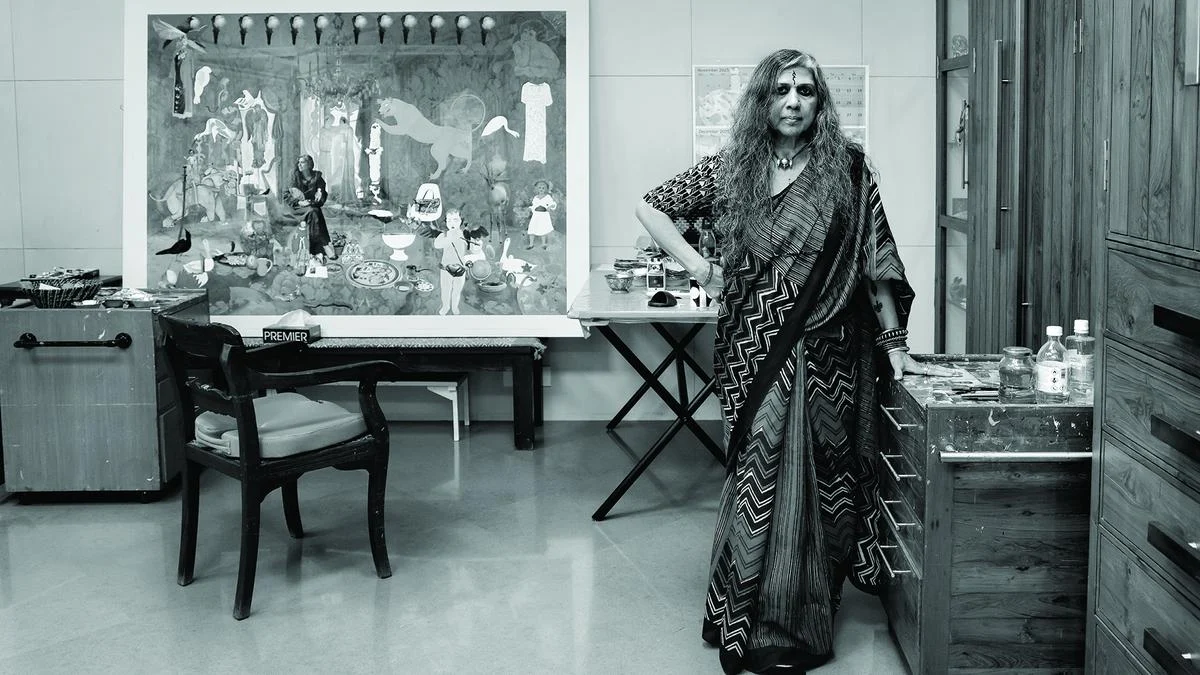
In the hallowed, often impenetrable world of Indian contemporary art, the camera is frequently viewed as an intruder—a mechanical eye that seeks to capture what is meant to be felt. Yet, for photographer Rohit Chawla, the camera has been more than a tool; it has been a passport. After forty years of navigating the inner sanctums of power, fame, and creativity, Chawla has released a definitive volume that serves as both a career retrospective and a profound sociological study. Portrait of an Artist, published by the Kiran Nadar Museum of Art (KNMA) in collaboration with Mapin Publishing, is not merely a collection of photographs; it is a 67-portrait testament to the evolution of the Indian aesthetic mind.

Main Facts: The Transition from Interloper to Insider
For the better part of four decades, Rohit Chawla’s name has been synonymous with the high-gloss world of prestige journalism. His lens has captured the visages of prime ministers, Hollywood icons like Robert De Niro, and literary giants such as Vikram Seth. However, despite his proximity to the sun of celebrity, Chawla long described his presence in these rooms through a single, evocative word: "trespassing."
In his earlier years, Chawla viewed himself as an interloper—a fortunate guest granted temporary access to the private lives of the elite. He was the man with the camera, grateful for whatever crumbs of personality a subject chose to reveal. However, Portrait of an Artist marks a psychological sea change. At this stage of his career, Chawla no longer feels like a visitor. He feels he belongs to the very creative firmament he once merely observed.

The book, priced at ₹2,500, features text by the noted art critic Kishore Singh. It brings together a staggering array of talent, bridging the gap between the "High Modernists" and the contemporary avant-garde. From the late masters like S.H. Raza, Akbar Padamsee, Tyeb Mehta, and Bhupen Khakhar to contemporary powerhouses like Bharti Kher and Shilpa Gupta, the volume acts as a visual census of Indian art.
Chronology: The Accidental Genesis of a Masterwork
The journey toward this book did not begin with a grand manifesto, but with a singular, serendipitous moment in 2010. Chawla photographed the iconic Anjolie Ela Menon, styling her as Frida Kahlo. This shoot was a revelation; it demonstrated that the portrait was not just a record of a face, but a dialogue between two creative spirits.

This sparked a decade-long odyssey. Chawla began seeking out artists not in the sanitized environments of galleries or award ceremonies, but in the "laboratories" where their work is born. The project evolved from a series of magazine assignments into a dedicated pursuit of the "studio soul."
Over the last fourteen years, Chawla’s method refined itself into a philosophy of minimalism. He eschewed the trappings of modern commercial photography—there were no banks of artificial lights, no frantic assistants, and no digital manipulation to "perfect" the subject. The chronology of this project is a timeline of stripping away the unnecessary, culminating in his current life in Assagao, Goa, where he operates out of a sparse, monastic studio, focusing on the essence of the human encounter.

Supporting Data: The Studio as a Living Text
The architecture of Portrait of an Artist is intentionally binary, divided into "The Portrait" and "The Studio." This structure supports Chawla’s central argument: that an artist’s workspace is a legible text, as vital to understanding their output as the canvases themselves.
The "data" of these studios reveals a fascinating spectrum of the creative psyche:

- The Chaos of Creation: The studios of Amit Ambalal and Akbar Padamsee are depicted as "magnificent chaos"—spaces overflowing with the physical debris of art: brushes, half-empty tubes of pigment, and stacked canvases.
- The Geometry of Silence: In contrast, Surendran Nair’s studio is a study in clean lines and geometric precision, reflecting a belief that art requires a certain vacuum of silence to exist.
- The Domestic Fusion: The book documents how the boundary between life and art is often non-existent. Arpita Singh operates from a cordoned-off section of her living room, while Jyoti Bhatt utilizes his dining table. Perhaps most extreme is the Hyderabad-based painter T. Venkanna, who built his home inside his studio, merging his bedroom and kitchen into the workspace.
- The Curated Oddity: Mithu Sen’s studio in Surajkund, Haryana, houses what is described as a "Museum of Unbelongings." Her shelves are a surrealist’s dream, containing everything from mermaid skeletons and dildos to dried leaves and doll busts.
Chawla’s data suggests that there is no "standard" artist’s environment; the diversity of the workspace mirrors the diversity of the Indian contemporary art movement itself.
Official Responses: Perspectives from the Curators and the Artist
The project has garnered significant praise from the upper echelons of the Indian art world. Kiran Nadar, the founder of KNMA and one of the world’s most influential art collectors, provided the foreword for the book. Her perspective frames the studio as a psychological battlefield. "The studio is never merely a room," Nadar writes. "It is simultaneously sanctuary and battleground, meditation space and laboratory, refuge and prison."

Kishore Singh, whose "crystalline and unencumbered" text accompanies the images, views the work as a necessary preservation of history. For the artists who have passed away—such as Ram Kumar and Manjit Bawa—Singh notes that these portraits now function as memorials. They preserve the "silent" studio, capturing the ghost of the creative process that once inhabited those rooms.
Chawla himself remains a vocal critic of the modern "curated" image. He speaks with a certain "psychoanalytic" detachment about his subjects. "The camera holds this power," Chawla asserts. "Whoever is opposite—a prime minister, Robert De Niro, Vikram Seth—they all become human." He is famously dismissive of art that requires extensive explanation, stating bluntly that "any work which can’t stand on its two legs and requires a curatorial note… is sheer nonsense."

Implications: Photography in the Age of Artificial Intelligence
The publication of Portrait of an Artist arrives at a critical juncture for the medium of photography. As generative Artificial Intelligence (AI) gains the ability to create "perfect" images that never existed, Chawla’s work serves as a stubborn, necessary defense of the "real."
The implications of Chawla’s philosophy are twofold:

1. The Return to the Human Encounter:
In an era of "image management" and aggressive retouching, Chawla’s insistence on one-on-one sessions with no assistants is a radical act. It implies that the value of a photograph lies in the "solitude" of the encounter. For Chawla, honesty is only possible when there is no audience—just the photographer and the subject. This approach suggests that the future of high-value photography may lie not in technical perfection, but in the authenticity of the human connection.
2. The Preservation of the "Real":
Chawla is planning a massive imaging festival in India, partly as a tribute to the late Raghu Rai. This move signifies a broader effort to revitalize photography that prioritizes "form, content, and poetry" over digital artifice. His upcoming project—portraying 300 authors for the Jaipur Literature Festival’s 20th anniversary in 2027—further reinforces the idea of the photographer as a historical chronicler.

The ultimate implication of Chawla’s work is a moral one. "A photograph only has value if it is real," he insists. "If something actually happened." In a world increasingly saturated with "plausible" but fake imagery, Portrait of an Artist stands as a bulwark for the truth of the moment. It suggests that while AI can simulate a face, it cannot simulate the "trespass" of a human soul into the sanctuary of another’s creative life.
As Chawla moves forward with his monumental task of documenting the literary world, his legacy is already secure. He has transitioned from the interloper at the door to the guardian of the room, proving that the most profound portraits are not taken with a lens, but with a lifetime of looking.
