

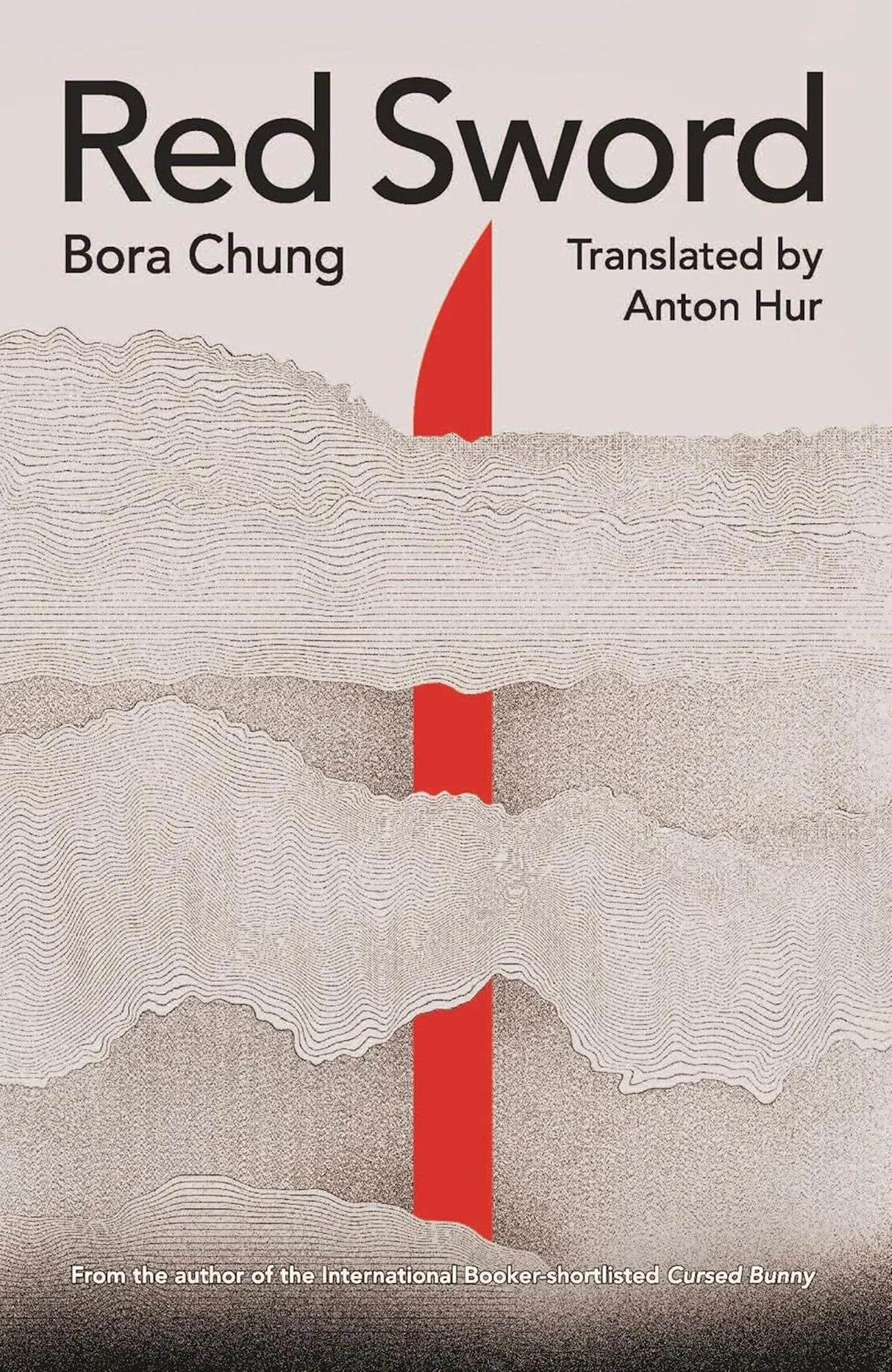
The literary world has recently seen the release of Red Sword, the latest novel by the acclaimed South Korean author Bora Chung. Translated into English by the prolific Anton Hur and published by Pan Macmillan, the work marks a significant departure from conventional narrative structures, opting instead for a stylistic "unreadability" that has sparked intense discussion among critics and scholars alike. Following the international success of her Booker Prize-shortlisted collection Cursed Bunny, Chung’s Red Sword challenges the boundaries of science fiction, historical allegory, and the psychological "uncanny valley."
Main Facts: The Premise and Production of ‘Red Sword’
Red Sword centers on Chrisna, a protagonist who exists simultaneously as a slave and a warrior under the yoke of a colonizing force known as the "Imperials." The narrative follows Chrisna’s forced participation in a nebulous conflict against "white aliens," a monstrous enemy whose motivations and origins remain largely obscured.
The novel is characterized by a "rinse-repeat" structure, involving a cycle of imperial oppression, high-tech combat (juxtaposing traditional swords with futuristic lasers), and a constant state of escape and recapture. A central sci-fi conceit involves the use of clones—beings burdened with "Xeroxed memories" who struggle to navigate a world that treats them as disposable assets.
Key publication details include:
- Author: Bora Chung
- Translator: Anton Hur
- Publisher: Pan Macmillan
- Genre: Speculative Fiction / Sci-Fi / Historical Allegory
- Core Themes: Colonialism, trauma, dehumanization, and the nature of memory.
While the book’s marketing material emphasizes its historical roots, the text itself presents as a minimalist, almost Beckettian exercise in repetitive violence and emotional detachment. This stylistic choice has become the focal point of critical inquiry: is the novel’s flatness a result of narrative failure, or a calculated attempt to mirror the psychological numbness of its characters?
Chronology: Bora Chung’s Rise and the Evolution of the ‘K-Gothic’
To understand the context of Red Sword, one must trace the trajectory of Bora Chung’s career and the broader "Korean Wave" (Hallyu) in literature.

- Early Career and Genre Blending: Bora Chung spent years writing fiction that blended elements of horror, science fiction, and the surreal. Her work often focused on the grotesque and the marginalized, though she remained a niche figure in the international market for much of her early career.
- The ‘Cursed Bunny’ Breakthrough (2022): The English translation of Cursed Bunny by Anton Hur was shortlisted for the International Booker Prize in 2022. This collection introduced global audiences to Chung’s "uncanny valley" of behavior—a world where the line between human and object is perpetually blurred.
- The Translation of ‘Red Sword’ (2024): Following her rise to international prominence, Red Sword was positioned as a major release. It sought to bridge the gap between Chung’s surrealist roots and a more expansive, world-building narrative.
- Current Critical Reception: Upon its release, the novel has met with a complex reception. Unlike the punchy, visceral horror of her short stories, Red Sword offers a long-form experience that many find intentionally monotonous, reflecting a shift in Chung’s artistic objectives toward the representation of systemic trauma.
Supporting Data: Stylistic Analysis and the ‘Uncanny Valley’
The "unreadability" of Red Sword is often cited by reviewers as its most striking feature. This is not necessarily a critique of the prose—which Anton Hur translates with his signature precision—but rather a reflection of the novel’s "monotonous narration."
The Dehumanization of Character
Chung’s characters are frequently described as "paper people." They undergo extreme trauma—severe battle wounds, imprisonment, and sexual encounters—with a lack of emotional depth that borders on the mechanical. For instance, a character wounded from "hip to armpit" simply "gritted his teeth" before proceeding with the plot.
This lack of interiority serves a specific purpose. If the characters are "copies of copies" (clones), their flattened emotions represent the loss of the original human essence. This correlates with the "uncanny valley" theory, typically applied to robotics, which suggests that as objects become more human-like, they eventually reach a point where their "almost-but-not-quite" nature provokes revulsion. Chung applies this to behavior. By stripping her characters of "plot realism" and "emotional warmth," she forces the reader to confront the horror of a life lived as a utility.
Narrative Restraint vs. Genre Tropes
The novel’s combat sequences have been compared to Japanese Isekai (other-world) gamebooks, which often feature repetitive, stylized violence. However, where Isekai seeks to entertain through power fantasies, Chung utilizes "Beckettian restraint." The violence in Red Sword is not spectacular; it is a chore. The use of color-coded labels like "Light Green Skirt" or "Indigo Skirt" for characters further strips them of individuality, reducing them to visual markers in a colonial ledger.
Official Responses and Historical Context
The official blurb for Red Sword notes that the story "draws upon" the history of the Qing Empire forcing Koreans to battle Russia in the 17th century (specifically the Naseon Jeongbeol, or the Northern Expedition).
The Allegorical Gap
Critics have noted a disconnect between this historical marketing and the text’s sci-fi trappings. The historical events involved Korean musketeers being dispatched by the Qing dynasty to help repel Russian expansion along the Amur River. While the allegory of being forced to fight a colonial master’s war is present, Chung abstracts it so thoroughly into a "sword-versus-laser" setting that the specific history becomes a ghost in the machine.

Translator’s Perspective
Anton Hur, who has been instrumental in the global success of Korean literature, has often spoken about the "New Weird" and genre-fluid nature of modern Korean writing. From the perspective of the translation, the "flatness" of the prose is an intentional preservation of Chung’s voice. In previous interviews regarding Chung’s work, Hur has emphasized that her writing often functions as a critique of social structures through the lens of the absurd. The "official response" of the text is one of stoic resistance to the reader’s desire for a traditional hero’s journey.
Implications: The Future of the ‘Difficult’ Novel
The publication and reception of Red Sword carry significant implications for the literary market and the evolution of speculative fiction.
1. The Challenge to ‘K-Content’ Expectations
Global audiences have become accustomed to a specific brand of Korean cultural export: the high-gloss production of K-Pop or the high-stakes tension of Squid Game. Red Sword subverts these expectations by offering a narrative that is intentionally devoid of "dreamy androgynous romances" or "zombie outbreaks." It signals a maturing of the "K-Wave" into more avant-garde and difficult territory, where the goal is not merely entertainment but a profound interrogation of the human condition.
2. The Valorization of Difficulty
By drawing comparisons to James Joyce’s Finnegans Wake or the works of Samuel Beckett, critics are placing Chung in a lineage of authors who use "unreadability" as a tool. The implication is that a book’s value is not found in its ease of consumption, but in its "obduracy." Red Sword suggests that the trauma of colonial history and the existential dread of a cloned existence cannot be captured through a "warm" or "realistic" narrative; they require a style that is as cold and repetitive as the events described.
3. Expanding the Sci-Fi Lexicon
Chung’s work pushes science fiction away from the "hard sci-fi" focus on technology and toward a "sociological sci-fi" that uses futuristic elements to explore ancient traumas. The "white aliens" and "clones" are not just tropes; they are metaphors for the "othering" inherent in imperial projects.
In conclusion, Red Sword is a demanding, often exhausting work that refuses to coddle its audience. While it may prove a "hard read" for those seeking traditional character arcs, its very intractability serves as a powerful monument to the endurance of those caught in the gears of empire. Bora Chung continues to prove that she is not merely a writer of "weird stories," but a clinical architect of the modern soul’s most uncomfortable corners.
