

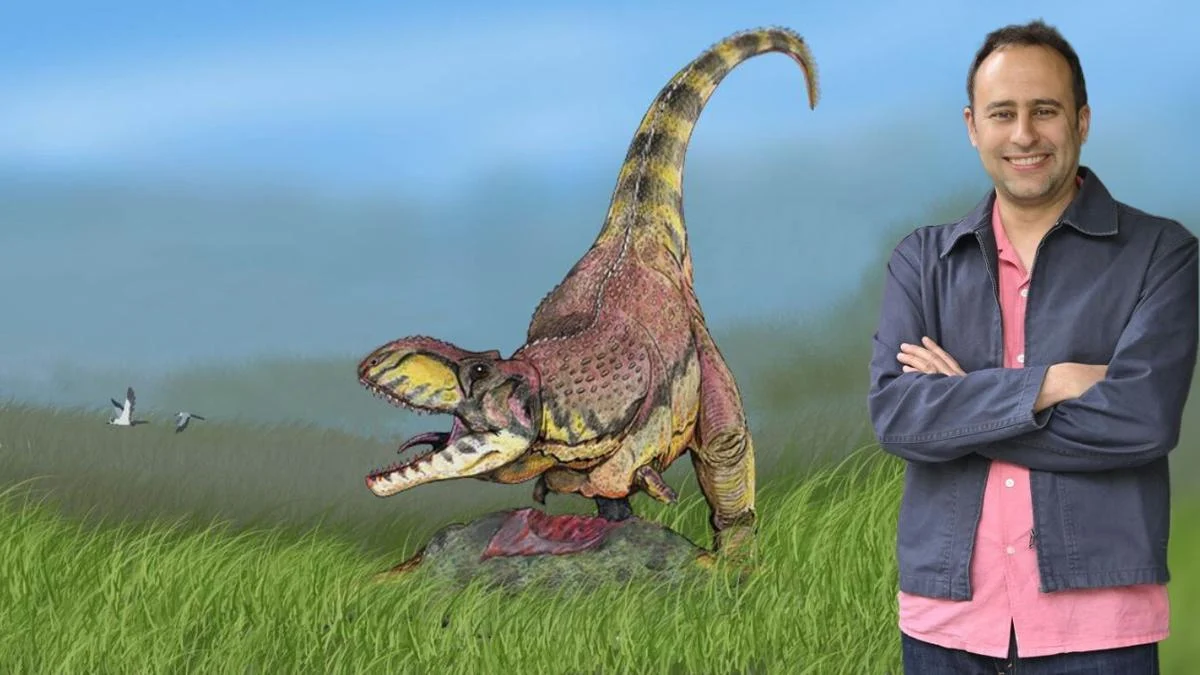
NEW DELHI — In the arid stretches of the Narmada Valley and the sedimentary pockets of Gujarat, a silent history lies buried, waiting for a shovel to strike stone. According to world-renowned palaeontologist Steve Brusatte, India is sitting on a goldmine of prehistoric data that could rewrite the history of the Cretaceous period. Yet, despite possessing "spectacular" fossils, the nation remains a peripheral player in what is being hailed as the global "Golden Age" of dinosaur discovery.
Brusatte, a professor at the University of Edinburgh and a consultant for the Jurassic World franchise, recently visited Delhi to lecture at the Lodha Genius Programme at Ashoka University. His message was clear: while the world is finding a new dinosaur species every week, India—home to the fearsome Rajasaurus narmadensis—is conspicuously under-represented on the global stage.
Main Facts: A Global Boom and an Indian Void
The field of palaeontology is currently experiencing an unprecedented renaissance. For most of the 20th century, dinosaur discovery was a slow, methodical process centered largely in North America and Europe. Today, that has changed.
"Roughly once a week, a creature dead for tens of millions of years is introduced to science for the first time," says Brusatte. This translates to approximately 50 new species named every year—a rate of discovery that exceeds any other period in human history. This "Golden Age" is driven by a shift in geographical focus. The frontiers of the field have moved to the "Global South," with China, Argentina, Brazil, Mongolia, and South Africa leading the charge.
India, however, presents a paradox. Geologically, the Indian subcontinent is one of the most significant landmasses for understanding the late Cretaceous period (145 to 66 million years ago). Because India was an island continent for millions of years after breaking away from Gondwana, its dinosaurs evolved in isolation, leading to unique, "spectacular" species that are found nowhere else on Earth.
The most famous of these is the Rajasaurus, a carnivorous abelisaurid theropod characterized by a distinctive crown-like horn on its skull. Excavated in Gujarat, the Rajasaurus was a top predator of the Narmada River valley, yet it remains one of only a handful of Indian dinosaurs known to the general public.
Chronology: From Colonial Curiosity to Modern Stagnation
The history of Indian palaeontology began with promise but has struggled with consistency and institutional support.
- 1828: Captain William Sleeman of the British East Indian Army discovered the first dinosaur bones in India (and some of the first in Asia) in the Jabalpur cantonment. These were later identified as Titanosaurus.
- 1982-1984: A breakthrough occurred when Suresh Srivastava of the Geological Survey of India (GSI) discovered the remains of Rajasaurus narmadensis in the Lameta Formation of Gujarat. The fossils were later studied in collaboration with American scientists in the early 2000s.
- 2003: The Rajasaurus was officially named and described, sparking a brief surge of interest in Indian "terrible lizards."
- 2018: Steve Brusatte published his global bestseller, The Rise and Fall of the Dinosaurs, highlighting the importance of Gondwanan fossils but noting the lack of intensive local excavation in many regions.
- 2024-2026: Brusatte’s visits to India highlight a growing concern. While he finds the younger generation of Indian students "incredibly bright," he observes a systemic lack of infrastructure and funding to move these students from the classroom to the dig site.
Supporting Data: The Geological Significance of India
The reason palaeontologists like Brusatte are so focused on India lies in its tectonic history. During the Mesozoic Era, India was part of the supercontinent Gondwana. Around 100 million years ago, it broke away and began a long, lonely journey across the Tethys Ocean toward Asia.
This "island phase" created a laboratory for evolution. Data suggests that Indian dinosaurs were distinct from their cousins in North America.
- The Lameta Formation: This sedimentary rock layer, found in Madhya Pradesh, Gujarat, and Maharashtra, is world-class. It has yielded not only bones but also dinosaur eggs and nesting sites, providing rare data on dinosaur reproductive behavior.
- The Deccan Traps: India’s massive volcanic province provides a unique window into the extinction of the dinosaurs. The interaction between the Chicxulub asteroid impact and the massive volcanic eruptions in India is a central debate in modern science.
- Global Comparison: While China names dozens of species annually due to massive state investment and a network of provincial museums, India’s count remains in the low dozens for the entire history of the field.
Official Responses: The Institutional Hurdle
During his time at Ashoka University, Brusatte engaged with both students and educators, identifying a "wrinkled optimism." The talent exists, but the pipeline does not.

Academic experts point to several "missing links" in the Indian scientific ecosystem:
- Legislative Gaps: Unlike the United States or China, India lacks robust "Geo-heritage" laws that protect fossil sites from mining, urban development, and illegal smuggling. Many potential sites in the Narmada Valley are currently threatened by industrial projects.
- Funding Disparity: Palaeontology is often viewed as a "luxury science" compared to space exploration or biotechnology. Consequently, the GSI and university geology departments often lack the specialized funding required for multi-year excavation projects.
- Public Awareness: While every Indian child knows the Tyrannosaurus Rex, few are taught about the Indosuchus or the Isisaurus. This lack of cultural "brand recognition" for local dinosaurs results in less public pressure for conservation and research.
Brusatte notes that the countries currently dominating the field—Argentina and Brazil—did not always have massive budgets. Instead, they built a culture of "young people hitting the rocks," encouraging students to view the earth as a library of history rather than just a source of minerals.
Implications: Why This Matters for India’s Future
The "Golden Age" of dinosaurs is about more than just old bones; it has profound implications for India’s scientific and economic standing.
1. Scientific Sovereignty:
When Indian fossils are excavated and then sent abroad for study due to a lack of local expertise or facilities, it constitutes a form of "scientific colonialism." By building local capacity, India can lead the research on its own heritage, ensuring that the primary data and the prestige of discovery remain within the country.
2. Climate Change Insights:
Dinosaurs lived through periods of extreme global warming and massive volcanic activity. Understanding how Indian ecosystems responded to the Deccan Trap eruptions can provide vital data for modern climate modeling. The fossils in the Narmada Valley are not just relics; they are data points on how life survives—or fails to survive—catastrophic environmental shifts.
3. The Economic Potential of Geo-Tourism:
In the United States and China, dinosaur "trail" tourism is a multi-million dollar industry. India’s Narmada Valley and the fossil parks of Gujarat have the potential to become global tourist destinations. "You have the spectacular fossils," Brusatte emphasizes. "What you need is the infrastructure to showcase them."
4. Educational Inspiration:
Palaeontology is often called a "gateway science." It is the first subject that sparks a child’s interest in biology, geology, and physics. By failing to promote its own dinosaur history, India misses an opportunity to draw thousands of students into the STEM (Science, Technology, Engineering, and Mathematics) fields.
Conclusion: A Call to Action
As Steve Brusatte concludes his lecture series in Delhi, the sentiment is one of urgency. The "Golden Age" will not last forever; the pace of development in India means that many fossil-rich sites are being paved over before they can be surveyed.
India stands at a crossroads. It can continue to be a spectator in the global race to uncover the history of life on Earth, or it can empower its "incredibly bright" youth to pick up the mantle. The Rajasaurus once ruled the Narmada Valley with a literal crown; it is perhaps time for India to reclaim that crown in the world of modern science.
The fossils are there. The talent is there. All that remains is for the nation to start digging.
