

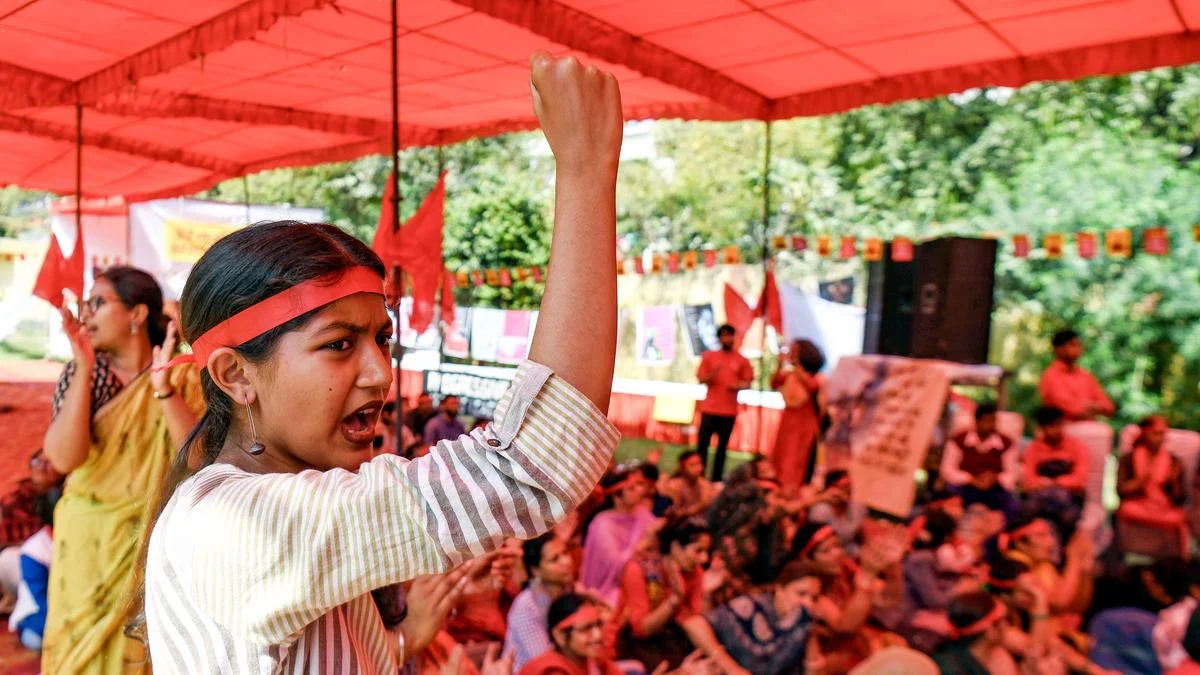
Poetry has long served as the rhythmic pulse of revolution. Across the centuries, from the protest songs of the American Civil Rights Movement to the defiant verses of the Palestinian Intifada, the written word has functioned as both a sanctuary for the weary and a bayonet for the oppressed. In the Indian context, few literary traditions carry as much weight, pain, and transformative power as Dalit literature.
The recently released anthology, Leaping Towards the Deep Blue Sky: The Poetry of Ambedkarite Women, edited and illustrated by Shrujana N. Shridhar and published by Maveli Publications, stands as a monumental addition to this lineage. By gathering the voices of Dalit women who have navigated the intersections of caste and gender, the volume offers a raw, unfiltered look at a sociopolitical movement that refuses to be silenced. This is not merely a collection of rhymes; it is a cartography of struggle, mapping the journey from the depths of structural violence to the "deep blue sky" of Ambedkarite liberation.
Main Facts: A New Milestone in Anti-Caste Literature
Leaping Towards the Deep Blue Sky is an anthology that brings together the works of several generations of Marathi Dalit women poets, translated into English to reach a global audience. The volume is edited and illustrated by Shrujana N. Shridhar, an artist and researcher whose work has consistently focused on the intersection of caste and gender. Shridhar also co-translated the poems alongside Shreeja Rao.
The book is published by Maveli Publications, an independent, anti-caste publishing platform that has carved out a niche by prioritizing voices that are often marginalized in the mainstream Indian publishing industry. The anthology features a diverse array of contributors, including pioneers like Hira Bansode and Urmila Pawar, as well as contemporary voices like Shital Sathe and Disha Pinki Shaikh.
The central thesis of the volume, as articulated by Shridhar, is the "embodied experience of Dalit womanhood." It explores five key pillars:
- Resistance against Brahmanical patriarchy.
- Community Building through resilient social structures.
- Conviction in the anti-caste philosophy of B.R. Ambedkar.
- Autonomy in both personal and political spheres.
- Freedom as an ongoing process of creative and social expression.
Chronology: The Evolution of Dalit Feminist Articulation
To understand the significance of this anthology, one must trace the historical trajectory of the Ambedkarite movement and its literary manifestations. The poems in this collection do not exist in a vacuum; they are the fruit of a century of agitation.

1927: The Mahad Satyagraha
The historical anchor for much of this poetry is the Mahad Satyagraha of 1927. Led by Dr. B.R. Ambedkar, this movement was a pivotal moment in Indian history where Dalits asserted their right to use water from a public tank. This event is directly referenced in Hira Bansode’s poem "Bhima’s Pen," where she invokes the "blazing waters of Mahad." This era established the "Educate, Agitate, Organise" mantra that serves as the "beating heart" of the current volume.
The 1960s and 70s: The Rise of Dalit Panthers
While Dalit literature began to take a formal shape in the 1960s, Urmila Pawar notes in her foreword that a "distinct shift" occurred with the establishment of the Dalit Panther movement in 1972. Influenced by the Black Panther Party in the United States, this movement brought a militant, assertive tone to Marathi literature. However, as the anthology highlights, this era was also a period of internal realization for Dalit women. They began to recognize that while they shared the struggle against caste with Dalit men, they also faced a secondary layer of oppression: patriarchy within their own communities.
The 1990s: The Emergence of Dalit Feminism
By the 1990s, a distinct articulation of Dalit feminism began to emerge. This was a response to two fronts of exclusion: "upper-caste" feminist movements that often ignored the specificities of caste, and the male-dominated Ambedkarite movement that often sidelined women’s issues. It was during this decade that Dalit women felt compelled to carve out their own creative and political spaces, a legacy that Leaping Towards the Deep Blue Sky continues to uphold.
Supporting Data: Thematic Analysis of the Verse
The anthology is structured to reflect the multifaceted nature of Dalit womanhood. Through the translations of Shridhar and Rao, the English reader is introduced to imagery that is as visceral as it is intellectual.
The Critique of "Sanatan" and the Reclamation of Knowledge
In Sharda Navale’s "Warrior Woman," the poet pays homage to Savitribai Phule, the 19th-century social reformer who started the first school for girls in India. Navale describes Phule as the one who "unlocked the treasure trove of knowledge" and "shattered the impregnable bastions of sanatan" (orthodox tradition). This poem underscores the importance of education as a tool for liberation, a theme central to the Ambedkarite identity.
Faith, Agency, and the Conversion to Buddhism
A significant portion of the anthology deals with the spiritual transition of the Dalit community. In "What Was Our Crime…?", Varsha Bhise writes:

“Their god felt desecrated / when we entered the temple / So we embraced Buddha.”
This highlights that the conversion to Buddhism (Dhamma) was not merely a change of faith but a radical act of agency—a rejection of a "religion of torment" in favor of a philosophy of dignity. However, the anthology does not treat faith as beyond critique. Chhaya Koregaonkar, in "It’s Not Easy," pointedly asks why Yashodhara (the Buddha’s wife) has "no place in any Buddha Vihara," demonstrating that Dalit feminist poetry is willing to question even the institutions that offer them solace.
The Poetry of the Body and the Domestic Sphere
The poems also delve into the domestic realities of Dalit women. Koregaonkar’s "Women" speaks of those who "soothe bruises on their backs left by in-laws with turmeric paste." Here, the poetry acts as a witness to the "embodied experience" mentioned in the introduction—the physical toll of existing at the intersection of caste-based poverty and patriarchal violence.
Official Responses and Critical Perspectives
The release of Leaping Towards the Deep Blue Sky has been met with acclaim from literary critics and social activists alike, who view it as a necessary intervention in the Indian literary canon.
The Foreword by Urmila Pawar
Writer and activist Urmila Pawar’s foreword is considered a critical document in its own right. She situates the collection within the broader history of the Ambedkarite movement, providing the necessary academic scaffolding for the emotional weight of the poems. Pawar emphasizes that these poems are a "roar," not a "plea," shifting the narrative from Dalit women as victims to Dalit women as protagonists of their own history.
The Role of Maveli Publications
Publishing industry analysts have noted the importance of Maveli Publications in this ecosystem. By focusing on "anti-caste publishing," the platform bypasses the traditional gatekeepers of Indian literature. This ensures that the nuances of the original Marathi—often lost in mainstream translations that seek to "sanitize" the language—are preserved in their most potent form.

The Visual Narrative
Reviewers have also highlighted Shrujana N. Shridhar’s illustrations. In a movement where visual symbols (the blue flag, the portrait of Ambedkar, the Ashoka Chakra) are vital, Shridhar’s art provides a visual language that complements the textual anger and hope. The illustrations serve to anchor the poems in a contemporary aesthetic, making the "deep blue sky" feel both like a dream and a tangible goal.
Implications: Academic and Sociopolitical Impact
The publication of this anthology carries significant implications for various fields of study and for the broader social fabric of India.
Educational Integration
The anthology is poised to become a staple in higher education. As the original text suggests, it would make a "valuable addition to courses in literature, gender studies, translation, and postcolonial writing." For universities in India and abroad, this volume provides a primary source for understanding Intersectional Feminism—a term often used in Western academia but rarely applied with such grounded, historical specificity to the Indian caste context.
The Politics of Translation
By translating these works into English, Shridhar and Rao have facilitated a "South-South" and "Global North-South" dialogue. The struggles of Dalit women in Maharashtra are now accessible to Black feminists in the US, indigenous activists in South America, and human rights advocates in Europe. This globalizes the anti-caste struggle, moving it from a "local Indian issue" to a universal human rights discourse.
A Challenge to the Status Quo
Perhaps the most potent implication is the critique of the state and the "establishment" artist. Shital Sathe’s scathing critique of artists who "sing praises of the master to be decorated by the hands of the President" serves as a reminder of the artist’s duty. In a political climate where dissent is often suppressed, these poems reaffirm that the true purpose of art is "emancipation, not adornment."
Conclusion
Leaping Towards the Deep Blue Sky is more than a book; it is a manifestation of the "blazing waters" of resistance. It captures a moment where Dalit women are no longer just the subjects of sociological study but are the authors of their own destiny. By documenting the rage, the bruises, the prayers, and the dreams of Ambedkarite women, the anthology ensures that their contribution to the fight for a "brave new world" is etched permanently into the annals of history. As the movement continues to evolve, these poems will undoubtedly serve as both the "balm" for the weary and the "weapon" for the brave.
