

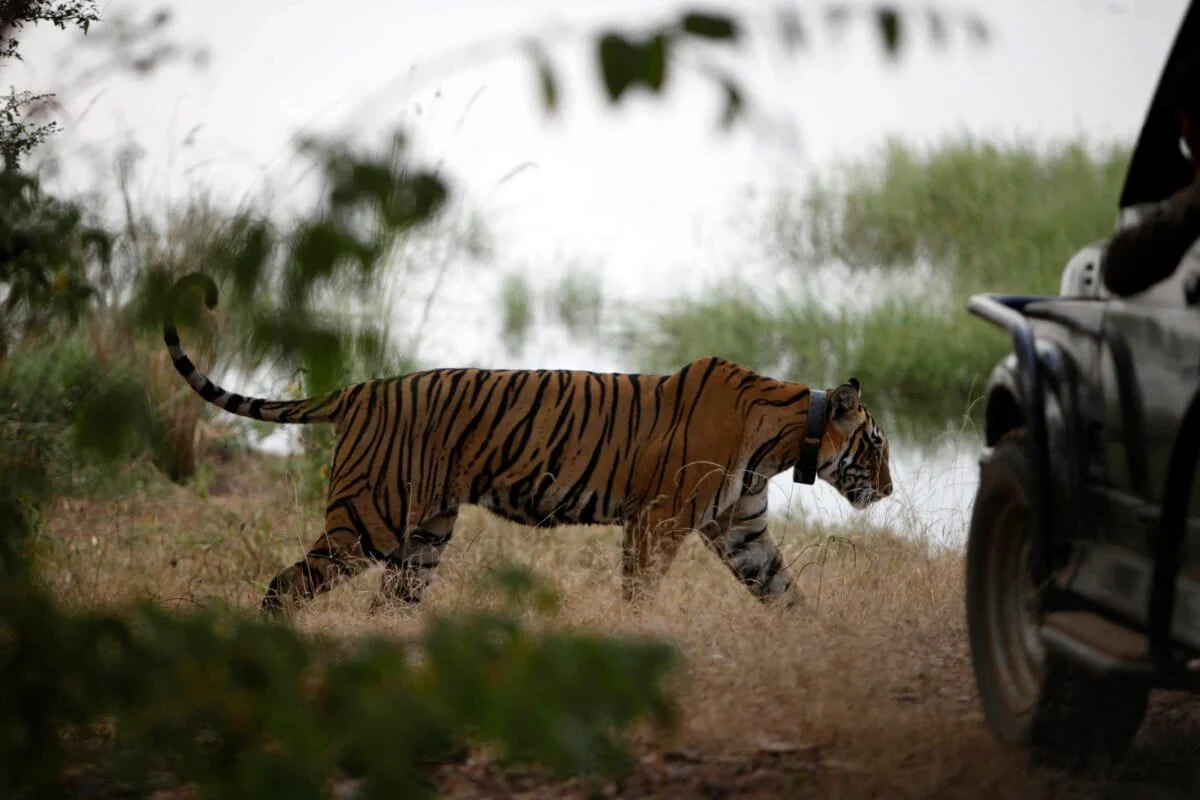
NEW DELHI – India’s tiger reserves are globally celebrated as the gold standard for wildlife recovery. Decades of stringent protection and the success of "Project Tiger" have seen populations rebound, turning protected forests into massive revenue generators through wildlife tourism. However, a comprehensive new study suggests that this success comes with a hidden physiological cost.
According to research conducted across five major reserves, the growing human footprint—specifically the influx of safari vehicles and anthropogenic disturbances—is significantly elevating stress hormone levels in tigers. More critically, the study indicates that these stress levels may be dictating where female tigers choose to establish their breeding territories, potentially pushing them out of optimal habitats into increasingly fragmented "calm pockets."
Main Facts: The Hidden Hormonal Shift
The study, led by Govindhaswamy Umapathy, chief scientist at the Laboratory for the Conservation of Endangered Species (LaCONES) under the CSIR-Centre for Cellular and Molecular Biology (CCMB), represents one of the most extensive physiological assessments of India’s national animal to date.
The core findings reveal a direct correlation between human activity and elevated levels of faecal glucocorticoid metabolites (fGCM)—a widely recognized biological marker for stress. While wildlife tourism provides the financial lifeblood for conservation efforts and local livelihoods, the researchers found that:
- Seasonal Spikes: Stress levels in tigers were markedly higher during the tourism season compared to periods when reserves were closed to the public.
- Vehicle Density: The number of tourist vehicles and their proximity to the animals were primary drivers of physiological distress.
- Core vs. Buffer Sensitivity: While tigers in buffer zones (areas where humans and wildlife coexist year-round) showed high baseline stress, tigers in "core" zones experienced sharper, more acute hormonal spikes when tourism activity commenced, suggesting a lack of habituation.
- Breeding Displacement: Spatial mapping showed that potential breeding hotspots for tigresses rarely overlapped with high-stress areas. Females appear to be seeking out the quietest remaining refuges to raise their young, areas that are increasingly under threat from expanding tourism routes.
“Wildlife tourism is growing rapidly around our protected areas. It funds conservation, but more people also means more stress for the animals,” Umapathy noted. “We wanted the full picture across the country—not only where tigers are stressed, but where tigresses choose to breed.”

Chronology: A Multi-Year Physiological Audit
The research was not a snapshot but a longitudinal study conducted between November 2020 and February 2023. The timeline reflects a period of fluctuating human activity, including the tail end of pandemic-related restrictions and the subsequent boom in domestic travel.
- November 2020 – Early 2021: Researchers selected five tiger reserves that represented a diverse cross-section of Indian geography, tiger density, and tourism styles:
- Corbett Tiger Reserve (Uttarakhand): High density, mountainous terrain.
- Tadoba-Andhari Tiger Reserve (Maharashtra): High visibility, dry deciduous forest.
- Kanha & Bandhavgarh Tiger Reserves (Madhya Pradesh): Traditional strongholds with high vehicle throughput.
- Periyar Tiger Reserve (Kerala): Unique for its year-round boat-based tourism.
- 2021 – 2022: Field teams conducted extensive "non-invasive" sampling. Over 700 scat samples were collected across different seasons (monsoon closures vs. peak tourism) and different zones (core vs. buffer).
- Late 2022 – Early 2023: Laboratory analysis at CCMB focused on genetic sexing and the measurement of glucocorticoid (stress) and progesterone (reproductive) metabolites.
- August 2024: The final findings were published in the journal Animal Conservation, providing a data-driven framework for future reserve management.
Supporting Data: Mapping the "Tourism Signal"
The study’s strength lies in its non-invasive methodology. By analyzing 610 genetically confirmed tiger scat samples (185 from males and 291 from females), the team could monitor the animals’ health without the stress of capture or collaring.
The Impact of Infrastructure and Traffic
The researchers utilized statistical models to isolate "tourism signals" from other anthropogenic pressures like cattle grazing or wood collection. The data showed that for every increase in the number of vehicles permitted into a zone, there was a measurable rise in fGCM levels. Proximity to tourism roads was a greater predictor of stress than proximity to natural water bodies, suggesting that the presence of the road itself—and the traffic it carries—is a persistent disturbance.
The "Core Zone" Paradox
One of the most striking pieces of data concerned the core areas of the reserves. Generally, core zones are meant to be sacrosanct. The study found that tigers in these areas were "hit hard" by the sudden burst of tourism after the monsoon season.
“Animals in the buffer live with people all year, so they’ve grown used to it,” Umapathy explained. “But a tiger in the core is sensitive. When the gates open and the vehicles pour in, their systems react sharply to the intrusion.”

The Corbett Exception
The study noted that Corbett Tiger Reserve presented a unique data set. Unlike other reserves where tourism was the primary stressor, Corbett’s core-zone tigers showed high stress even in areas of lower tourism. The researchers attributed this to "unusually high tiger density." In Corbett, the biological stress of competing with other tigers for territory and prey appears to rival the stress induced by human presence.
Reproductive Mapping
By analyzing faecal progesterone metabolites, the team mapped "reproductive hotspots." When overlaid with stress maps, the results were clear: tigresses were found to have the highest reproductive hormone levels in areas where their stress levels were at their lowest. The maps showed a distinct spatial separation between disturbed tourism zones and potential breeding areas.
Official Responses: A Nuanced Conservation Debate
The study has sparked a vital conversation within India’s conservation community. While the data highlights the risks of tourism, officials and experts are quick to point out that tourism is not the "villain" of the story, but rather a tool that requires better calibration.
Anish Andheria, President and CEO of the Wildlife Conservation Trust, provided a broader perspective on the findings. While acknowledging the physiological impact, he cautioned against viewing tourism as the primary threat to the species.
“Wildlife tourism, despite its drawbacks, is one of the most sustainable industries that can coexist with nature,” Andheria stated. “Mining, highway expansion, and large-scale infrastructure development have a far greater, more permanent impact on tiger habitats. Tourism generates the revenue and the public ‘eyes on the ground’ that support forest protection.”

He emphasized that the goal should not be the abolition of tourism, but the evolution of its management. "Tourism should continue to evolve to minimize disturbance while ensuring that local communities remain among its primary beneficiaries," he added.
Govindhaswamy Umapathy echoed this sentiment, suggesting that the study provides a roadmap for "ethical tourism" rather than a call for closures. He noted that the survival of the species depends on maintaining the integrity of the quiet "refuges" identified in the study.
Implications for the Future of Tiger Management
The findings of the CSIR-CCMB study suggest that India’s National Tiger Conservation Authority (NTCA) may need to revisit the guidelines governing how tourists interact with the wild. The researchers and industry experts have proposed several actionable shifts:
1. Re-evaluating Safari Logistics
The study suggests that shortening the duration of morning and evening safaris by just one hour could provide tigers with vital "quiet windows" during their most active periods. Furthermore, the researchers recommend strict caps on vehicle numbers, particularly in core zones that serve as reproductive refuges.
2. Ending the "Guaranteed Sighting" Culture
One of the primary causes of acute stress identified was "vehicle crowding"—multiple jeeps surrounding a single tiger. Umapathy recommends training safari drivers and guides to follow stricter ethical rules and, crucially, ending the practice where tourists pay premiums for "guaranteed sightings." This practice often leads to drivers speeding or maneuvering aggressively to find a cat, further distressing the animal.

3. Strengthening Buffer Zone Management
Since buffer-zone tigers are under constant pressure from both tourism and local anthropogenic activities (grazing, farming), the study calls for enhanced patrolling and the creation of "no-go" corridors within buffers to allow tigers to move between core areas without constant human interaction.
4. Biological Monitoring as a Management Tool
The researchers argue that monitoring stress and breeding hormones should become a standard part of reserve management. By identifying where tigresses are breeding through non-invasive scat analysis, forest departments can "quietly keep tourists out of those areas at the right time."
Conclusion: A Path toward Coexistence
The study serves as a reminder that conservation success is not merely measured by the number of heads counted in a census, but by the physiological health and reproductive freedom of the animals. As India continues to lead the world in tiger conservation, the challenge of the next decade will be balancing the economic necessity of wildlife tourism with the biological needs of the "Great Cat."
As Umapathy concluded, "Done well, tourism and tiger reproduction can coexist. We just need to listen to what the animals’ biology is telling us."
