

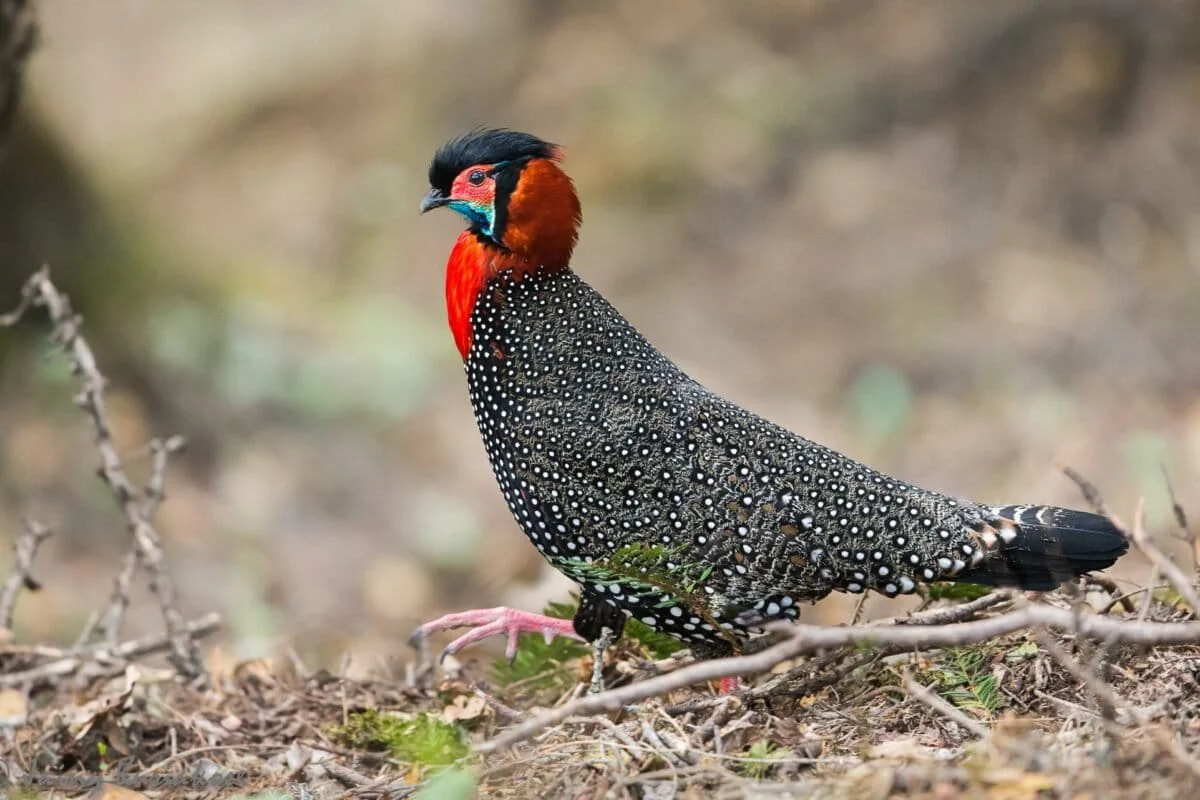
In the mist-shrouded forests of the northwestern Himalayas, the vibrant plumage of the white-crested kalij pheasant and the elusive western tragopan serve as more than just aesthetic wonders; they are vital barometers of an ecosystem under siege. While some species remain common for now, a growing body of research suggests that the "jewels of the forest" are facing an unprecedented convergence of anthropogenic pressures. From habitat fragmentation and overgrazing to the subtle but devastating impact of seasonal mushroom collection, the survival of these ground-dwelling birds is increasingly precarious.
The recent findings, highlighted by researchers from the University of Kashmir and international biodiversity institutes, suggest that even species currently listed as "Least Concern" are providing an early warning. If the relatively adaptable kalij pheasant is struggling with habitat degradation, the fate of rarer, more specialized species like the western tragopan may be even more dire.
Main Facts: The Ecological Sentinels of the Western Himalayas
Pheasants belong to the family Phasianidae, a group of ground-dwelling birds known for their spectacular colors and complex social behaviors. The Indian subcontinent is a global hotspot for these birds, hosting 51 species, 20 of which are endemic to the Himalayan range. These birds occupy diverse ecological niches, ranging from the humid tropical foothills to the frigid alpine meadows.
The Adaptable Kalij Pheasant
The white-crested kalij pheasant (Lophura leucomelanos hamiltoni) is perhaps the most recognizable of these species in the western Himalayas, including the regions of Jammu and Kashmir. Unlike its cousins that prefer high-altitude isolation, the kalij is found at lower elevations—typically between 1,300 and 2,500 meters above sea level. It is a generalist, inhabiting mixed forests, coniferous stands, and scrublands, often near human settlements.

Despite its current status as "Least Concern" on the IUCN Red List, the kalij is essential to the forest’s lifecycle. It acts as a primary seed disperser and soil aerator. Locally known in Kashmir as "wan-kokur" (wild cock), it serves as a critical prey base for the region’s apex predators, including leopards and various raptors.
The Elusive Western Tragopan
In contrast, the western tragopan (Tragopan melanocephalus) represents the "vulnerable" side of the spectrum. Endemic to the region and listed under Schedule I of India’s Wildlife (Protection) Act, it is one of the world’s rarest pheasants. Known as "danne geer" in Kashmiri, this bird is a specialist that requires undisturbed, primary oak and conifer forests with dense undergrowth. Its population in Jammu and Kashmir is estimated to be as low as 200 to 300 individuals, making every surviving bird a critical component of the species’ genetic future.
Chronology: From Baseline Surveys to Modern Warnings
The history of pheasant conservation in the Himalayas has transitioned from basic distribution mapping to sophisticated threat analysis.
In the early 2000s, organizations like the Wildlife Trust of India (WTI) and the Department of Wildlife Protection began systematic surveys to identify the range of the western tragopan. These efforts established its presence in key areas like the Kazinag range, the Shamshabari mountains, and the Pir Panjal range. These surveys relied heavily on "call counts"—auditory monitoring during the breeding season when males are most vocal.

By the mid-2010s, researchers began to notice a shift in the landscape. While the birds were still present, the quality of their habitat was rapidly declining due to developmental pressures and increased human-wildlife overlap.
The most recent phase of research, culminating in a 2025 study focused on the Limber and Lachipora wildlife sanctuaries, has shifted the focus toward community perceptions and anthropogenic threats. Scientists are now moving beyond just "counting birds" to understanding how human behavior—specifically resource extraction—is disrupting the birds’ life cycles. This modern chronology shows a clear trend: as human activity pushes deeper into the forest, even the most adaptable species are beginning to show signs of stress.
Supporting Data: A Multi-Pronged Threat Landscape
The decline of Himalayan pheasants is not the result of a single factor but a "death by a thousand cuts" scenario involving habitat loss, hunting, and climate-driven shifts.
Habitat Degradation and Human Disturbance
Research led by Arif Nabi Lone of the University of Kashmir identifies habitat degradation and hunting as the most severe threats. Because the kalij pheasant lives in proximity to humans, it is disproportionately affected by:

- Timber and Firewood Collection: Thinning of the forest canopy and removal of the understorey deprives birds of nesting sites and protection from predators.
- Overgrazing: Livestock grazing not only degrades the vegetation but can lead to the accidental trampling of nests.
- Mushroom Collection: This is a particularly insidious threat. The collection of wild mushrooms often coincides with the pheasants’ peak breeding season. As villagers scour the forest floor for mushrooms, they inadvertently flush nesting females, leading to abandoned eggs or increased predation of the exposed nests.
The Climate Squeeze
Supporting data from the Forest Research Institute in Dehradun suggests that climate change is fundamentally altering the birds’ range. Modeling studies indicate that suitable habitats for the western tragopan are shifting toward higher elevations. However, as the birds move up, they may find less suitable forest cover or encounter "mountain-top extinction" where there is no more room to climb.
Population Gaps
Ecologists like Ankita Sinha note that while traditional call counts provided a baseline, they are insufficient for long-term conservation. There is a significant lack of long-term tracking data. Without knowing the exact movement patterns and survival rates of chicks, conservationists are working with incomplete maps. Currently, the use of camera traps and social surveys is being scaled up to fill these knowledge gaps.
Official Responses: Balancing Stability and Vigilance
The Department of Wildlife Protection in Jammu and Kashmir maintains a cautiously optimistic but vigilant stance. Intesar Suhail, the Wildlife Warden for North Kashmir, notes that while the kalij remains common, the department does not take its "Least Concern" status for granted.
"Pheasant populations in Kashmir are generally well-protected and doing well," Suhail stated. He pointed to encouraging recent sightings of the western tragopan in Kazinag National Park as evidence that protected areas are functioning as intended.

To combat the threats, the department has implemented several measures:
- Anti-Poaching Squads: Specialized units are deployed during the winter months. Heavy snowfall often drives pheasants to lower elevations near roads and villages, making them easy targets for hunters.
- Habitat Management: Efforts in protected areas are focused on "holistic" improvement, ensuring that the dense understorey required by pheasants is preserved.
- Surveillance: Increased patrolling during the breeding season to minimize disturbance from mushroom and medicinal plant collectors.
However, independent researchers argue that while these measures are helpful, they often lack the "landscape-level" approach needed to protect species that move across administrative boundaries.
Implications: The Indicator Species Argument
The survival of the kalij pheasant and the western tragopan has implications that extend far beyond the avian world. Pheasants are considered "indicator species." Their presence signifies a healthy, complex forest structure with a robust food web. If these birds decline, it serves as a warning that the entire Himalayan ecosystem—including the water sources and soil stability that millions of humans rely on—is degrading.
Flagship for Conservation
Rahul Kaul, a specialist with the IUCN Galliformes Specialist Group, argues that India holds nearly one-third of the world’s pheasant species. This gives the nation a global responsibility. He suggests that a centrally launched "Project Pheasant," similar to Project Tiger, could provide the necessary funding and focus to protect the entire Himalayan biodiversity corridor.

Community-Led Protection
The future of these birds likely rests in the hands of the local communities. Since many of the threats—such as grazing and mushroom collection—are tied to local livelihoods, conservation cannot succeed through enforcement alone. Experts suggest that "participatory conservation action plans" are the only way forward. By involving locals in the monitoring of birds and providing alternative livelihood options that do not disturb the breeding season, the pressure on the forests can be reduced.
The Road Ahead
The white-crested kalij pheasant may still be common today, but its struggle is a harbinger of things to come. As climate change pushes species higher and human activity fragments what remains of the lower forests, the western Himalayas are at a crossroads. Protecting these birds is not merely an act of preserving "pretty" wildlife; it is an essential investment in the ecological integrity of one of the world’s most fragile and vital mountain ranges.
Without a concerted effort to bridge scientific research, official policy, and community involvement, the vibrant "wild cocks" of Kashmir may one day become nothing more than a memory in the folklore of the mountains.
