

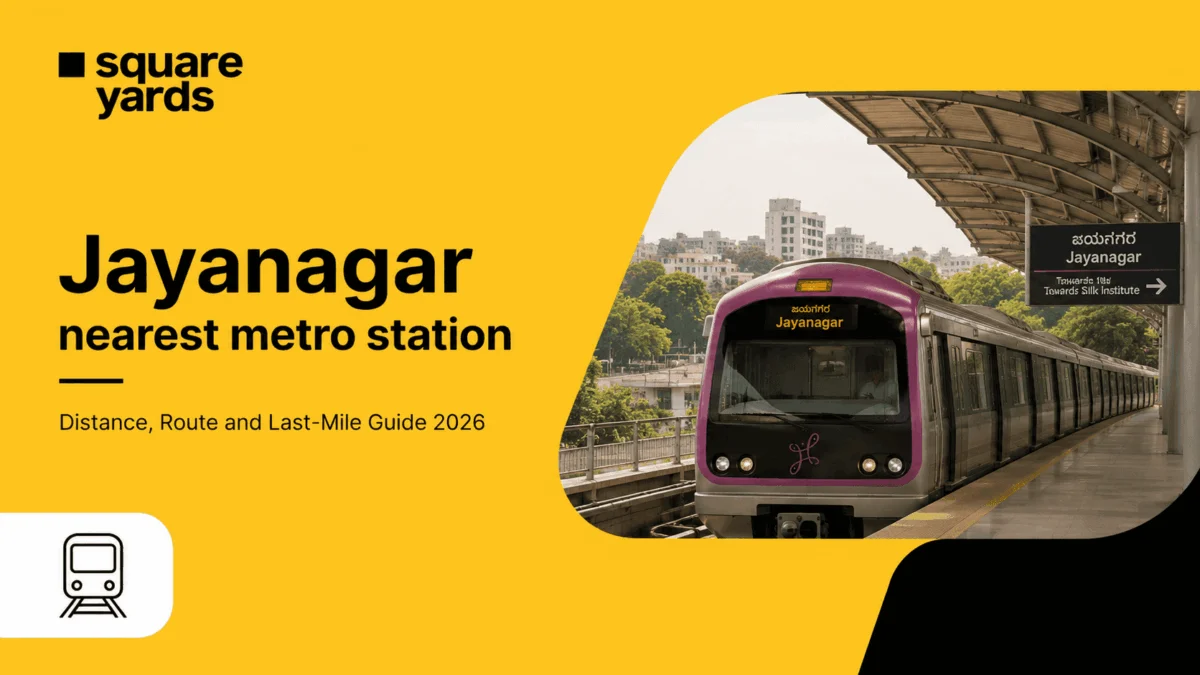
BENGALURU – For decades, Jayanagar was whispered about in Bengaluru’s social circles as the "pensioner’s paradise"—a meticulously planned residential layout characterized by wide, tree-lined avenues, quiet boulevards, and a distinct "Old Bangalore" charm. However, since the hum of the first Green Line train vibrated through the air in mid-2017, the neighborhood has undergone a profound structural shift. Today, the Jayanagar Metro Station is no longer a novelty; it is the beating heart of a transit-oriented ecosystem that has redefined property values, commercial viability, and the very lifestyle of South Bengaluru.
As the city continues to grapple with surface-level congestion, the strategic importance of Jayanagar’s connectivity—now bolstered by the recent expansion of the Yellow Line—has positioned the locality as a premier case study in successful urban integration.
I. Main Facts: The Infrastructure Backbone of South Bengaluru
At the center of this transformation is the Jayanagar Metro Station, an elevated facility situated on Rashtreeya Vidyalaya (RV) Road in the 4th Block. Serving as a primary artery on the Namma Metro Green Line, the station facilitates a seamless north-south corridor, connecting the northern industrial hubs like Nagasandra and Madavara to the southern residential extensions of Silk Institute.
The significance of Jayanagar’s metro connectivity is not limited to a single station. The neighborhood is uniquely serviced by a "metro cluster" that includes:
- Jayanagar Station (Green Line): The primary hub for 4th and 7th Block residents.
- Rashtreeya Vidyalaya Road (Interchange): A critical junction where the Green Line meets the newly operational Yellow Line, linking Jayanagar directly to the IT corridors of Electronic City and Bommasandra.
- South End Circle: Providing access to the heritage-rich areas of Basavanagudi and Gandhi Bazaar.
- Ragigudda (Yellow Line): A recent addition serving the 9th Block and the Marenahalli-JP Nagar border.
This density of transit points ensures that nearly every corner of Jayanagar is within a 1.5-kilometer radius of a high-speed rail link—a rarity in a city where "last-mile connectivity" is often the greatest hurdle for commuters.
II. Chronology: From Planned Suburb to Transit Hub
The evolution of Jayanagar’s transport landscape has been a multi-phase journey that mirrors the broader expansion of the Bangalore Metro Rail Corporation Limited (BMRCL) network.
- June 18, 2017: The Jayanagar Metro Station officially opened its doors as part of the Green Line’s Phase 1 extension. This was a watershed moment for South Bengaluru, providing the first direct, air-conditioned link to Majestic (KSR Bengaluru Station), the city’s central transit node.
- 2018–2022: The "Metro Effect" began to manifest in local real estate. Older independent bungalows started making way for boutique apartment complexes and commercial "builder floors," as developers banked on the proximity to the station.
- August 2025: The inauguration of the Yellow Line marked the second major shift. By making RV Road an interchange station and opening the Ragigudda station near the 9th Block, the BMRCL effectively brought the "Silicon Valley" of Electronic City within a 25-minute commute of Jayanagar.
- Present Day: Jayanagar has transitioned from being a destination for retirees to a high-demand hub for young professionals and families who prioritize time-efficiency over the sprawling suburban experience of the city’s periphery.
III. Supporting Data: The Economics of Connectivity
The impact of the metro is most visible when examining the hard data surrounding property appreciation, ridership, and operational efficiency.
1. Real Estate Appreciation
According to recent market analytics, Jayanagar has defied the stagnation often seen in "saturated" localities. While newer areas like Sarjapur or Varthur see growth driven by new construction, Jayanagar’s growth is driven by scarcity and accessibility.
| Metric | Jayanagar (Current) | 5-Year Growth Trend |
|---|---|---|
| Avg. Price per Sq. Ft. | ₹15,000 – ₹25,000 | ~42% Increase |
| Year-on-Year Growth | 14% (2023-2024) | Outpacing city avg (9%) |
| Rental Yield | 3.5% – 4.2% | High demand for "Walk-to-Metro" |
2. Operational Efficiency and Timings
The reliability of the Green Line remains a significant draw for daily commuters. The station operates with high frequency during peak hours (every 4–6 minutes), drastically reducing the "uncertainty factor" of Bengaluru’s road traffic.
Standard Operating Hours:
- First Train (Towards Silk Institute): 05:18 AM
- First Train (Towards Nagasandra): 05:38 AM
- Last Train: Approximately 11:18 PM – 11:38 PM
- Fares: Ranging from ₹10 to ₹60, with a 5% discount for Smart Card and QR-code users.
3. Comparative Locality Analysis
When compared to neighboring South Bengaluru districts, Jayanagar remains the premium benchmark.
- Basavanagudi: While offering similar cultural value, its price point (₹12,000–₹20,000/sq.ft.) reflects slightly older infrastructure and fewer modern apartment complexes.
- JP Nagar: Offers more affordable options (₹9,000–₹16,000/sq.ft.) but lacks the central planning and immediate proximity to the 4th Block commercial core.
IV. Official Responses: The Vision for Transit-Oriented Development (TOD)
While BMRCL officials rarely comment on specific property price hikes, their broader strategic goals for the Jayanagar-RV Road corridor align with the principles of Transit-Oriented Development (TOD).
Urban planners associated with the Revised Master Plan for Bengaluru have frequently highlighted Jayanagar as a "Gold Standard" for TOD. The official perspective suggests that by increasing the Floor Area Ratio (FAR) near metro stations, the city can encourage higher density in areas that can support it through mass transit, rather than allowing urban sprawl to consume the city’s outskirts.
"The goal is to move from a ‘car-centric’ city to a ‘people-centric’ city," noted a senior urban consultant. "Jayanagar’s grid-like structure already made it walkable. The addition of the metro simply amplified that inherent strength, making it one of the few places in Bengaluru where owning a vehicle is truly optional."
Furthermore, the BMRCL has focused on improving the "intermodal" experience. The integration of the Yellow Line at RV Road was designed specifically to alleviate the pressure on the Silk Board junction—historically one of the most congested intersections in the world. By providing an underground and elevated alternative, officials aim to reduce surface traffic by an estimated 15-20% along the Marenahalli stretch.
V. Implications: The Future of Living in Jayanagar
The "Metro-fication" of Jayanagar has far-reaching implications for residents, investors, and the city’s cultural identity.
1. The Commercial Boom
The 4th Block shopping complex and the surrounding high streets (such as 11th Main and 10th Main) have seen a surge in footfall. Retailers who once relied solely on local residents now draw customers from across the Green Line—from Yeshwanthpur to Banashankari. This has led to a spike in commercial rentals, often pushing out smaller "mom-and-pop" stores in favor of national and international brands.
2. Gentrification and Demographic Shifts
The 14% annual rise in property prices is a double-edged sword. While it benefits existing homeowners, it has made Jayanagar increasingly inaccessible to the middle class. The neighborhood is witnessing a demographic shift, with older residents moving to quieter outskirts and renting their properties to high-income professionals who work in the IT corridor but desire the cultural richness of South Bengaluru.
3. Last-Mile Connectivity: The Final Hurdle
Despite the metro’s success, challenges remain. The "last-mile" commute—getting from the station to the interior of the 9th Block or the 5th Block—still relies heavily on auto-rickshaws and ride-hailing apps. While BMTC feeder buses exist, their frequency is often inconsistent. The rise of e-scooter rentals near the Jayanagar station exits is a private-sector response to this gap, indicating a need for more formalized "micro-mobility" solutions.
4. Environmental Impact
By shifting thousands of commuters from petrol-powered vehicles to the electric-powered Namma Metro, Jayanagar has seen a marginal improvement in localized air quality compared to the more congested corridors of Outer Ring Road (ORR). The preservation of the tree canopy along RV Road, despite the construction of the elevated tracks, remains a point of pride for the local residents’ welfare associations.
Conclusion: A Model for the Modern Indian City
The story of Jayanagar’s metro connectivity is more than just a tale of trains and tracks. It is a narrative of how strategic infrastructure can breathe new life into an established neighborhood. For a prospective homebuyer, the "Jayanagar nearest metro station" search is not just about convenience; it is an investment in a lifestyle that bypasses the most grueling aspects of Bengaluru’s urban growth.
As the Yellow Line settles into its full operational rhythm and the Green Line continues to expand northward, Jayanagar stands as a testament to the fact that heritage and high-tech transit can coexist. It remains one of the few places in India where one can walk out of a 50-year-old traditional South Indian temple and, within five minutes, board a high-speed train to the heart of a global IT hub. In the volatile world of Indian real estate, that level of permanence and connectivity is the ultimate luxury.
