

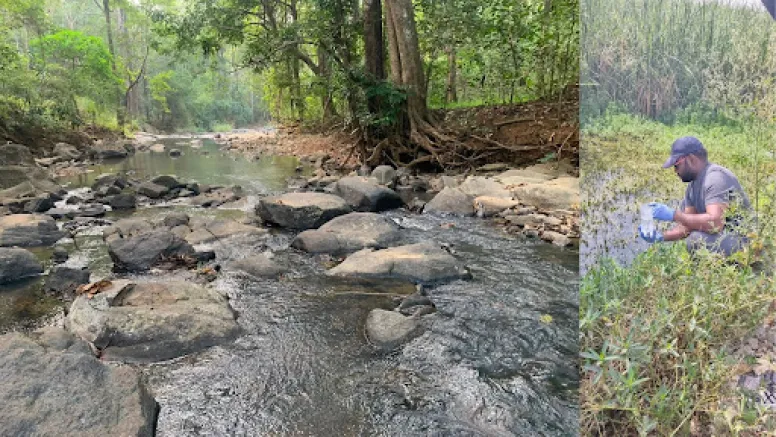
PUNE — In the intricate world of aquatic ecosystems, the smallest inhabitants often tell the most significant stories. New research emerging from a collaborative effort between the Agharkar Research Institute (ARI), Savitribai Phule Pune University, and the Canadian Museum of Nature has unveiled a groundbreaking discovery regarding diatoms—microscopic, single-celled algae that serve as the "canaries in the coal mine" for river health.
The study, conducted across the lush and biodiverse landscapes of India’s Western Ghats, reveals that these organisms are far more adaptable than previously theorized. Challenging decades of established ecological dogma primarily derived from temperate climates, the research demonstrates that tropical diatoms do not discriminate between their "homes," whether they be submerged rocks or the stems of aquatic plants. This finding is set to transform how scientists and conservationists monitor water quality in tropical regions, offering a more flexible, cost-effective, and streamlined approach to preserving some of the world’s most vital freshwater resources.
The Main Facts: Breaking the Substrate Barrier
For nearly half a century, the standard protocol for assessing river health has relied on the analysis of diatoms. These algae are encased in intricate, glass-like shells made of silica, known as frustules. Because different species of diatoms have highly specific tolerances for pollutants, acidity levels, and nutrient concentrations, their presence—or absence—provides a precise snapshot of a river’s chemical and biological state.
Historically, limnologists (scientists who study inland waters) have operated under the "substrate-preference" hypothesis. In Europe and North America, research consistently suggested that diatom communities were specialized: some preferred the stable, hard surfaces of rocks (epilithic diatoms), while others thrived on the organic surfaces of aquatic plants (epiphytic diatoms). Consequently, monitoring manuals mandated that scientists collect samples from specific substrates to ensure data consistency, often making fieldwork in remote or silty areas difficult and expensive.

However, the new study published by the Pune-based team turns this notion on its head for tropical ecosystems. By analyzing 40 different sites across the Western Ghats, researchers found that the diatom communities on rocks and plants were nearly identical. In the tropics, it appears, the "neighborhood" (the water chemistry) matters far more than the "house" (the substrate).
Chronology of the Study: From the Field to the Lab
The journey to this discovery began with an ambitious sampling project across the Western Ghats, a UNESCO World Heritage site and one of the world’s eight "hottest hotspots" of biological diversity. The mountain range, which runs parallel to the western coast of the Indian peninsula, provides a complex network of river systems that are under increasing threat from human activity.
- Site Selection and Fieldwork: The research team, led by experts including Karthick Balasubramanian, identified 40 diverse sites spanning various altitudes and land-use types. At each site, the team meticulously collected samples from two primary sources: submerged boulders and the stems/leaves of aquatic macrophytes.
- Environmental Characterization: Alongside biological sampling, the team recorded a suite of physicochemical parameters, including water temperature, pH, electrical conductivity, and nutrient levels (specifically phosphorus and nitrogen).
- Taxonomic Identification: Back in the laboratory, the diatoms were cleaned of organic matter to reveal their silica shells. Using high-resolution microscopy, the researchers identified thousands of individual diatoms, categorizing them into species—many of which had never been documented before.
- Statistical Modeling: The final phase involved complex multivariate statistical analysis. The researchers sought to determine how much of the variation in diatom communities was due to the type of surface they lived on versus the chemical composition of the water.
The results, finalized in early 2024 and recently publicized, provided a clear answer: the environmental filter of the tropical river was the dominant force, rendering the substrate choice largely irrelevant.
Supporting Data: The 13-Fold Influence
The data supporting this shift in perspective is robust. The researchers utilized a method called "variance partitioning" to weigh the influence of different factors on the diatom populations.

- Environmental Dominance: The study found that environmental variables—primarily phosphorus levels, water temperature, and electrical conductivity—were thirteen times more influential in shaping the diatom communities than the substrate type.
- Phosphorus as a Catalyst: In many temperate systems, phosphorus is a limiting nutrient. However, the Western Ghats feature many streams naturally rich in phosphorus due to the region’s unique geology. This high nutrient availability creates a "species-sorting" effect where the water’s chemistry acts as a rigorous biological filter.
- High Endemism: Perhaps most strikingly, the study revealed that 57% of the diatom species found were endemic to the Western Ghats. This means more than half of the organisms responsible for maintaining the local food web exist nowhere else on Earth. This level of uniqueness is significantly higher than that found in similar studies across Europe or North America, highlighting the urgent need for localized conservation strategies.
- Generalist Behavior: Unlike their temperate cousins, tropical diatoms in this region behave as "generalists." The stable, warm temperatures of the tropics reduce the seasonal stressors that often force diatoms into specialized niches in colder climates.
Official Responses and Scientific Commentary
Lead researchers emphasize that these findings are not just academic—they have immediate practical applications for environmental policy in India and other tropical nations.
"Our research suggests that the ‘Gold Standard’ protocols developed in the West cannot be blindly applied to tropical systems," noted the research team in their summary. "In the Western Ghats, the stability of the environment allows diatoms to colonize whatever surface is available. This ‘substrate-independence’ is a game-changer for ecological monitoring."
Experts from the Canadian Museum of Nature, who collaborated on the study, pointed out that this research fills a critical "knowledge gap" in global limnology. For too long, tropical river health has been assessed using frameworks designed for the Rhine or the Mississippi. This study provides a bespoke framework for the Global South.
Local environmentalists in Pune have also welcomed the news. "The Western Ghats are the water tower of Peninsular India," said a local conservation spokesperson. "Simplifying the process of monitoring these waters means we can catch pollution events faster and involve more local communities in citizen science initiatives."

Implications: A New Era for Water Conservation
The implications of this study are far-reaching, affecting scientific methodology, economic policy, and conservation efforts.
1. Streamlining Environmental Impact Assessments (EIAs)
Currently, EIAs for infrastructure projects like dams or bridges require rigorous biological sampling. If researchers are no longer tethered to finding specific types of rocks—which might be buried under silt or absent in fast-flowing rapids—the speed and reliability of these assessments will improve. Monitoring can now proceed using whatever substrate is at hand, be it a submerged branch, a leaf, or a pebble.
2. Cost-Effective Monitoring for Developing Nations
High-tech water sensors are expensive to maintain. Diatoms offer a low-cost, high-accuracy alternative. By proving that sampling can be flexible, this research lowers the barrier to entry for regional pollution boards and NGOs. It allows for a "substrate-independent" monitoring regime that is both cheaper and less labor-intensive.
3. Preserving Endemic Biodiversity
With 57% of species being endemic, the Western Ghats represent a unique evolutionary laboratory. Understanding that these species are shaped by water chemistry rather than physical surfaces allows conservationists to focus on the real threats: nutrient runoff from agriculture and thermal pollution from urbanization.

4. Climate Change Resilience
As global temperatures rise, temperate rivers may begin to exhibit "tropical" characteristics. The findings from the Western Ghats could provide a preview of how diatom communities worldwide might shift from specialists to generalists as their environments stabilize at higher temperatures.
5. Empowering Citizen Science
The flexibility in sampling opens the door for "citizen scientists"—local students and community members—to participate in river monitoring. Without the need for specialized training in substrate identification, a broader demographic can contribute to data collection, fostering a greater sense of stewardship over local water bodies.
Conclusion
The microscopic diatoms of the Western Ghats may be invisible to the naked eye, but their message is clear. In the complex, nutrient-rich waters of the tropics, life is defined by the essence of the water itself rather than the ground beneath. As India continues to balance rapid urbanization with environmental preservation, the insights provided by the Agharkar Research Institute and its partners offer a vital tool for ensuring that the life-giving rivers of the Western Ghats continue to flow with health and vitality for generations to come.
By listening to these "glass-shelled" messengers, scientists have not only simplified a complex field of study but have also provided a roadmap for more inclusive and effective environmental protection across the tropical world.
