

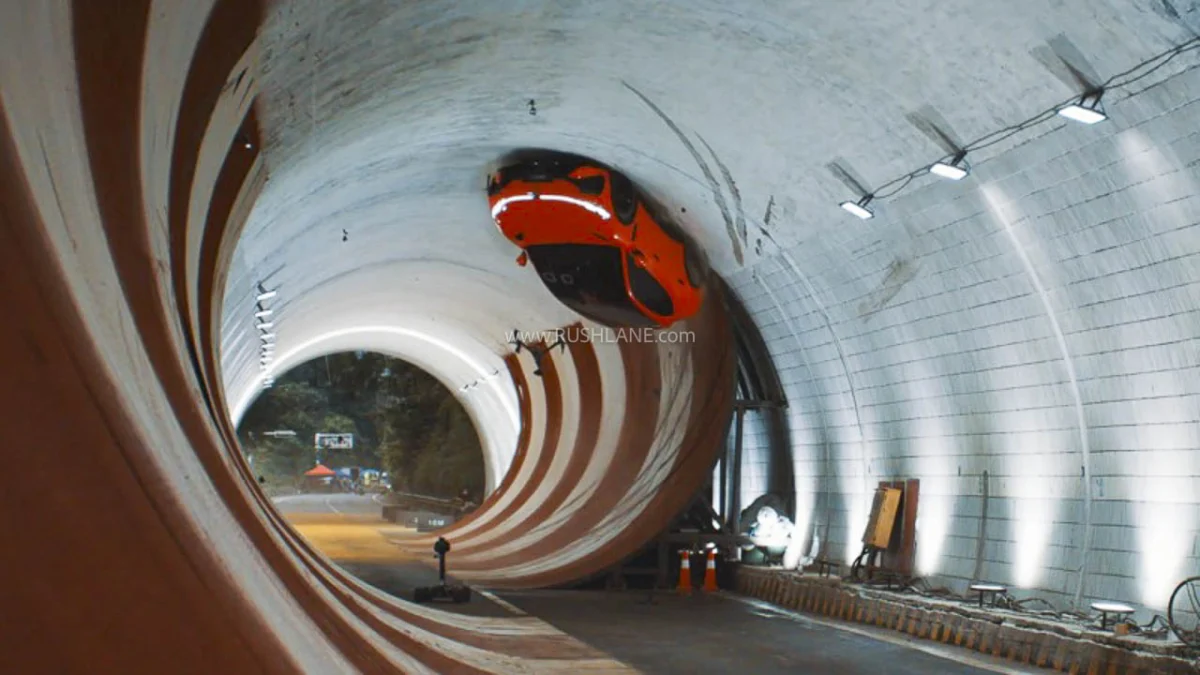
In the high-stakes arena of global electric vehicle (EV) marketing, performance figures and range estimates are no longer the only metrics of success. As the Chinese automotive industry pivots from rapid expansion to global brand-building, manufacturers are increasingly turning to "spectacle engineering" to prove their mettle. The latest and perhaps most audacious demonstration comes from Voyah, the premium electric vehicle arm of state-owned Dongfeng Motor Corporation.
In a dramatic video recently released by the automaker, a production-spec Voyah Passion S electric SUV is seen completing a full 360-degree loop inside a tunnel, driving completely upside down before returning to the asphalt. The feat is a direct, calculated tribute to the legendary 2010 Mercedes-Benz SLS AMG commercial, which featured seven-time Formula 1 World Champion Michael Schumacher performing a similar maneuver. By successfully replicating this "holy grail" of automotive stunts, Dongfeng is sending a clear message: Chinese EVs are ready to challenge the legacy of European engineering icons.
The Main Event: A 360-Degree Defiance of Physics
The stunt took place in a specially prepared, closed-circuit test tunnel in Wuhan, China. Unlike previous cinematic representations of such feats, which often relied on CGI or heavily modified stunt cars, Voyah claims the Passion S used for the loop was a standard production-spec vehicle. This detail is significant because the Passion S is a luxury SUV, not a lightweight supercar, making the physics of the maneuver significantly more complex.
To achieve the loop, the vehicle had to combat the force of gravity using nothing but velocity and centrifugal force. According to Dongfeng’s engineering team, the margin for error was razor-thin. The vehicle entered the curved wall of the tunnel at a precise speed of 130 km/h (approximately 81 mph). At this velocity, the outward force generated by the car’s circular path exceeded the downward pull of gravity, effectively "pinning" the tires to the ceiling of the tunnel.
However, speed was only one part of the equation. Engineers calculated that a constant steering angle of exactly 16 degrees was required to maintain the trajectory. Any deviation in steering or a drop in speed of as little as 3 to 5 km/h would have resulted in a catastrophic loss of traction, causing the multi-ton SUV to fall from the ceiling.
A Chronology of Performance: From Schumacher to Wuhan
To understand the weight of this achievement, one must look back to January 2010. Mercedes-Benz released a promotional film for the SLS AMG "Gullwing," where Michael Schumacher drove the V8-powered supercar through a tunnel, up the wall, and across the ceiling. For over a decade, that video has been the subject of intense debate among enthusiasts regarding whether it was a real physical feat or a masterpiece of digital editing.
Voyah’s decision to recreate this specific moment is a strategic move in the ongoing narrative of Chinese automotive evolution. It follows a series of high-profile performance milestones from Chinese OEMs:
- The Hypercar Benchmark: Earlier this year, BYD’s Yangwang U9 made headlines by becoming the world’s fastest electric production car, clocking a top speed of 496.22 km/h.
- The Nürburgring Assault: Xiaomi’s SU7 Ultra recently set a blistering lap record at the Nürburgring Nordschleife for a four-door car, signaling that Chinese manufacturers are targeting the "Green Hell" to validate their chassis tuning.
- The Voyah Loop: By tackling the tunnel loop, Dongfeng is moving the conversation from raw speed to structural integrity, power-to-weight precision, and the sheer audacity of engineering.
While the final edited video from Voyah shows a seamless transition, evidence of the difficulty involved is visible. Sharp-eyed observers noted multiple sets of tire marks on the tunnel ceiling in the footage, suggesting that several attempts—and perhaps some near-misses—were required to perfect the run. A separate video circulating on social media platform X (formerly Twitter) reportedly shows an unsuccessful attempt where a vehicle failed to maintain the necessary line, highlighting the genuine danger involved in the stunt.
Supporting Data: The Specs Behind the Stunt
The Voyah Passion S (known in China as the Zhuiguang) is a flagship sedan/SUV crossover designed to compete with the likes of the Tesla Model S and the Porsche Taycan. Its ability to perform such a stunt is rooted in its robust powertrain and low center of gravity—a characteristic common to high-end EVs due to floor-mounted battery packs.
Powertrain and Performance
The stunt vehicle utilized a dual-motor, all-wheel-drive (AWD) configuration. This setup delivers a combined output of 637 horsepower and a staggering 765 Nm of torque. This instant torque is critical for maintaining the high entry speed required to initiate the climb up the tunnel wall. The vehicle is capable of accelerating from 0-100 km/h in just 4.5 seconds, providing the necessary thrust to hit the 130 km/h "sweet spot" within the confines of a tunnel.
Battery and Architecture
The Passion S is built on an advanced 800V high-voltage architecture, which allows for better thermal management and more consistent power delivery during high-load scenarios. It is equipped with a 98 kWh battery pack. Interestingly, Voyah opted not to strip the car for the stunt. The vehicle retained its full battery weight, interior trim, and its comprehensive suite of driver-assistance hardware, including sensors and cameras developed in partnership with Huawei.

Range and Efficiency
While not directly relevant to the stunt itself, the vehicle’s efficiency highlights its daily-driver credentials. The rear-wheel-drive version offers up to 700 km of range (CLTC), while the high-performance AWD variant used in the loop offers approximately 660 km.
Official Responses and Engineering Validation
Dongfeng’s engineers have been vocal about the technical hurdles faced during the project. A spokesperson for the Voyah engineering department stated that the primary challenge was not the car’s power, but the management of "G-load transitions."
"When the vehicle moves from the horizontal floor to the vertical wall and finally the inverted ceiling, the suspension system undergoes extreme compression and extension cycles," the engineer explained. "The Passion S utilizes an air suspension system with CDC (Continuous Damping Control), which we calibrated to ensure the tires maintained a consistent contact patch even when the car was effectively weightless relative to the ground."
The company also emphasized that the stunt served as a "torture test" for the vehicle’s structural rigidity. The torque of the dual motors had to be distributed with millisecond precision to prevent any wheel spin on the smooth tunnel surface, which would have led to an immediate loss of the centrifugal grip required to stay inverted.
Implications for the Global EV Market
The Voyah tunnel loop is more than just a viral marketing campaign; it represents a shift in the competitive landscape of the global auto industry.
1. Brand Perception and Emotional Resonance
For decades, Chinese cars were perceived as budget-friendly alternatives to Western brands. By recreating a Mercedes-Benz stunt, Voyah is attempting to bridge the "prestige gap." They are positioning themselves not just as a technology provider, but as a brand capable of the same "automotive magic" that defined the golden era of German and Italian performance cars.
2. The Tech-Performance Convergence
The inclusion of Huawei-developed ADAS (Advanced Driver Assistance Systems) hardware in a car performing a 360-degree loop highlights a new trend: the fusion of "smart" tech and "hard" performance. Voyah is marketing the idea that a car can be both a sophisticated computer on wheels and a physics-defying performance machine.
3. Safety and Structural Confidence
While driving upside down is not a real-world use case, the stunt serves as a proxy for safety. A vehicle that can withstand the unique stresses of a tunnel loop without structural failure or battery coolant leaks sends a powerful message about build quality—a crucial factor as Chinese brands seek to enter stringent European and North American markets.
Conclusion: A New Era of Stunt Marketing
Whether the 2010 Mercedes SLS AMG commercial was "real" or not almost doesn’t matter anymore. By putting a production-spec SUV through the same paces in a controlled, documented environment, Dongfeng and Voyah have claimed a piece of automotive history for themselves.
As the EV market becomes increasingly crowded, manufacturers are finding that traditional advertising is no longer enough. To capture the imagination of a global audience, they must perform the impossible. The Voyah Passion S tunnel loop is a testament to the rapid maturation of the Chinese EV industry—a sector that is no longer content with following the leaders, but is now intent on turning the entire industry upside down.
