

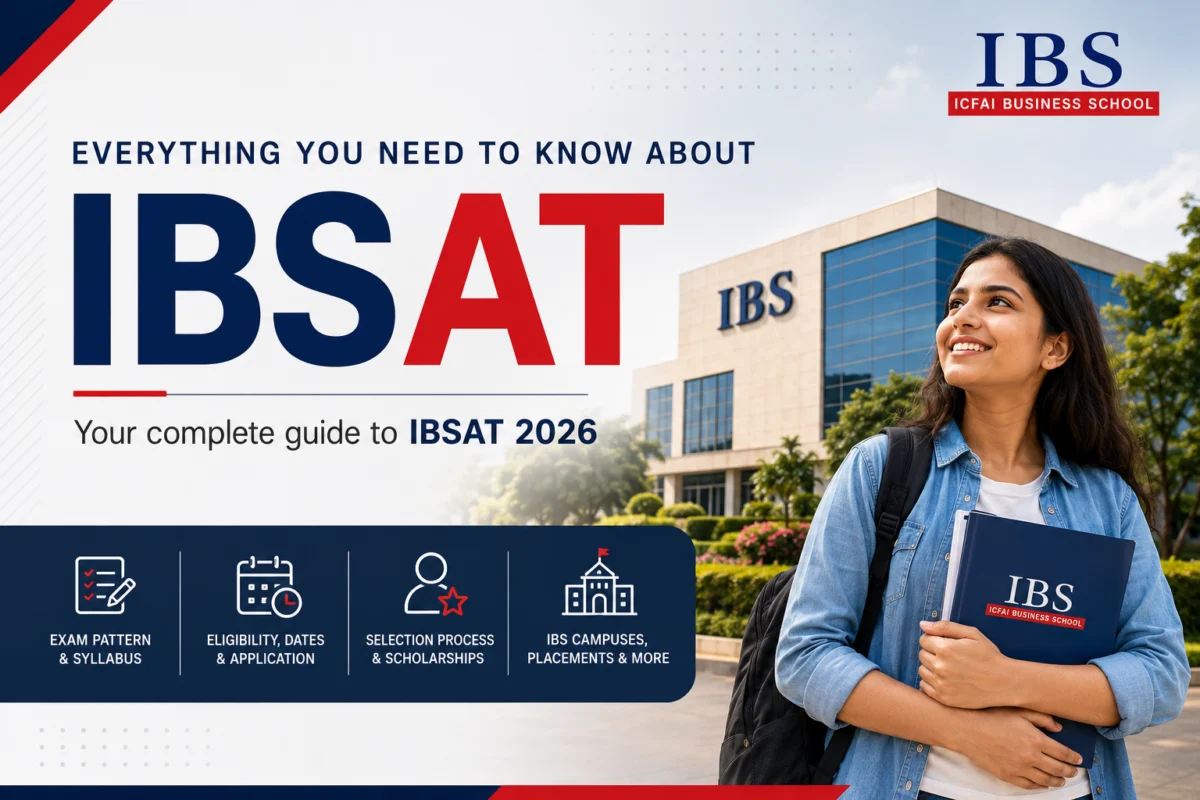
Hyderabad, India – [Insert Date of Publication] – The landscape of management education in India is a competitive one, and for aspiring MBA candidates, the ICFAI Business School (IBS) network presents a compelling proposition. Central to accessing this esteemed group of institutions is the ICFAI Business School Aptitude Test (IBSAT). More than just another standardized examination, IBSAT 2026 serves as a primary pathway to nine IBS campuses, offering a streamlined application process, a unique testing format, and the added flexibility of utilizing scores from other prominent management entrance tests. As applications for IBSAT 2026 are now open, a comprehensive understanding of its intricacies is crucial for ambitious B-school aspirants.
IBSAT 2026: A Holistic Overview
IBSAT 2026 is scheduled to be conducted in December 2026, with applications currently being accepted. The examination, organized by the ICFAI Foundation for Higher Education (IFHE), is a national-level aptitude test designed to evaluate candidates for admission into the two-year full-time MBA/PGPM programs across the IBS network. A significant advantage of the IBSAT application process is its single-window approach, allowing candidates to apply to multiple IBS campuses with just one application. Furthermore, IBS offers a crucial alternative for candidates who have already appeared for or plan to appear for other leading management entrance exams. Valid scores from CAT, XAT, NMAT by GMAC, or GMAT can be used to apply for admission to IBS, potentially eliminating the need to take the IBSAT itself.
Key Details for IBSAT 2026:
| Particulars | Details |
|---|---|
| Full Form | ICFAI Business School Aptitude Test |
| Conducting Body | ICFAI Foundation for Higher Education (IFHE) |
| Exam Level | National |
| Frequency | Once a year |
| Exam Month | December 2026 |
| Mode of Exam | Online |
| Duration | 120 minutes |
| Total Questions | 140 |
| Total Marks | 140 |
| Sections | 4 |
| Question Type | Multiple Choice Questions (MCQs) |
| Marking Scheme | +1 for each correct answer; No negative marking |
| Application Fee | ₹1,800 |
| Application Window | July 1 – Third week of December 2026 |
| Expected Result Date | First week of January 2027 (Tentative) |
| Selection Briefings | January 2027 |
| Selection Process | February 2027 |
Note: Dates marked as tentative are subject to change by IBS. Applicants are advised to refer to the official IBSAT website for the latest updates.
The IBSAT Journey: A Chronology of Events
The IBSAT 2026 application cycle has commenced, offering a structured timeline for prospective students. The application window officially opened on July 1, 2026, and will remain open until the third week of December 2026. The IBSAT examination itself is slated for December 2026, with the detailed test schedule to be announced shortly by IBS. Following the examination, candidates can anticipate the release of results in the first week of January 2027, albeit on a tentative basis. The subsequent stages of the admission process include selection briefings in January 2027, culminating in the final selection process in February 2027. This carefully orchestrated schedule ensures a systematic progression from application to final admission.
Unpacking the IBSAT Exam Structure and Syllabus
IBSAT distinguishes itself with a unique examination format designed to assess a candidate’s aptitude and speed under pressure. The test comprises 140 multiple-choice questions to be answered within a strict 120-minute timeframe. Crucially, there are no sectional time limits, affording candidates the flexibility to allocate their time across different sections as per their strategic approach. Furthermore, the absence of negative marking encourages an aggressive approach to attempting questions, as every correct answer contributes positively to the final score.
The IBSAT syllabus is broadly divided into four key sections:
-
Verbal Ability (50 Questions): This is the most significant section in terms of question count, testing a candidate’s command over English language and its nuances. Key areas of focus include:
- Vocabulary (synonyms, antonyms, analogies, idioms)
- Grammar (sentence correction, error spotting)
- Verbal Reasoning (logical sequencing of sentences, critical reasoning)
- Sentence Completion and Fill-in-the-blanks
-
Reading Comprehension (30 Questions): This section evaluates a candidate’s ability to comprehend, analyze, and interpret written passages efficiently. Preparation should emphasize:
- Identifying the main idea and supporting arguments within passages.
- Understanding tone, intent, and author’s perspective.
- Inferring meaning and drawing conclusions based on the text.
- Answering questions related to vocabulary within the context of the passage.
-
Quantitative Aptitude (30 Questions): This section covers fundamental mathematical concepts typically found in management entrance examinations. Key areas include:
- Arithmetic (percentages, profit & loss, ratios, time & work, time & distance)
- Algebra (equations, functions, progressions)
- Geometry (basic theorems, mensuration)
- Number Theory (divisibility, remainders)
- Permutations & Combinations and Probability
-
Data Adequacy & Interpretation (30 Questions): This section tests a candidate’s ability to analyze and interpret data presented in various formats, along with their reasoning skills. Preparation should encompass:
- Data Interpretation: Analyzing charts, graphs, tables, and caselets.
- Data Sufficiency: Determining if the provided information is adequate to answer a question.
- Logical Reasoning related to data analysis.
The absence of negative marking in IBSAT is a significant tactical advantage. It shifts the focus from avoiding penalties to maximizing correct answers. Candidates are encouraged to attempt all questions, as even a guessed answer has a chance of being correct without any penalty for an incorrect response. This necessitates a strong emphasis on speed and efficient question selection.
Official Response and Clarifications on IBSAT
IBS has been proactive in providing information regarding IBSAT 2026, with their official website serving as the primary source for updates. Regarding the examination dates, IBS has officially stated that the test will be conducted in December 2026, with detailed schedules to be announced shortly. The application fee is set at ₹1,800. When questioned about the perceived difficulty level, IBS officials, through their communication channels, have emphasized that IBSAT is not designed to be a "easier CAT." Instead, it presents a distinct challenge characterized by a high volume of questions within a limited timeframe, demanding a different strategic approach focused on speed and efficiency.
Implications for Aspiring MBA Candidates
The IBSAT 2026 examination holds significant implications for a broad spectrum of MBA aspirants:
- Access to the IBS Network: IBSAT is the primary gateway to nine well-established IBS campuses across India, including IBS Hyderabad, Bengaluru, Dehradun, Jaipur, Ahmedabad, Gurgaon, Kolkata, Mumbai, and Pune. This offers a diverse range of options in terms of location, specialization, and campus culture.
- Flexibility in Application: The option to use CAT, XAT, NMAT by GMAC, or GMAT scores provides a critical alternative for candidates who have already performed well in these examinations, potentially saving them the effort of preparing for and taking another test.
- Strategic Advantage of No Negative Marking: The absence of negative marking fundamentally alters the test-taking strategy. It encourages a more aggressive approach to answering questions and minimizes the fear of penalty for incorrect attempts.
- Emphasis on Speed and Efficiency: The 140 questions in 120 minutes format translates to approximately 51 seconds per question. This underscores the paramount importance of speed, accuracy, and efficient question selection. Candidates who can quickly identify and solve solvable problems while knowing when to move on will have a distinct advantage.
- Holistic Selection Process: Beyond the entrance test, IBS considers academic performance, Micro Presentation, and Personal Interview for final selection. This means that a strong academic record and well-honed communication skills are equally vital for admission.
- Scholarship Opportunities: For the 2027-29 intake, IBS has announced a substantial ₹10 crore merit scholarship pool, incentivizing high-achieving students and making an MBA from IBS more accessible. This initiative is a significant development that could influence many candidates’ decision-making processes.
- National Mock Test Initiative: IBS is actively promoting a national mock test series for IBSAT 2026, offering prizes and a platform for candidates to benchmark their preparation against the actual exam format. This initiative provides invaluable practice and insights.
Navigating the IBSAT Strategy: Speed is Key
The core of a successful IBSAT strategy lies in mastering speed and efficiency. With approximately 51 seconds per question, candidates must develop a multi-layered approach:
- Accuracy: Build a strong conceptual foundation to ensure that easier and moderate questions are answered correctly and reliably.
- Speed: Practice solving familiar question types rapidly, minimizing unnecessary calculations.
- Selection: Develop the crucial skill of identifying and moving on from difficult or time-consuming questions, thereby maximizing the number of questions attempted.
Simultaneous preparation for other management entrance exams like CAT can cover a significant portion of the IBSAT syllabus. However, IBSAT-specific mock tests are essential to acclimatize to the unique format, particularly the 140-question, 120-minute structure without sectional time limits. Analyzing performance in these mocks is paramount, focusing on identifying strengths, weaknesses, question-selection strategies, and time management techniques.
The Application Process: A Seamless Experience
IBS has designed a straightforward online application process for IBSAT 2026. Prospective candidates need to:
- Register Online: Visit the official IBSAT website and create an application account.
- Pay the Application Fee: Submit the non-refundable application fee of ₹1,800.
- Complete Profile: Log in to the portal and fill in all required personal, academic, and contact details.
- Select Test Score Route: Choose to appear for IBSAT or submit scores from accepted exams (CAT, XAT, NMAT by GMAC, GMAT).
- Submit Application: Finalize and submit the completed application form.
Candidates are advised to stay updated with official announcements regarding the detailed test schedule and any further guidelines.
Conclusion: A Strategic Approach to IBS Admission
IBSAT 2026 is more than just an entrance examination; it is a strategic opportunity for aspiring MBA students to access a reputable network of business schools. Its unique format, combined with the flexibility of accepting scores from other major exams and the allure of substantial scholarships, makes it a pivotal component of the Indian B-school admissions landscape. By understanding the exam structure, syllabus, and strategic imperatives, candidates can position themselves effectively for success. The key lies not just in conceptual knowledge, but in the ability to execute that knowledge with speed and precision within the allotted time. As the application window opens, a focused and strategic approach to IBSAT 2026 will undoubtedly pave the way for a promising future in management education.
