

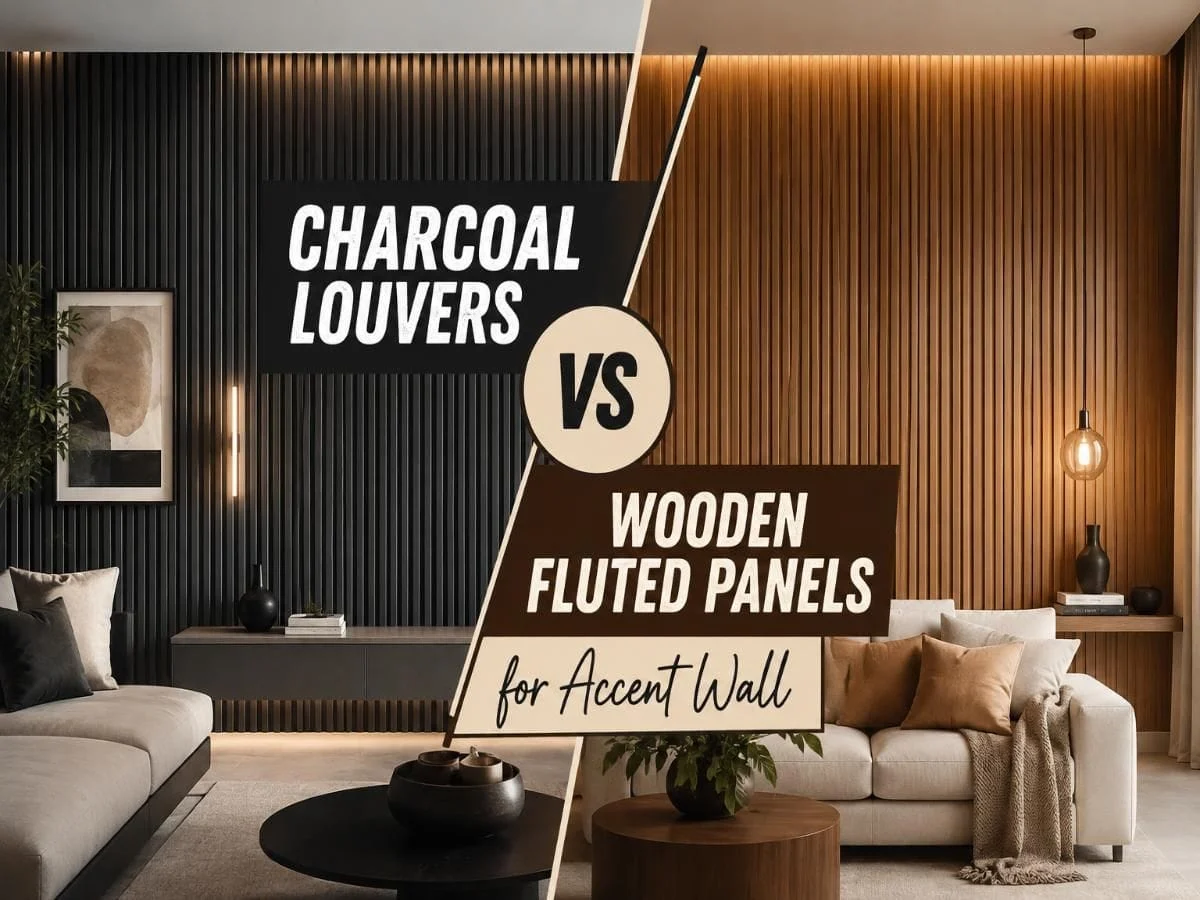
In the contemporary interior design landscape, the "blank wall" has transitioned from a mere structural necessity to a high-stakes canvas for personal expression. For decades, homeowners and designers relied on a fresh coat of paint or decorative wallpaper to break the monotony of a room. However, as global design trends shift toward tactile architecture and three-dimensional surfaces, the industry has seen a massive surge in the popularity of wall paneling.
The current market is dominated by two primary contenders: Charcoal Louvers and Wooden Fluted Panels. While they may appear indistinguishable in low-resolution Pinterest boards, these two materials represent fundamentally different philosophies in engineering, aesthetics, and long-term durability. This report provides an in-depth analysis of the "Texture Revolution," comparing these two materials across technical specifications, environmental resilience, and psychological impact on living spaces.
1. Main Facts: Defining the Modern Wall Panel
To understand the choice between charcoal louvers and wooden fluted panels, one must first deconstruct the materials. The term "fluted" refers to the series of shallow or deep vertical grooves—a design element dating back to classical Greek columns—that creates a play of light and shadow.
What are Charcoal Louvers?
Contrary to what the name might suggest, charcoal louvers are not made of solid blocks of coal. They are sophisticated composite products typically manufactured from Evolved Polystyrene (EPS) or other recycled polymers mixed with charcoal powder. This material is essentially a high-density plastic composite that is molded under high pressure.
- Key Characteristics: Lightweight, waterproof, and inherently resistant to biological threats like mold or termites.
- Surface Finish: Usually comes pre-finished in matte, metallic, or textured dark tones.
What are Wooden Fluted Panels?
Wooden fluted panels are more traditional in their material composition but varied in their execution. They are generally categorized into three types:
- MDF (Medium-Density Fiberboard): Engineered wood that is routed and painted or wrapped in a membrane.
- WPC (Wood Plastic Composite): A hybrid of wood fibers and plastic, offering a middle ground in durability.
- Solid Wood/Veneer: The premium tier, involving real timber (like teak, oak, or walnut) carved into ridges.
- Key Characteristics: Organic texture, natural grain variations, and a "warm" tactile feel.
2. Chronology: The Evolution of Wall Texturing
The journey to today’s fluted panel craze followed a distinct evolutionary path in home decor.
- The Minimalist Era (2000s–2010s): The "less is more" philosophy dominated. Walls were kept flat, and interest was created through "accent walls" painted in a single bold color.
- The Wallpaper Revival (2012–2018): Homeowners sought more pattern. Digital printing allowed for intricate designs, but the "flatness" of the wall remained a limitation.
- The Rise of 3D Wall Panels (2018–2021): Large-scale PVC 3D tiles became popular in commercial spaces, eventually migrating to residential TV units. These were often bulky and difficult to maintain.
- The "Fluting" Phenomenon (2022–Present): Borrowing from the "Japandi" (Japanese-Scandinavian) and "Mid-Century Modern" movements, the industry pivoted toward verticality. The "slat" or "fluted" look became the gold standard for adding height and sophistication to a room without the visual clutter of 3D geometric shapes.
3. Supporting Data: A Technical Head-to-Head
When choosing between these materials, designers often look past the surface. The following data points highlight the functional divergence between charcoal and wood.
Durability and Environmental Resilience
In high-humidity regions—such as coastal cities like Mumbai, Chennai, or Singapore—the material’s reaction to moisture is the primary concern.
- Charcoal Louvers: Because they are polymer-based, they are 100% waterproof. They do not swell, warp, or rot when exposed to dampness. Furthermore, being inorganic, they offer no food source for termites.
- Wooden Fluted Panels: Standard MDF panels are highly susceptible to moisture, often "bubbling" at the edges if the humidity is not controlled. Even WPC, while better, can experience slight expansion. Real wood requires seasonal polishing and anti-termite treatments to maintain its integrity.
Installation Efficiency
Time-on-site is a critical metric for modern renovations.
- Weight: Charcoal louvers are significantly lighter than wood. A standard 8-foot panel can often be handled by a single technician.
- Adhesion: Charcoal panels are typically installed using high-strength cyanoacrylate adhesives or "silicon" glue, requiring no heavy framing.
- Precision: Wooden panels, especially real wood, require skilled carpentry for seamless "book-matching" of grains and precise interlocking to avoid visible gaps as the wood breathes.
Comparative Specification Table
| Feature | Charcoal Louvers | Wooden Fluted Panels |
|---|---|---|
| Composition | EPS / Polymer + Charcoal | MDF / WPC / Real Timber |
| Visual Vibe | Bold, Urban, Industrial | Warm, Organic, Timeless |
| Water Resistance | Excellent (Waterproof) | Moderate (WPC) to Poor (MDF) |
| Termite Resistance | 100% Immune | Requires Treatment |
| Maintenance | Damp cloth wipe only | Periodic dusting/polishing |
| Average Cost | Mid-range | Low (MDF) to High (Solid Wood) |
4. Industry Perspectives: Where Designers Deploy Them
Professional interior designers in major urban hubs like Delhi and Gurgaon have developed a "rule of thumb" for these materials based on the psychological impact they have on a room.
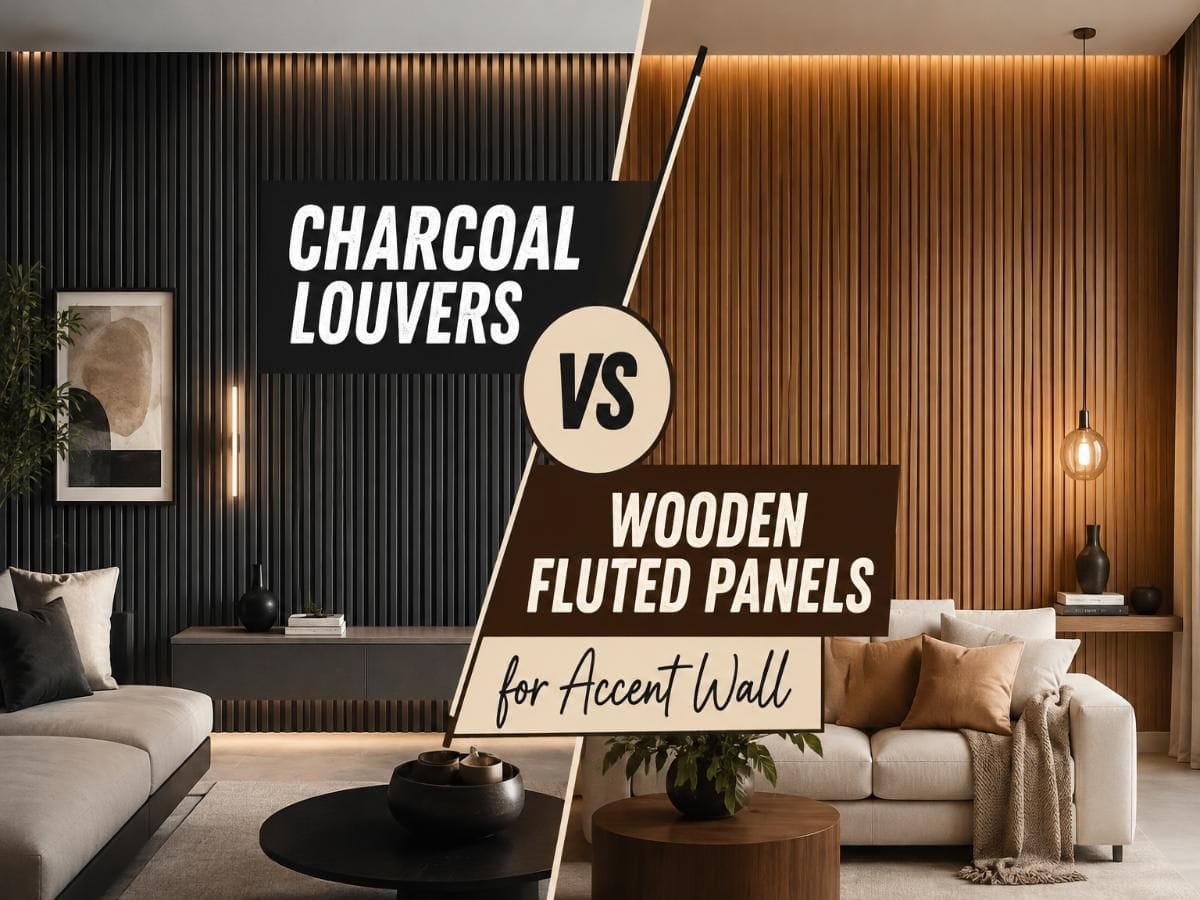
The "Drama" of Charcoal
Designers often specify charcoal louvers for "high-impact" zones.
- The TV Unit: The dark, matte finish of charcoal panels helps the television screen blend into the wall when off, creating a "stealth" luxury look.
- Entrance Foyers: Charcoal creates an immediate sense of gravity and modernism.
- Commercial Spaces: Bars and lounges prefer charcoal due to its resistance to spills and its ability to look premium under dim, moody lighting.
The "Sanctuary" of Wood
Wooden fluted panels are the preferred choice for areas intended for relaxation.
- The Master Bedroom: Wood has a natural acoustic-dampening quality. The warmth of the grain promotes a sense of calm that plastic-based composites struggle to replicate.
- Home Libraries/Offices: Wood signals tradition and intellectual permanence.
- The "Japandi" Aesthetic: For homes using light oaks and neutral linens, wooden fluted panels are essential to maintain the organic palette.
5. Economic Implications and Market Trends
The choice between these two materials also reflects broader economic shifts in the home improvement sector.
Cost-Benefit Analysis:
While the initial purchase price of charcoal louvers may be higher than low-end MDF wooden panels, the "Total Cost of Ownership" (TCO) is often lower. Because charcoal requires no painting, no polishing, and no termite treatment, the maintenance budget over a five-year period is effectively zero. Conversely, real wood panels are seen as an "appreciating asset" in luxury real estate. A home featuring genuine teak fluting often commands a higher resale value than one using synthetic composites.
The "Hybrid" Trend:
The most recent trend observed in 2024 is the "Mixed Media" wall. Rather than choosing one over the other, designers are layering charcoal louvers with wooden accents. For example, a charcoal-fluted base may be topped with a smooth wooden mantle or vice versa. This balance prevents a room from feeling too "cold" (a risk with charcoal) or too "dated" (a risk with poorly executed wood).
6. Implications: The Future of Interior Surfaces
As we look toward the future of interior design, the debate between charcoal and wood highlights a larger tension between convenience and authenticity.
- Sustainability: Charcoal louvers, being made from recycled polymers, represent a circular economy approach to decor. However, the rise of "sustainable forestry" certificates (like FSC) is making real wood a viable eco-friendly option for those who want to avoid plastics.
- Urbanization: As more people move into high-rise apartments where "seepage" and "dampness" are common structural issues, the market share for charcoal louvers is expected to grow. Its resilience makes it the "safe" choice for the modern apartment dweller.
- Technological Convergence: We are beginning to see "Charcoal-Wood Hybrids"—panels made of charcoal composite but printed with high-definition, 4K wood-grain textures that even mimic the feel of bark. This may eventually render the "Charcoal vs. Wood" debate obsolete.
Final Take: Choosing Your Winner
There is no objective "superior" material in the battle of Charcoal Louvers vs. Wooden Fluted Panels. The decision rests on two questions:
- What is the environment? (If it’s a damp basement or a kitchen-adjacent wall, go with Charcoal. If it’s a dry, sunlit bedroom, go with Wood.)
- What is the desired emotion? (If you want your guests to feel "wowed" by a sleek, modern edge, choose Charcoal. If you want them to feel "at home" and cozy, choose Wood.)
Ultimately, the fluted panel trend proves that texture has officially replaced color as the most important element of a room. Whether through the industrial grit of charcoal or the timeless grace of wood, the goal remains the same: to turn a house into a three-dimensional experience.
Disclaimer: This report is based on current industry standards and material science as of 2024. Local availability and specific manufacturing processes may vary. Always consult with a certified structural engineer or interior designer before making permanent alterations to your property.
