

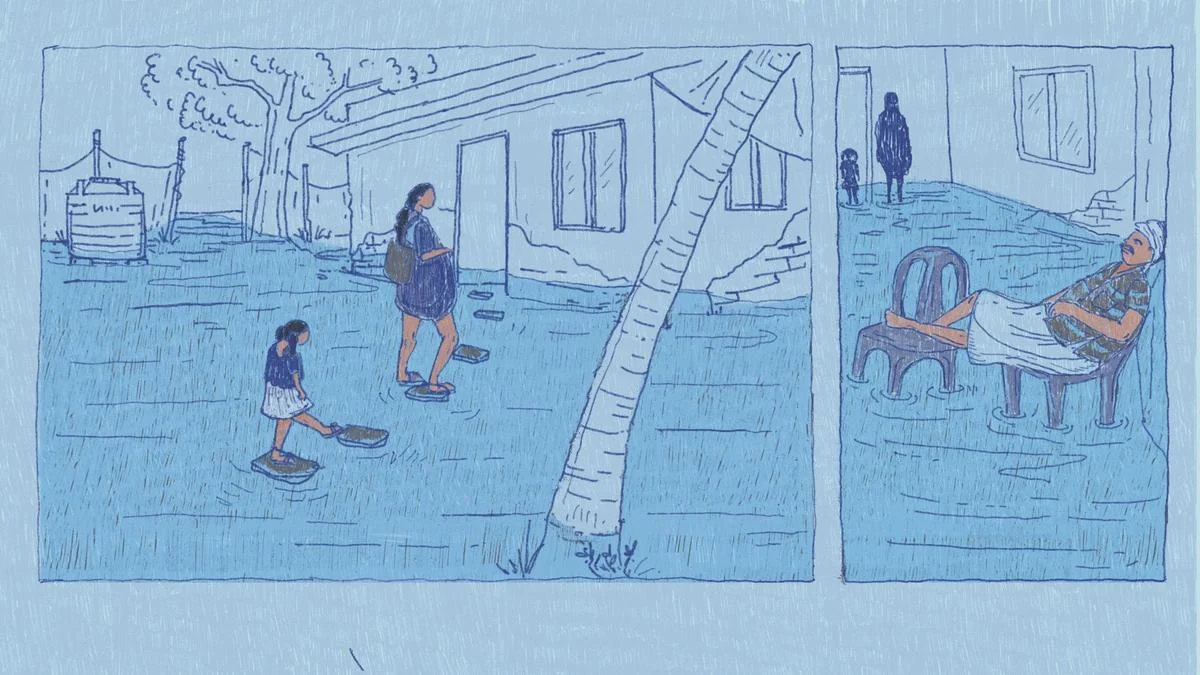
In the coastal stretches of Kochi, Kerala, the rhythm of life is dictated not by the ticking of a clock, but by the relentless pull of the moon and the surging of the tides. For the residents of these low-lying regions, the encroaching sea is no longer a distant threat of global warming—it is a nightly visitor that seeps through floorboards and submerges courtyards. This harrowing reality is captured with haunting poignancy in Nanavu (meaning ‘Wetness’ or ‘Dampness’), a silent comic by illustrator Athulya Pillai.
The narrative of Nanavu begins with a simple, relatable image: a pair of vibrant pink slippers. A young girl in Kochi spots them in a shop, her mother buys them, and they quickly become her most prized possession. She wears them everywhere, a symbol of childhood joy and mobility. However, the story takes a somber turn at nightfall. As she prepares for bed, she does not leave her slippers by the door. Instead, she places them high atop a shelf. She does this because she knows, with the weary certainty of a child of the coast, that by the time she wakes up, her home will be under several inches of water.
Main Facts: Art as a Witness to Inundation
Nanavu is a 28-page silent comic that eschews dialogue to focus on the visual and emotional weight of tidal flooding. Published by Studio Niyat, the book serves as both a piece of art and a social document. It highlights the "permanent battle" faced by coastal communities in Kerala, particularly in the Ernakulam district, where rising sea levels and land subsidence have made tidal flooding a daily occurrence.

The book is rendered in a carefully curated palette of powder blue. This choice of color is intentional; it reflects the omnipresence of water—the shrimp farms, the flooded Pokkali rice fields, and the moonlit tides that dictate the region’s survival. By removing text, Pillai emphasizes the "silence" of the water as it creeps into living rooms, and more importantly, the silence of the authorities and the wider world toward the plight of these "climate refugees in situ."
The comic does not merely portray loss; it documents resilience. It shows how communities have adapted, how they track lunar cycles to predict the next surge, and how they have become amateur scientists in their own right, documenting flood levels to provide data that the state often lacks.
Chronology: From the Glaciers of Ladakh to the Floods of Kochi
The genesis of Nanavu is a journey of geographic and emotional contrasts. To understand the perspective Athulya Pillai brings to this work, one must look at the timeline of her career and the experiences that shaped her environmental consciousness.

2018–2021: The Ladakh Years
After completing her degree in Retail and Exhibition Design at the Maharashtra Institute of Technology (MIT) in Pune, Pillai moved to Ladakh. For three years, she lived in the high-altitude desert, a region defined by acute water scarcity. During this time, she worked with teams creating "ice stupas"—artificial glaciers designed to store winter water for use during the parched spring planting season.
Living in Leh, she began documenting her daily life through doodles and sketches. This period saw the publication of her first major work, Yangdol (2021), co-authored with Pankaj Singh. Yangdol told the story of a Ladakhi girl’s yearning to see a snow leopard, blending cultural heritage with environmental themes.
2022–2024: Return to the Coast
Upon returning to her hometown of Kochi, Pillai was struck by a "stark and jarring contrast." Having just come from a region where every drop of water was a hard-won treasure, she found herself in a landscape where water was an invasive, destructive force. The "persistent wetness" of the coastal ground became a source of creative unease.

She began working with Common Ground India, a collaborative initiative focused on enhancing the ecological and economic wellbeing of rural India. This role allowed her to engage deeply with the grassroots realities of Kerala’s changing geography.
2025: The Catalyst of KaBhumM
The turning point for the creation of Nanavu occurred in 2025, during a visit to KaBhumM, a climate-driven art initiative. The exhibition brought the visceral impacts of climate change into the public spotlight. Witnessing how art could bridge the gap between scientific data and human empathy, Pillai felt compelled to tell the story of Kochi’s tides.
She reached out to Equinoct, a Kochi-based community-sourced modeling solution provider. With their guidance, she conducted extensive field visits to Ezhikkara, one of the regions most severely affected by tidal flooding. She visited homes, spoke with families who had lost furniture and livelihoods to the salt water, and observed the meticulous ways they documented the rising water levels.

Supporting Data: The Science of the "Sinking" Coast
The narrative of Nanavu is backed by alarming environmental data. Kochi and its surrounding suburbs, such as Ezhikkara, Kumbalangi, and Chellanam, are on the front lines of the climate crisis.
- Tidal Inundation: Unlike seasonal monsoon floods, tidal flooding (often called "high tide flooding" or "nuisance flooding") occurs during high tides, particularly during full moon and new moon phases. In Ezhikkara, residents report that water enters their homes up to 100 days a year.
- Sea Level Rise: According to IPCC reports, the Arabian Sea is rising at a rate higher than the global average. This, combined with the low elevation of the Kerala backwaters, means that even a few centimeters of rise can result in kilometers of inland flooding.
- Salinity Intrusion: The flooding isn’t just a matter of "wetness." The influx of salt water destroys the Pokkali rice crops—a unique, saline-tolerant rice variety native to Kerala—and disrupts the traditional shrimp farming cycles that the local economy relies on.
- Community Science: Organizations like Equinoct have pioneered "community-led tidal monitoring." Because official tidal gauges are often far from residential clusters, local citizens use marked poles to record water height. This data is what Pillai witnessed during her field research and subsequently illustrated in her comic.
Official Responses and Community Action
The response to the coastal crisis in Kerala has been a mixture of infrastructure-heavy engineering and grassroots adaptation.
Government Infrastructure
The State Government has invested heavily in the "Chellanam Model," which involves the construction of tetrapods and seawalls to prevent coastal erosion. While these measures provide a buffer against heavy wave action during monsoons, they are often less effective against the slow, steady rise of tidal waters in the backwater regions like Ezhikkara.

The Role of NGOs and Private Initiatives
Groups like Common Ground India and Equinoct have stepped in where traditional policy has lagged. They focus on "soft" solutions: restoring mangroves to act as natural buffers, improving local drainage systems, and empowering residents with data. By documenting the floods, these communities are building a case for "loss and damage" compensation, a key topic in global climate negotiations.
In Nanavu, Pillai captures this spirit of collective action. One frame depicts community members gathered around a flood marker, a scene that mirrors the real-world efforts of Ezhikkara’s residents to make their plight visible to the state.
Implications: The Power of Silent Storytelling in Climate Advocacy
The decision to make Nanavu a silent comic is perhaps its most significant artistic and political choice. Pillai explains that the silence represents two things: the stealthy nature of the water and the lack of a voice for the affected people.

Art as Climate Communication
Traditional climate reporting often relies on "disaster porn"—images of catastrophic storms or dry, technical graphs. Nanavu offers a third way. By focusing on a pair of pink slippers, it humanizes the crisis. It moves the conversation from "global hectares" and "carbon parts per million" to the daily indignity of having to put your shoes on a high shelf before you sleep.
Cultural Preservation
Beyond its environmental message, the book serves as a cultural archive. It documents the specific architecture of coastal Kerala homes, the tools used in Pokkali farming, and the unique geography of the shrimp filtration ponds (Chemmeen Kettu). As these landscapes are permanently altered by the sea, Nanavu may one day serve as a record of a way of life that was "washed away."
An Invitation to Learn
Ultimately, Nanavu is an open invitation for the urban population of Kerala and the world to look toward the coast. It encourages readers to understand the lunar cycles and the fishing rhythms that their neighbors live by. It suggests that while the water is coming in silently, our response to it should be anything but.

As the book becomes available at outlets like the Mehrab Book Store, it stands as a testament to the fact that in the face of an overwhelming tide, the first step toward resilience is the simple, courageous act of witnessing. Through Athulya Pillai’s powder-blue panels, the "persistent wetness" of Kochi is no longer just a local problem—it is a story that demands to be seen.
