

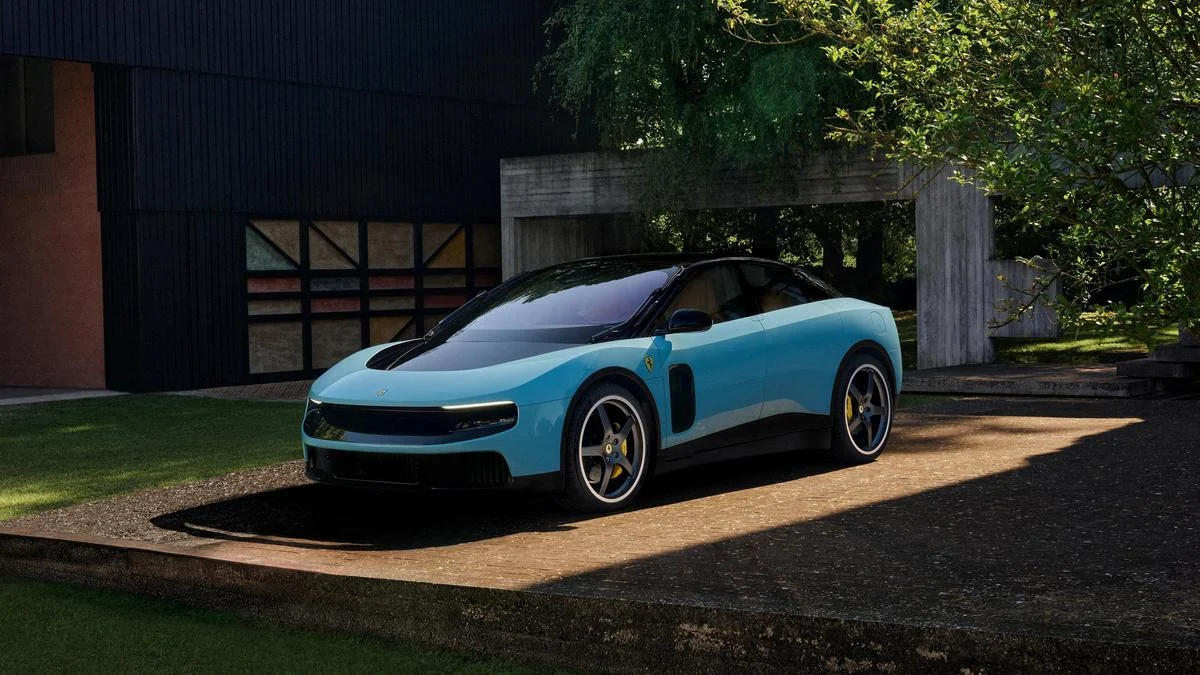
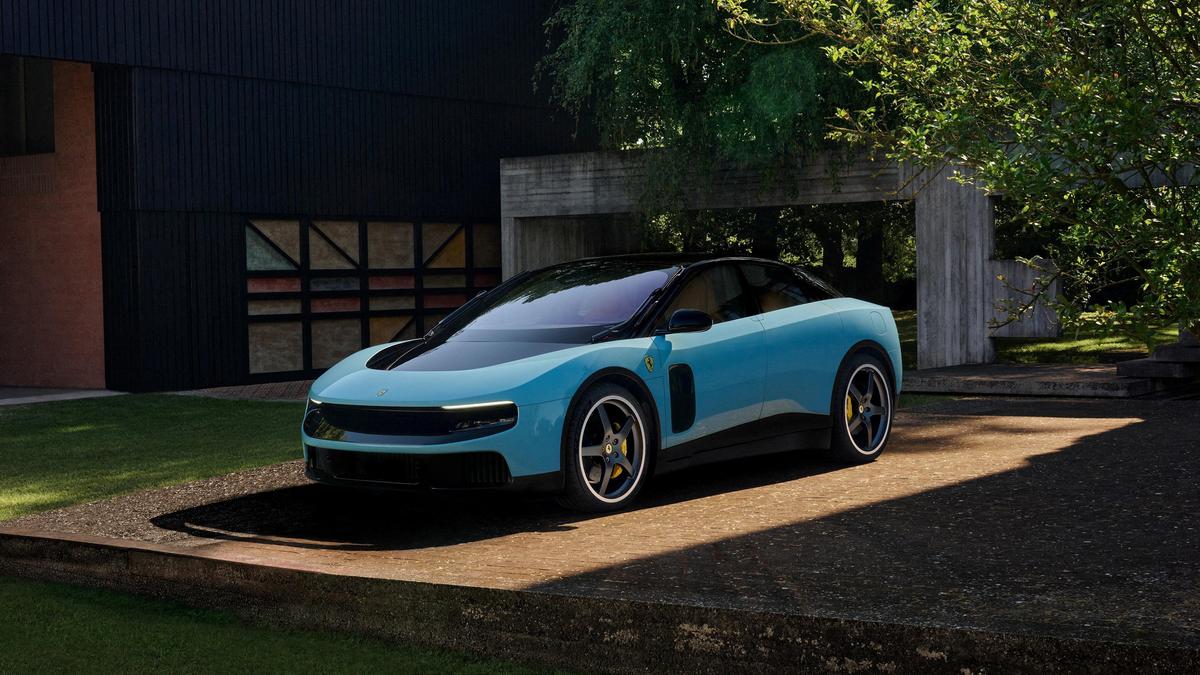
MARANELLO, ITALY — In a move that signals a definitive, if cautious, pivot for the world’s most storied automotive brand, Ferrari has officially pulled the silk off its first fully electric vehicle (EV). Named the Luce—Italian for "Light"—the model represents a watershed moment for the Prancing Horse, an emblem long synonymous with the visceral roar of internal combustion V12 engines.
The unveiling, held at the company’s headquarters in Maranello, marks Ferrari’s late but high-impact entry into the high-performance electric segment. As the automotive industry grapples with a cooling global demand for EVs and shifting regulatory landscapes, the Luce arrives as a statement of intent: a car designed to prove that the "soul" of a Ferrari can survive the transition from gasoline to electrons.
I. Main Facts: Defining the Luce
The Ferrari Luce is not merely a battery-powered version of an existing model; it is a ground-up reimagining of what a grand tourer can be in the 21st century.
Performance and Powertrain
The specifications released by Maranello place the Luce at the pinnacle of the current EV performance hierarchy. Powered by a massive 122 kWh battery pack, the Luce produces instantaneous torque that allows it to sprint from 0 to 100 kph (62 mph) in a staggering 2.5 seconds. This puts it in direct competition with the quickest hypercars on the planet.
Furthermore, Ferrari has addressed the primary concern of its "tifosi" (fans) and customers: range and speed. The Luce boasts a top speed exceeding 310 kilometres per hour (190 mph) and an estimated range of over 530 kilometres (329 miles) on a single charge. While these figures are impressive, they come at a physical cost. The Luce weighs in at 2.26 tonnes, making it the heaviest vehicle ever to wear the Ferrari badge—a byproduct of the heavy lithium-ion chemistry required to achieve such high performance.
A Departure in Design
Beyond its powertrain, the Luce breaks several Ferrari traditions. It is only the second four-door model in the company’s history (following the Purosangue) and the first-ever five-seater. By offering a more spacious, practical cabin, Ferrari is clearly targeting a broader demographic, moving into the "daily driver" luxury segment currently dominated by the Porsche Taycan and the Lucid Air.
II. Chronology: The Road to Maranello’s Electric Era
The journey to the Luce has been one of calculated hesitation and technical evolution. For decades, Enzo Ferrari’s philosophy was built around the engine; he famously said, "I sell engines. The rest of the car I give away for free."
- 2013 – The Hybrid Genesis: Ferrari introduced the LaFerrari, its first mild-hybrid hypercar. While it used an electric motor, its primary purpose was to "fill the gaps" in the V12’s torque curve, not to provide zero-emission driving.
- 2019 – The Plug-in Pivot: The launch of the SF90 Stradale marked Ferrari’s first Plug-in Hybrid Electric Vehicle (PHEV). It allowed for short bursts of electric-only driving, signaling that the company was getting serious about battery management.
- 2022 – The Purosangue and the "E-Building": Ferrari launched its first four-door vehicle and simultaneously broke ground on a dedicated "e-building" at its Maranello plant—a factory specifically designed to manufacture electric motors, battery packs, and power inverters.
- May 2026 – The Luce: After years of development and testing of "sound signatures" to replace the engine note, the Luce is officially unveiled as the brand’s first Battery Electric Vehicle (BEV).
III. Supporting Data: Market Positioning and Technical Analysis
To understand the Luce, one must look at the data surrounding its competitors and the technical hurdles Ferrari had to overcome.
The Weight-to-Power Struggle
At 2.26 tonnes, the Luce is approximately 500 kilograms heavier than the Ferrari Roma. To mitigate this, Ferrari has reportedly utilized advanced carbon-fiber composites in the chassis and a new proprietary "Side Slip Control" system designed specifically for the instant torque of electric motors.
| Feature | Ferrari Luce | Porsche Taycan Turbo GT | Tesla Model S Plaid |
|---|---|---|---|
| 0-100 kph | 2.5 Seconds | 2.3 Seconds | 2.1 Seconds |
| Top Speed | 310+ kph | 305 kph | 322 kph |
| Battery Size | 122 kWh | 97 kWh | 100 kWh |
| Weight | 2,260 kg | 2,290 kg | 2,167 kg |
The data shows that while Tesla and Porsche may edge out the Luce in pure acceleration, Ferrari has opted for a larger battery (122 kWh) to ensure sustained performance. Unlike many EVs that see power drop-off after repeated high-speed runs, the Luce’s cooling system is designed for "track-day endurance."
Adjusted Sales Forecasts
The launch of the Luce comes at a time of fiscal recalibration. In late 2023, Ferrari’s management was bullish, predicting that EVs would make up 40% of their lineup by 2030. However, the statement released alongside the Luce launch confirmed a revised target: 20% by 2030.
This 50% reduction in the EV sales target reflects a broader luxury market trend. High-net-worth individuals have shown a lingering preference for the "mechanical soul" of internal combustion engines, and Ferrari appears to be hedging its bets by maintaining a diverse portfolio of ICE, Hybrid, and EV options.
IV. Official Responses: Leadership’s Vision
The unveiling was accompanied by a rare public statement from John Elkann, President of Ferrari and scion of the Agnelli family. Elkann framed the Luce not as a departure from tradition, but as an evolution of it.
"With the Luce, we are inaugurating a chapter that turns our vision into reality, strengthening Ferrari’s tradition of anticipating and shaping the future," Elkann stated. "Our customers do not just buy a car; they buy an emotion. The Luce is proof that the thrill of a Ferrari is not tied to a specific fuel, but to the excellence of Italian engineering."
Company executives also addressed the "sound" issue—a point of contention for many purists. While the Luce is naturally silent, Ferrari engineers have developed an "authentic acoustic experience." Rather than playing a fake recording of a V12 through speakers, the Luce uses the natural frequencies of the electric motors and tires, amplified through the chassis, to provide tactile and auditory feedback to the driver.
Benedetto Vigna, Ferrari’s CEO, noted that the car was designed to be "the most aerodynamically efficient Ferrari ever built," utilizing active aero-flaps that adjust based on whether the driver is seeking maximum range or maximum downforce.
V. Implications: The Future of the Prancing Horse
The Luce arrives at a crossroads for the automotive industry. Its release carries significant implications for the brand’s identity, the luxury market, and the environment.
1. The Challenge of Brand Identity
For 80 years, Ferrari has been defined by the "scream" of its engines. By moving to electric, Ferrari risks "commoditizing" its driving experience. If a Tesla or a Lucid can match a Ferrari’s 0-100 kph time for a fraction of the price, Ferrari must rely on superior handling, brand prestige, and bespoke craftsmanship to justify its likely $500,000+ price tag. The Luce is a test of whether the "Ferrari Myth" can exist without the smell of gasoline.
2. The Five-Seater Strategy
By making the Luce a five-seater, Ferrari is acknowledging that the future of luxury is versatility. The success of the Purosangue SUV proved that there is a massive market for Ferraris that can be shared with family and friends. The Luce positions itself as the ultimate "Grand Tourer"—a car for a weekend trip from Milan to Monaco, capable of carrying luggage and passengers in total silence and absolute luxury.
3. Regulatory Navigation and E-Fuels
While the Luce is a nod to global electrification mandates, Ferrari is not abandoning the combustion engine. The company remains one of the strongest advocates for e-fuels (synthetic fuels). By introducing the Luce, Ferrari satisfies the ESG (Environmental, Social, and Governance) requirements of its institutional investors while simultaneously lobbying the EU to allow carbon-neutral combustion engines to remain on the road after 2035.
4. Supply Chain and the "E-Building"
The Luce is the first vehicle to benefit from Ferrari’s in-house battery assembly. By not outsourcing its battery tech to third-party suppliers, Ferrari maintains control over its performance characteristics and weight distribution. This vertical integration is a massive financial gamble, but it ensures that the "brain" of the car remains uniquely Italian.
Conclusion
The Ferrari Luce is a paradox on wheels: it is the "Light" (Luce) that weighs over two tonnes; it is a silent machine from a company built on noise; and it is a five-seater from a brand that conquered the world with two.
While the 20% sales target by 2030 suggests that Ferrari is not yet ready to leave the internal combustion engine behind, the Luce proves that Maranello is ready for the inevitable. It is a car designed to bridge the gap between the legendary past of Enzo Ferrari and a future where the thrill of the drive is powered by the grid. Whether the "tifosi" will embrace a silent Ferrari remains to be seen, but on paper, the Luce has all the markings of a masterpiece.
