

On Rattray Street, in the heart of Dunedin, New Zealand, a peculiar urban ritual unfolds daily. Drivers pull over, engines idling, as they emerge with empty plastic carboys and glass flagons. They gather at a modest public tap situated just outside the red-brick walls of a massive industrial complex. This is no ordinary utility; the tap pumps untreated, non-chlorinated, and non-fluoridated spring water directly from an aquifer deep beneath the city. While the water is free for the public, its primary purpose is the lifeblood of the institution next door: Speight’s Brewery.
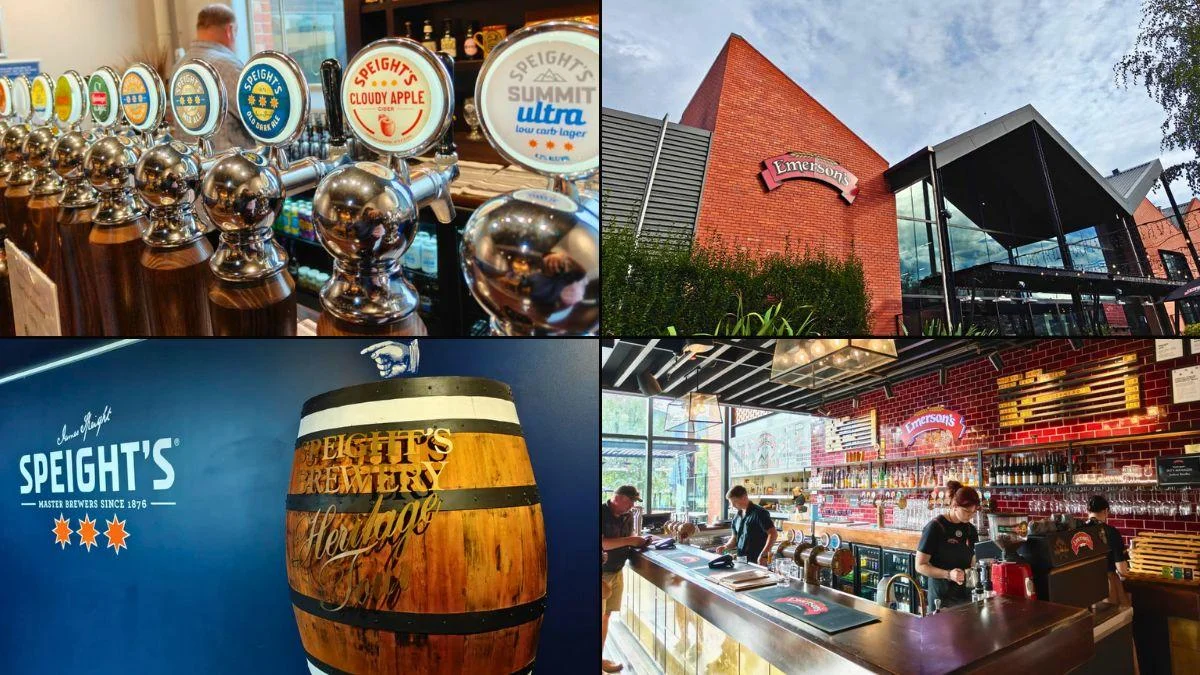
In Dunedin, beer is more than a beverage; it is a geological and cultural foundation. This "Edinburgh of the South"—a city defined by its steep hills, Scottish stone architecture, and the biting winds of the Otago coast—has cultivated a brewing identity that is both fiercely local and globally significant. At the center of this identity are two distinct entities: the 148-year-old Speight’s Brewery and its younger, more experimental sibling, Emerson’s Brewery. Together, they represent the past, present, and future of New Zealand’s liquid heritage.

Main Facts: The Tap, the Turf, and the Two Titans
Dunedin’s brewing scene is unique for its physical and social integration into the city’s fabric. The city, home to roughly 130,000 residents and the prestigious University of Otago, operates on a scale where history remains visible. The presence of the public spring water tap is a literal manifestation of this; it carries the act of brewing out of the factory and into the kitchens of the citizenry.
The local market is dominated by two philosophies. Speight’s represents the "Pride of the South"—a mass-market powerhouse with a legacy dating back to the Gold Rush era. Its Gold Medal Ale is a staple of New Zealand pubs, synonymous with a rugged, "Southern Man" archetype. Conversely, Emerson’s Brewery, founded in 1992, represents the craft revolution. It focuses on small-batch diversity, drawing on European traditions and New Zealand’s world-class hops to create complex flavor profiles.

Despite their different market positions, both breweries share a surprising commonality: they are owned by Lion, an Australasian beverage giant which is, in turn, a subsidiary of the Japanese conglomerate Kirin. This corporate structure creates a fascinating paradox—global capital sustaining hyper-local identities.
Chronology: From the Gold Rush to the Craft Revolution
To understand Dunedin’s beer culture, one must look back to the mid-19th century. Dunedin was transformed from a struggling settlement into New Zealand’s wealthiest city during the Otago Gold Rush. This era of "bracing recklessness" provided the perfect soil for James Speight, Charles Greenslade, and William Dawson.

In 1876, these three men—a salesman, a maltster, and a brewer—walked away from their jobs at the Well Park Brewery to start their own venture on Rattray Street. Their gamble was legendary; they brewed their first batch of beer before they had even secured a formal lease or a brewing license. By the 1890s, Speight’s had become the largest brewery in the country, even commissioning its own merchant ships to transport its product to the North Island. For over a century, Speight’s survived the temperance movements, two World Wars, and the consolidation of the global beer market, outliving every local competitor to become a regional monument.
The next major shift occurred in 1992. Richard Emerson, a local brewer who had discovered the rich, malty complexity of European beers while traveling in Scotland, returned to a New Zealand market dominated by pale lagers. Frustrated by the lack of variety, he began brewing in his kitchen, eventually moving to a makeshift setup using repurposed dairy equipment.

Emerson’s rise mirrored the global "craft" movement but remained deeply tethered to Dunedin. As the brewery scaled, it moved through various sites in the city, eventually landing in a state-of-the-art facility near the University. In 2012, Emerson’s was acquired by Lion, providing the capital needed for massive expansion while retaining Richard Emerson’s creative oversight.
Supporting Data: The Scale of Production and Market Dominance
The technical disparity between the two breweries highlights their different roles in the economy. Marty McPate, a representative at Speight’s, provides a window into the sheer scale of their operation.

"A day’s brew is 164,000 liters of product," McPate notes. "We brew 24/7 on three different shifts." This high-octane production schedule allows Speight’s to claim a staggering 75% market share against its primary competitors in the region. The brewery has evolved from its manual roots into a highly automated system capable of 6 to 8 brews in a 24-hour period. While Speight’s once focused solely on the South Island, it has since expanded into a national brand with a major production facility in Auckland to "dominate the country."
In contrast, Emerson’s operates at a different order of magnitude but with significant impact for a craft label. Ella Walker, a tour guide and tasting expert at Emerson’s, reports that the brewery produces approximately 2.7 million liters of beer annually. Their flagship Pilsner accounts for nearly half of that volume. While Speight’s focuses on consistency and volume, Emerson’s focuses on the interplay of ingredients. Walker highlights the use of New Zealand-grown hops, which provide distinctive citrus notes, compared to the tropical characteristics found in American varieties.

Official Responses: Voices from the Brew Floor
The representatives of these breweries view their relationship as a "healthy rivalry" tempered by corporate brotherhood.
For Marty McPate, Speight’s is an inextricable part of the New Zealand psyche. "If you mention Speight’s, everybody knows it," he says. He emphasizes that the brand’s success is built on more than just liquid; it is built on cultural associations. The "Southern Man" advertising campaign of the late 20th century cemented Speight’s as the drink of the stoic South Island outdoorsman. Furthermore, the brewery’s deep ties to rugby—sponsoring the Highlanders and the Otago Rugby Football Union—have made the beer the default post-match celebratory drink.

At Emerson’s, the focus is on the "backstory" of the beer. Ella Walker explains that their brews are often tributes to the local community. The "Bookbinder" is named after a local craftsman; "Bird Dog" takes its name from a song by the iconic Dunedin band The Verlaines. This cultural "layering" helps Emerson’s appeal to a different demographic—students, families, and craft enthusiasts who seek a narrative with their pint.
"We definitely do see [Speight’s] as competition at times," Walker admits, "but we sell different styles of beer. Speight’s is more mainstream and this is definitely more niche, but we are both sister breweries."

Implications: Global Localism and the Future of the Pint
The Dunedin brewing model offers a compelling case study in the future of the global beverage industry. The fact that both Speight’s and Emerson’s thrive under the same corporate umbrella (Lion/Kirin) suggests a shift in how multinational corporations approach local markets. Rather than homogenizing their portfolio, they are increasingly investing in "provenance"—the idea that a product’s value is tied to its specific place of origin.
However, this "global localism" comes with strict boundaries. Marty McPate reveals a key strategic constraint: Speight’s does not export. "We own a lot of other breweries in Australia, so we don’t want to be competing against 그 market," he explains. This ensures that while the brand remains a "national treasure" in New Zealand, it does not cannibalize the profits of its sister brands abroad.

For the city of Dunedin, the implications are largely positive. The breweries serve as major social hubs and tourism magnets. Emerson’s taproom, located near the Forsyth Barr Stadium, becomes a "social node" that can host hundreds of people on game days, effectively linking the city’s sports culture with its culinary scene. The presence of these institutions also ensures the preservation of Dunedin’s history; the Speight’s site on Rattray Street is a living museum of industrial heritage that continues to provide jobs and identity to the "Edinburgh of the South."
Ultimately, the story of Dunedin’s beer is a story of water and will. From the free spring water tap that serves the public to the automated vats that fuel a nation’s rugby fans, the city has managed to keep its brewing traditions alive in a rapidly changing world. Whether one reaches for a Gold Medal Ale or a London Porter, the result is the same: a taste of a city that refuses to let its history go dry.
