

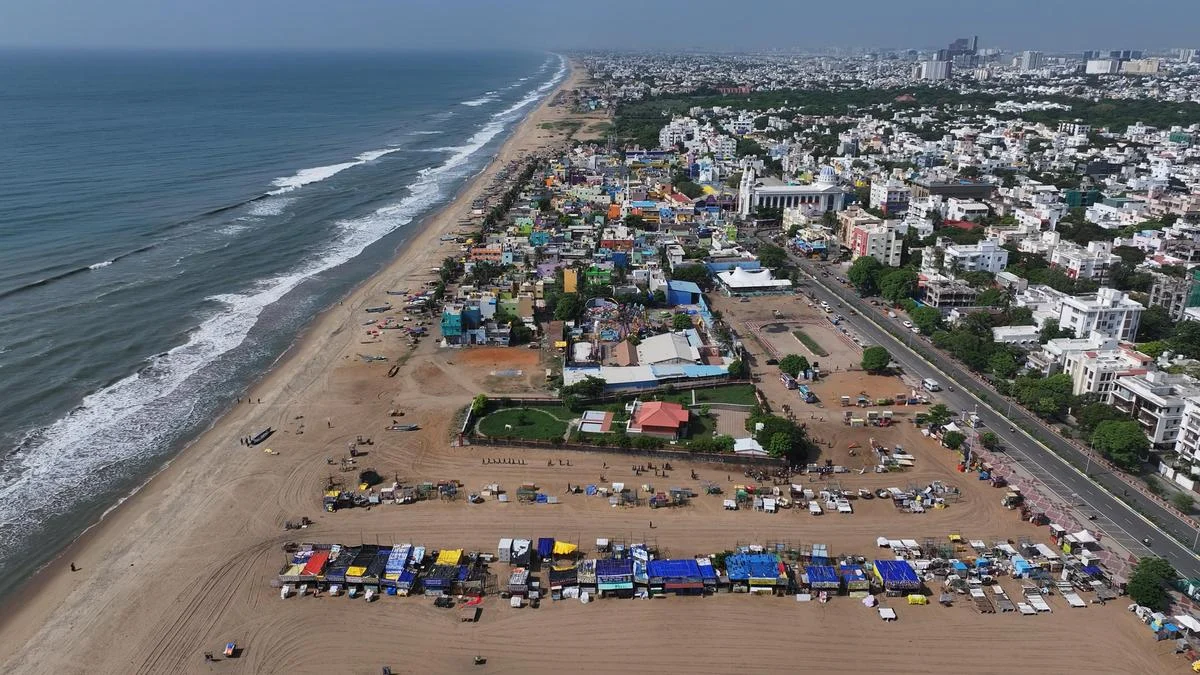
Chennai, India – The descent into Chennai often offers a striking visual: a ribbon of blue-grey meeting the sprawling urban landscape. From the sky, this coastline appears as an immutable boundary, a permanent demarcation between land and sea. Yet, this enduring image belies a dynamic history of profound transformation, shaped by centuries of human intervention, evolving urbanisation, and now, the looming specter of climate change. The very definition of Chennai’s coast has been a fluid entity, a testament to both its foundational role in the city’s genesis and its increasing vulnerability.
The Genesis of a Coastal Metropolis: From Fishing Villages to Colonial Hub
Long before Madras became a byword for colonial trade and administrative prowess, its coastline was a vibrant tapestry of fishing settlements. Nestled between the gentle flow of the Cooum and Adyar rivers, and in proximity to the ancient settlement of Mylapore, these communities were intrinsically linked to the rhythms of the sea. It was within this ancestral maritime domain that the English East India Company, in the 17th century, strategically established Madraspatnam. This nascent settlement, burgeoning around the imposing Fort St. George, would eventually blossom into the megacity known today as Chennai. The initial interactions between colonial ambitions and the existing coastal ecosystem laid the groundwork for a future where human development would irrevocably alter the natural contours of the land.
The early coastline, as envisioned from the perspective of a sailor arriving in Madras two centuries ago, would have been a vastly different tableau. The very landmark that defines Chennai’s waterfront today, the Marina, one of the world’s longest urban beaches, is not the naturally occurring expanse of sand it often appears to be. Its current form is a direct consequence of a monumental human undertaking: the construction of the Madras Harbour in the late 19th century. This ambitious engineering feat, designed to provide a safe haven for ships, represented one of the most significant alterations to Chennai’s coast, fundamentally disrupting the natural flow of sand and sediment.

The Harbour’s Ripple Effect: Shaping the Marina and Beyond
The construction of the artificial harbour acted as a colossal dam, effectively trapping sand on its southern side. This interruption in the natural littoral drift gradually led to the accretion of sand, sculpting the present-day Marina over the span of a century. What appears as a natural phenomenon is, in reality, a meticulously engineered consequence of human foresight, or perhaps, a calculated gamble with ecological processes.
However, the impact of the harbour was not uniform. While the southern flank witnessed a burgeoning beach, the situation to the north presented a starkly different reality. Karthik Gunasekaran, co-founder of Aram Thinai, an environmental organisation dedicated to coastal conservation, explains the asymmetrical impact. "The very breakwaters that trapped sand on one side of the harbour effectively starved the northern coast of its essential sediment supply," he elaborates. "This imbalance contributed significantly to coastal erosion along stretches of North Chennai, a problem that continues to plague these areas."
As Madras evolved into a burgeoning industrial and commercial powerhouse, further port infrastructure was erected along its coastline. The development of Kamarajar Port (formerly Ennore Port) and subsequently Kattupalli Port further north, each accompanied by additional breakwaters and structures, only exacerbated the alterations to an already modified shoreline. These interventions, while facilitating trade and economic growth, have incrementally reshaped the natural dynamics of the coast, setting in motion a chain of ecological consequences.

A Glimpse into the Past: The Marina as a Democratic Commons
To truly appreciate the extent of this transformation, one must turn to historical accounts that paint a vivid picture of a bygone era. Naturalist M. Krishnan, writing in The Hindu on January 25, 1959, described a Marina that was a far cry from its present-day avatar. His evocative prose conjures an image of a vast, open landscape teeming with life and activity. Fishermen meticulously mended and dried their nets, their livelihoods inextricably linked to the sea. Young boys, with an explorer’s spirit, hunted for crabs amidst the tide pools, while elderly men, with quiet patience, cast their lines with primitive tackle. Herdsmen, in a timeless ritual, guided their buffaloes to the sea for their daily ablutions.
Traditional vessels, the iconic catamarans and sturdy masula boats, lay resting on the sand, their presence a testament to the enduring maritime heritage of the region. The waterline was a natural conveyor belt of life’s detritus – shells, the skeletal remains of crabs, and other organic debris washed ashore, each piece a narrative from the deep. For Krishnan, the Marina was more than just a beach; it was a vibrant, democratic public space. Judges, lawyers, clerks, employers, and children alike shared this expansive stretch of sand, their differences dissolving on the common ground of the shore. It was a space where the city met the sea in an unfiltered, communal embrace.
Urbanisation’s Inroads: Alienation and Shifting Perceptions
However, the relentless march of urbanisation has fundamentally altered the way the coast is perceived and utilised. The expansion of the city has, in many instances, alienated the very communities whose ancestral ties to the shore predate the metropolis itself. "Earlier, there were at least ten fishing hamlets dotted along the Marina," observes Mr. Gunasekaran. "Today, only three remain. The very definition of what constitutes a ‘clean’ or ‘good’ beach has shifted, often prioritising aesthetic appeal over the ecological and cultural significance of these spaces." This shift in perception has led to the marginalisation of traditional users, their spaces encroached upon by development and their voices often drowned out by the cacophony of urban progress.

The changes were not confined to the bustling Marina. Historian S. Muthiah, reminiscing in The Hindu on August 21, 2002, recalled a childhood Marina that stretched uninterrupted from the mouth of the Cooum to the Adyar estuary. He vividly remembered the southern end of the beach as a place of such profound solitude that, as an eight-year-old, he could spend an entire evening playing on the sand, even being buried in a pit by friends, without any fear of adult intervention. This image of an untamed, expansive shoreline stands in stark contrast to the highly managed and developed coastal frontages of today.
The Southern Fringe: Development’s Double-Edged Sword
South of the city, the sandy stretches from Valmiki Nagar to Uthandi remained relatively pristine until the turn of the millennium. However, in the last two decades, the region has witnessed a surge in residential development and a proliferation of encroachments. T.D. Babu of the environmental organisation Nizhal highlights the precarious state of these once-pristine beaches. "We are at risk of losing what little we have left if these trends continue," he warns. "Anthropogenic activities, those driven by human interference, must be moved away from the beach. The entire stretch of the East Coast Road (ECR) is heavily encroached, and the proliferation of hard structures has undeniably led to increased erosion."
The dynamic interplay of development, recreation, and traditional fishing activities continues to shape the beaches from Besant Nagar to Neelankarai and beyond. As the physical shoreline undergoes continuous alteration, so too do the ways in which people interact with and experience this vital interface between land and sea. The once-communal spaces are increasingly segmented by private property, commercial establishments, and the infrastructure of modern living.

The Unseen Threat: Climate Change and the Future of Chennai’s Coast
Adding a formidable new layer to Chennai’s already complex coastal narrative is the escalating threat of climate change. The sea, once a source of sustenance and a backdrop to urban life, is now a potent symbol of potential peril. Rising sea levels, amplified by global warming, pose a direct threat to coastal communities and infrastructure. More intense and frequent storms, a predicted consequence of a changing climate, further exacerbate erosion and increase the risk of storm surges inundation.
Compounding these natural threats is the continued pace of coastal development. The relentless construction of buildings, roads, and other infrastructure in close proximity to the shoreline makes the city more vulnerable to the impacts of rising seas and extreme weather events. The very human interventions that have shaped the coast over centuries are now, in the face of climate change, increasing its fragility.
The question that looms large is whether Chennai, like many coastal cities globally, is on the precipice of a stark realisation. Will the value and significance of its coastline only become truly apparent when it is irrevocably diminished, when, as the adage warns, "the well runs dry"? The current trajectory suggests a pressing need for a paradigm shift in how Chennai views and manages its coastal resources. Moving forward, a holistic approach that integrates ecological preservation, sustainable development, and robust climate adaptation strategies will be paramount to safeguarding the future of this historic and dynamic coastline. The enduring allure of Chennai’s shorelines must be balanced with a clear-eyed understanding of their vulnerability and a proactive commitment to their protection.
