

Together, these twin establishments represent the latest evolution in Kolkata’s burgeoning fine-dining scene—a dual-concept venture that refuses to let its identities bleed into one another.
Main Facts: A Tale of Two Philosophies
The dual opening of Tua and Synthe is the brainchild of a trio of entrepreneurs: Aman Bansal, Umaid Ahmed, and Tabrez Nadeem. While many hospitality ventures are born in boardrooms, this partnership was forged over late-night karaoke sessions in the very space they now occupy.

"We joked that in another universe we should work together," recalls Aman Bansal. "One conversation led to another, and here we are."
The result is a fascinating study in contrast:
- Tua: A 3,000-square-foot, 75-seater restaurant focused on "Modern Asian" and European cuisine, built around a philosophy of feminine comfort and the revival of "dine and dance" culture.
- Synthe: An intimate, futuristic bar and omakase-style kitchen that seats only 32 guests, featuring a cocktail program based on a speculative timeline from the year 2030 to 2130.
Despite sharing a wall, the two venues operate with independent kitchens, distinct bar programs, and entirely different service rhythms.

Chronology: From Karaoke to Concept
The timeline of the Altitude Building’s transformation began in the early months of 2024, as the founders sought to fill a perceived gap in Kolkata’s nightlife—a lack of spaces that offered high-concept mixology without sacrificing the intimacy of a traditional dinner.
- May 27, 2024: Synthe officially began operations. Positioned as the more avant-garde of the two, it was launched first to establish the duo’s credentials in experimental mixology.
- June 24, 2024: Tua opened its doors. Its launch was timed to coincide with the onset of the monsoon season, providing a warm, indoor "retro-contemporary" escape for the city’s diners.
The development process involved months of R&D. Every cocktail at Synthe, for instance, underwent a three-month trial period to ensure that the "philosophy" of the drink—such as the concept of "scarcity" or "unlearning"—was reflected in its chemical composition and presentation.
Tua: The Architecture of Intimacy and "Dance and Dine"
The name "Tua" is derived from the Latin word for "yours." According to the founders, the space was imagined as an "unapologetically feminine" environment. However, Aman Bansal is quick to clarify that this does not translate to cliché aesthetics.

"It’s not about pink interiors," Bansal explains. "It’s about the emotional architecture. We wanted to create a space where women, who have shaped who we are, feel comfortable and relaxed."
The Sensory Experience
The interior of Tua is a masterclass in soft-focus hospitality. Warm red palettes, hushed yellow lighting, and recurring rose motifs create a cocoon-like atmosphere. A unique touch is the "embroidered dialogue" on the table napkins; every guest receives a different message, such as "Drinks Before Decisions," adding a layer of personalized whimsy to the start of the meal.
Culinary Direction: Beyond the "Usual Suspects"
Under the guidance of consultant chef Vaibhav Bhargav and sous chef Shobuj Sheikh, Tua’s kitchen eschews the "Chilli Chicken" staples of typical Indo-Chinese menus. Instead, it focuses on Modern Asian, West Asian, and European influences.

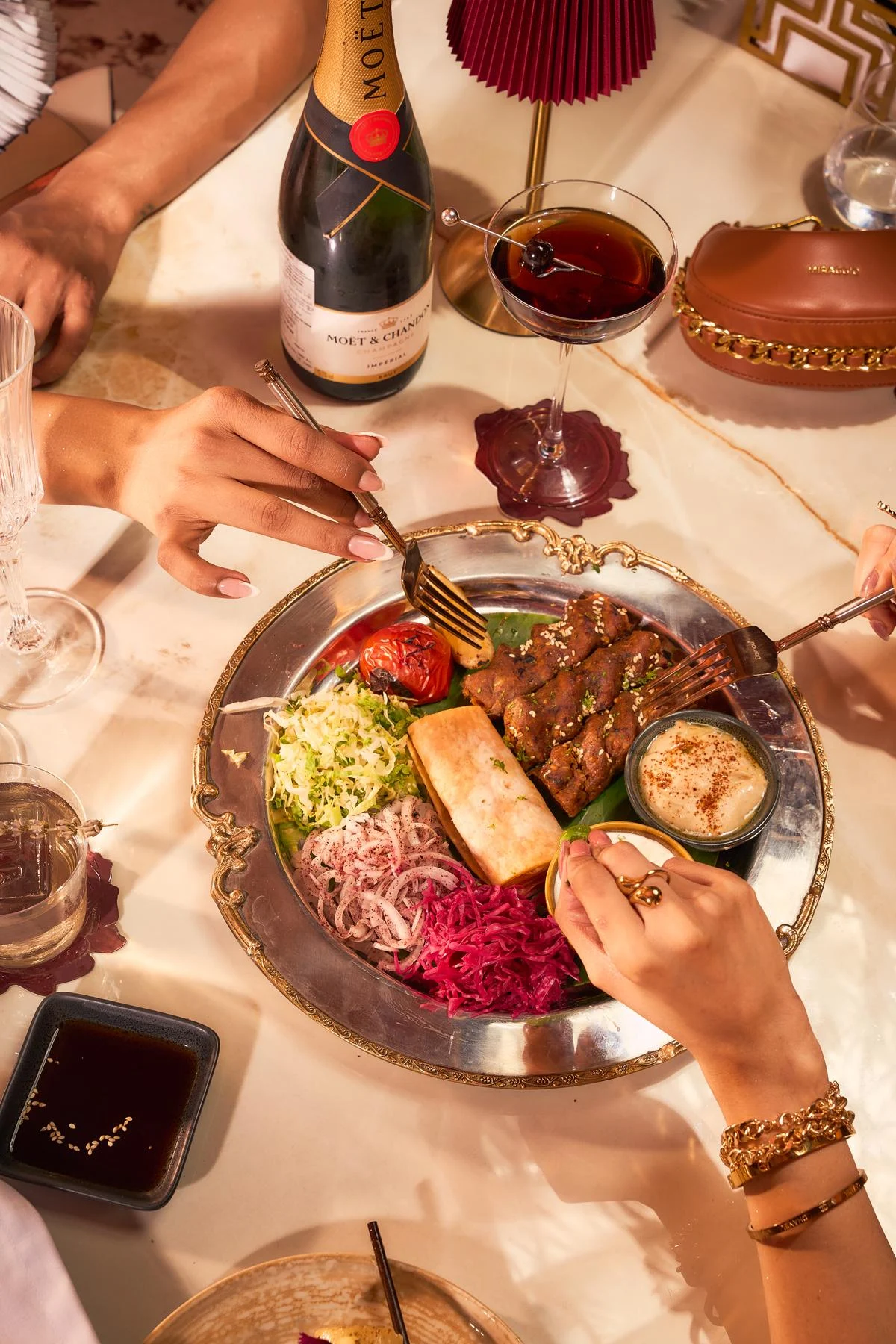
A standout is the Turkish Kebab Platter. Prepared at a robatayaki counter, the dish features smoky, tender meat served with warm flatbread, house-made tzatziki, and Turkish chilies that provide a buttery depth rather than sharp heat. Another highlight is the Prawn Har Gow, which is served in a rich Dan Dan sauce—a clever subversion of traditional dim sum that adds a spicy, nutty complexity to the sweetness of the shellfish.
The Mixology Arc
The bar at Tua, managed by Akash James Mondal, follows the "emotional progression of a night." The drinks are designed to be "easy-going," with a zero-waste policy that utilizes kitchen byproducts for infusions like banana oleo and plum liqueur. A technical highlight is the use of Yukina ice, a high-density ice that chills the drink without rapid dilution, ensuring the cocktail remains balanced from the first sip to the last.
Synthe: A Century of Flavors (2030–2130)
Crossing the threshold into Synthe feels like a leap forward in time. The name is inspired by electronic pioneers Daft Punk and their track "Giorgio by Moroder," which describes the synthesizer as the "instrument of the future."

The space is dominated by neon accents and a Japanese omakase-style setup. Mixologist Abhishek Das, known for his mismatched black-and-white spectacles, leads a program that is as much about storytelling as it is about spirits.
The Speculative Timeline
Synthe’s cocktail menu is structured as a chronological journey:
- Reclamation (2030): A vodka-based drink using fresh greens (cucumber, mint, shiso) to represent a return to health-conscious living.
- Restrain (2060): A minimalist Old Fashioned made with Johnnie Walker Black Label and chamomile, symbolizing a future defined by resource scarcity.
- Unlearn (The Mid-Century): A cocktail that challenges the palate with a blend of tomato juice, strawberry, and vinegar, featuring a cherry tomato frozen inside a clear ice block.
- Nostalgia: A Rum Old Fashioned designed to evoke memories of school and college, acknowledging that even in a high-tech future, humans remain tethered to the past.
Small Plates, Big Impact
The food at Synthe is calibrated to support the drinks. The 22-dish menu includes the Blackout Futomaki (charcoal asparagus tempura) and the Tropical Fire Bird, which uses a mango habanero glaze to balance heat with fruitiness. The Charred Grilled Prawns with yuzu chili butter offer a delicate, citrusy finish that complements the bar’s more complex, layered cocktails.

Official Responses: The Founders’ Vision
The founders view Tua and Synthe not just as businesses, but as a response to the "forgetful" nature of modern nightlife.
"The city has forgotten how to dance," says co-founder Tabrez Nadeem. "Our idea at Tua is simple: dine first, dance later. Good food should naturally put you in the mood to celebrate."
Regarding the intellectual rigor of Synthe, Aman Bansal notes that the narrative-driven menu, curated by beverage consultant Ankur Chawla, was designed to engage the "curious drinker."

"We spent three months perfecting each drink. It sounds whimsical until the drink arrives and you realize the science behind it," Bansal says.
Supporting Data and Logistics
- Location: 2nd Floor, Altitude Building, Lee Road, Kolkata.
- Capacity: Tua (75 seats, 3,000 sq. ft.); Synthe (32 seats).
- Staffing: Two independent kitchen and bar teams to maintain distinct flavor profiles.
- Average Cost for Two: Approximately ₹4,000 (including alcohol).
- Key Personnel:
- Consultant Chef: Vaibhav Bhargav
- Beverage Consultant: Ankur Chawla
- Bar Managers: Akash James Mondal (Tua) & Abhishek Das (Synthe).
Implications: The Future of Kolkata’s F&B Scene
The opening of Tua and Synthe signals a shift in the Indian hospitality market toward "hyper-niche" experiences. By housing two vastly different concepts under one roof, the founders are hedging against the "one-size-fits-all" fatigue that often plagues large-scale restaurants.
Furthermore, the focus on "Modern Asian" without the usual suspects (like Chilli Paneer) suggests a growing culinary literacy among Kolkata’s diners. The success of Synthe’s speculative menu also indicates a market for "intellectual drinking"—where the story behind the glass is as important as the liquid inside it.

As Kolkata continues to modernize its urban landscape, the Altitude Building stands as a microcosm of the city’s duality: one foot firmly planted in the warm, nostalgic traditions of hospitality, and the other stepping boldly into a neon-lit, speculative future. Whether one chooses the roses of Tua or the neons of Synthe, the underlying message is clear—hospitality in 2024 is no longer just about service; it is about world-building.
