

DEHRADUN — For decades, the Doon Valley was defined by its "retirement town" charm—a serene basin cradled between the Himalayas and the Shivaliks, characterized by its elite boarding schools and temperate climate. However, as of late 2024, that image is being rapidly overwritten by the roar of earthmovers and the precision of high-speed civil engineering.
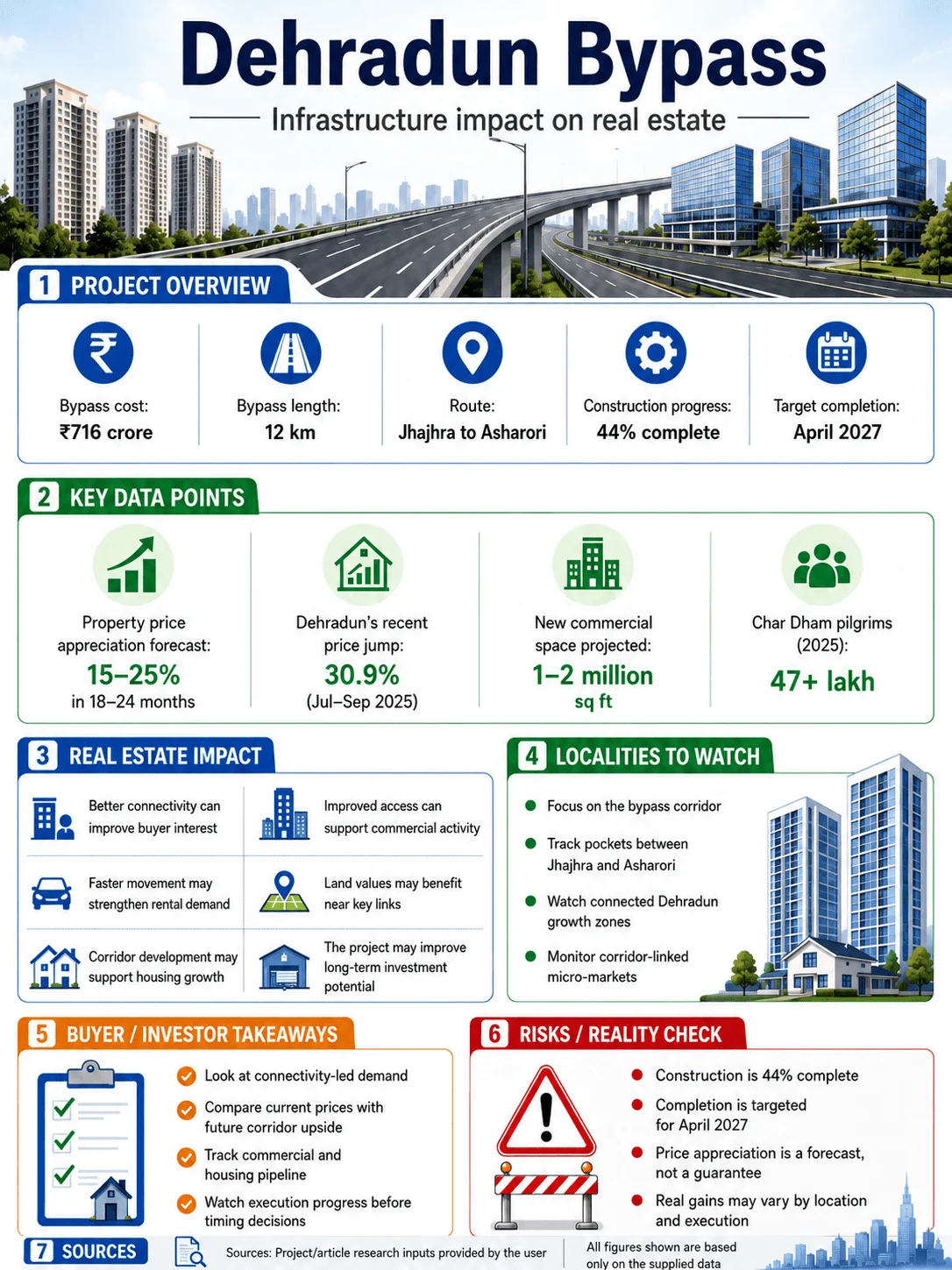
A transformative "double-header" of infrastructure projects—the Rs 12,000 crore Delhi-Dehradun Economic Corridor and the newly advancing Rs 716 crore Dehradun Bypass—is fundamentally altering the region’s economic DNA. Together, these projects represent a capital infusion exceeding Rs 12,700 crore, aimed at turning a chronic traffic bottleneck into a streamlined northern gateway. For real estate stakeholders, from institutional investors to first-time homebuyers, the implications are profound, marking a shift from local speculation to strategic regional planning.
I. The Main Facts: A Tale of Two Corridors
The current transformation rests on two distinct but interconnected pillars of engineering.
1. The Delhi-Dehradun Economic Corridor
At the heart of the region’s connectivity revolution is the 213-km, six-lane, access-controlled expressway. Built at an estimated cost of over Rs 12,000 crore, this corridor has achieved what was once thought impossible: compressing the travel time between the national capital and the Uttarakhand state capital from a grueling six or seven hours to a mere 2.5 hours. This expressway isn’t just a road; it is a "time-compression machine" that brings Dehradun into the orbit of the National Capital Region (NCR) as a viable satellite hub for both commerce and high-end residential living.
2. The Rs 716 Crore Dehradun Bypass
While the expressway brings people to the city, the newly under-construction bypass determines where they go once they arrive. This 12-km, four-lane, access-controlled stretch runs from Jhajhra to the Asharori check post.
Functioning as a critical "relief valve," the bypass ties into the Delhi-Dehradun Economic Corridor and the Paonta Sahib-Ballupur stretch of NH-7. Its primary objective is to divert heavy transit traffic—specifically vehicles heading toward Himachal Pradesh, Punjab, and Haryana—away from the city’s congested urban core.
II. Chronology: From Colonial Outpost to Overburdened Capital
To understand why these projects are moving property prices today, one must look at the timeline of Dehradun’s rapid urbanization.
- The Pre-2000 Era: Dehradun served as a quiet administrative and educational hub. Its infrastructure was designed for a population of a few hundred thousand.
- 2000–2011: Following the formation of Uttarakhand, Dehradun became the interim capital. The 2011 Census recorded a population of roughly 7 lakh. Infrastructure began to show signs of strain as the city transitioned into a political and defense powerhouse.
- 2011–2024: The population surged past the 10-lakh mark. The city became the primary transit point for the Char Dham Yatra. In 2025 alone, the circuit drew over 47 lakh pilgrims, the majority of whom funneled through Dehradun’s narrow arteries.
- 2023–2024: The Delhi-Dehradun Expressway enters advanced stages of completion, causing an initial spike in land queries. Work begins in earnest on the Rs 716 crore bypass.
- August 2026 (Current Status): The bypass project reaches approximately 44% physical progress. Real estate markets in peripheral nodes like Jhajhra begin to see a shift in land-use patterns from agricultural to semi-industrial and residential.
- April 2027 (Projected): The scheduled completion date for the bypass, marking the full integration of the south-western corridor.
III. Supporting Data: The Economics of the Bypass
The impact of these projects is best reflected in the shifting price bands and demographic pressures.
Real Estate Valuation Trends
According to data from Square Yards, the residential market is already reacting to the anticipated ease of movement. On Sahastradhara Road, a primary residential artery, flats are currently trading in the Rs 2,500–3,500 per sq. ft. band. Analysts suggest that as the bypass nears its 2027 completion, these rates are likely to see upward pressure, not because of the road itself, but because the bypass will remove the "through-traffic" that currently chokes these residential neighborhoods.
The "Triple-Connectivity" Premium
The most significant data point for investors is the emergence of "Triple-Connectivity Zones." Areas like Jhajhra and the Asharori-Ballupur belt now sit at the intersection of:
- A National Highway (NH-7).
- A 213-km Economic Corridor.
- A controlled-access local bypass.
Historically, in Indian tier-II cities, such intersections have seen land value appreciation of 15–25% higher than the city average in the three years following project completion.
Tourism and Transit Loads
The urgency of the bypass is underscored by the 2025 pilgrimage figures. With 4.7 million pilgrims and millions more heading to Mussoorie and Rishikesh, the city’s internal roads were effectively functioning as national highways. The bypass is designed to siphon off approximately 30-40% of this non-city-bound traffic.
IV. Official Responses and Strategic Vision
The National Highway Authority of India (NHAI) and state urban planners view the bypass as more than just a road; they see it as a "reallocation machine."
NHAI’s Stated Objectives:
Official project documents emphasize three core goals:
- Decongestion: Removing heavy multi-axle vehicles from the city core.
- Environmental Impact: Reducing vehicular idling time and pollution within the valley’s sensitive ecosystem.
- Inter-State Integration: Strengthening the logistical link between Uttarakhand and the industrial belts of Haryana and Himachal Pradesh.
Experts in urban planning note that a bypass does something a standard highway upgrade cannot: it rebalances value. By relieving the congested core, it makes the "Old City" more livable (and thus more valuable for high-end residential use) while simultaneously creating new economic nodes at its termini for logistics and warehousing.
V. Implications: The Micro-Market Deep Dive
The ripple effects of the Rs 716 crore investment are creating distinct opportunities and risks across different segments of the market.
1. For the End-Use Homebuyer
For those looking to live in Dehradun, the bypass offers a "livability dividend." Currently, residents in areas like Premnagar and Chakrata Road suffer from a chaotic mix of residential traffic and heavy interstate trucks. Once the bypass is operational, these neighborhoods are expected to see a reduction in noise pollution and an improvement in local air quality. The "calculus" for the homebuyer is shifting from "how close am I to the center?" to "how easily can I bypass the center?"
2. For the Investor and Developer
The "play" here is at the termini. Jhajhra, once considered the outskirts, is emerging as a textbook candidate for institutional land banking. Developers are closely watching the Asharori-Doiwala belt. With direct expressway access to Delhi and bypass access to the rest of the state, this corridor is being positioned as a logistics and light-industrial hub.
However, the rental market remains in a "wait-and-see" mode. Rental yields typically do not spike until infrastructure is 80-90% complete. With the bypass at 44% progress, savvy investors are focusing on land acquisition rather than immediate rental income.
3. The Logistics Frontier
The bypass effectively creates a "South-Western Corridor" that bypasses the city entirely. This makes the region between Asharori and the Paonta Sahib road ideal for warehousing. As e-commerce expands into the hill states, this "plug-and-play" connectivity to the Delhi-Dehradun Expressway will be a primary driver of commercial land rates.
VI. The Cautionary Note: Risks and Constraints
Despite the bullish outlook, the "Doon Metamorphosis" faces significant headwinds.
Construction Disruption:
With an April 2027 deadline, the region faces at least two more years of "construction-phase disruption." Potential buyers must weigh the long-term benefits against the immediate reality of dust, diversions, and localized traffic snarls.
The Infrastructure Gap:
A bypass is only as effective as its feeder roads. There is a risk that while the bypass moves traffic around the city, the "last-mile" connectivity into residential colonies remains antiquated. Furthermore, Dehradun’s unique geography—limited flat land and sensitive drainage systems—means that a surge in demand could overwhelm civic services like water and waste management.
Speculative Bubbles:
As with any major infrastructure announcement, there is the risk of "information-led inflation." Land rates in Jhajhra and Asharori have already seen speculative hikes. Analysts warn that not every parcel of land near the alignment will see a commercial windfall; success will depend on specific access points and zoning regulations.
VII. Conclusion: A Test of Urban Evolution
The Rs 716 crore bypass and the Rs 12,000 crore expressway represent a turning point for Dehradun. The city is no longer just a destination; it is a node in a high-speed national network.
In real estate terms, the bypass is a signal that the city’s growth is moving outward. It offers a rare window of opportunity for the state to match this "hard infrastructure" (roads) with "soft infrastructure" (water, drainage, and parks).
By 2027, the road will be finished. Whether Dehradun becomes a model of modern, connected urban living or simply a more accessible version of its currently congested self depends on how the city utilizes this window. For now, the "Doon Valley" is no longer just a place to retire—it is a place where the future of North Indian commerce and connectivity is being paved, one kilometer at a time.
