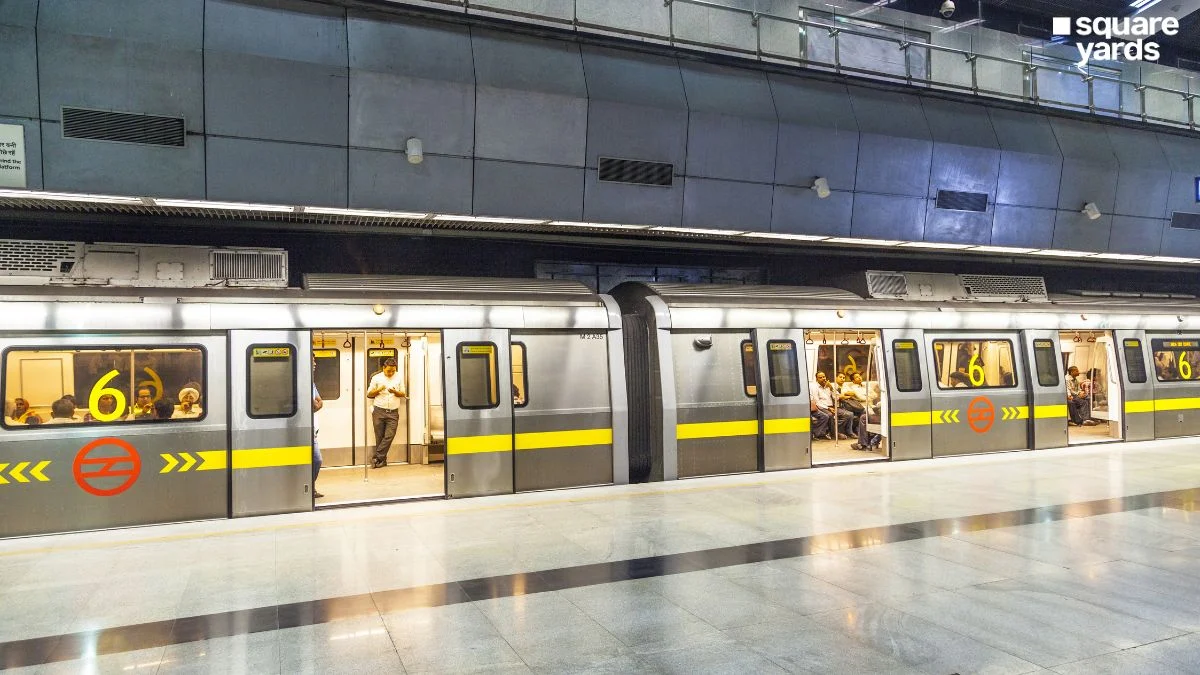
Introduction: The Pulse of an Aspirant’s Paradise
Every morning, as the sun rises over the narrow lanes of North Delhi, a specific rhythm takes over Mukherjee Nagar. It is a rhythm dictated by the rustle of newspapers, the aroma of cutting chai, and the steady hum of thousands of students making their way to coaching centers. Known globally as the "Coaching District" of India, Mukherjee Nagar is more than just a residential neighborhood; it is a dream factory for Union Public Service Commission (UPSC) aspirants and competitive exam candidates from every corner of the country.
Central to this ecosystem is the seamless movement of people. While Mukherjee Nagar does not house a metro station within its immediate boundaries, it is anchored by a sophisticated network of stations on the Delhi Metro’s Yellow Line. This connectivity is the silent engine driving the area’s academic success and its burgeoning real estate market. In this detailed exploration, we analyze the transit infrastructure, the socio-economic impact of the Delhi Metro on the region, and why this pocket of North Delhi remains a goldmine for property investors.
1. Main Facts: The Connectivity Blueprint
Mukherjee Nagar’s strategic location in North Delhi places it at the heart of a transport web. The neighborhood is bordered by the University of Delhi’s North Campus, GTB Nagar, and the historic Civil Lines. Despite the absence of a "Mukherjee Nagar Metro Station" on the map, the locality is served by four major transit nodes, all situated on the Yellow Line—the metro’s most critical corridor connecting North Delhi to the heart of the city and the corporate hubs of Gurugram.
The Primary Gateways
The transit experience for a visitor or a resident is defined by four key stations:
- GTB Nagar: The primary lifeline, located less than 1.5 km away.
- Vishwavidyalaya: The student hub, serving the dual purpose of University access and coaching connectivity.
- Vidhan Sabha: A strategic alternative for those coming from Central or South Delhi.
- Adarsh Nagar: The northern gateway for commuters from North-West Delhi and Rohini.
This multi-station accessibility ensures that the "commuter flux"—the daily movement of over 50,000 students and professionals—remains manageable even during peak hours.
2. Chronology: From Residential Suburb to Education Hub
The transformation of Mukherjee Nagar is inextricably linked to the expansion of the Delhi Metro.
- Pre-2004: Before the Yellow Line reached North Delhi, Mukherjee Nagar was a quiet residential colony primarily inhabited by post-partition migrants and government employees. Commuting to Central Delhi was a time-consuming affair involving erratic bus services.
- The Metro Revolution (2004-2010): The inauguration of the Vishwavidyalaya and GTB Nagar stations changed the landscape. Suddenly, Mukherjee Nagar was only 20 minutes away from Connaught Place. This sparked the "Coaching Boom."
- 2010-Present: As the Yellow Line extended to Huda City Centre (now Millennium City Centre), the area became accessible to students from South Delhi and Gurgaon. The "Mukherjee Nagar Model" of education—high-density coaching centers supported by high-density transit—became the standard for the city.
3. Supporting Data: Navigating the Metro Ecosystem
To understand the efficiency of this network, one must look at the specific logistics of each station serving the area.
Table 1: Metro Stations Near Mukherjee Nagar – Quick Overview
| Metro Station | Metro Line | Distance to Mukherjee Nagar | Est. Travel Time | Mode of Transport |
|---|---|---|---|---|
| GTB Nagar | Yellow Line | 1.0 – 1.5 km | 5 – 10 mins | Auto, E-rickshaw, Walk |
| Vishwavidyalaya | Yellow Line | 3.0 – 3.4 km | 8 – 12 mins | Auto, E-rickshaw |
| Vidhan Sabha | Yellow Line | 4.5 – 5.0 km | 10 – 13 mins | Auto, Cab |
| Adarsh Nagar | Yellow Line | 5.8 – 6.0 km | 15 – 20 mins | Auto, Cab |
Detailed Analysis of Key Transit Points
GTB Nagar: The Universal Entry Point
For the vast majority, GTB Nagar is the "de facto" Mukherjee Nagar station. Exit Gate No. 2 is a hive of activity, where a disciplined line of e-rickshaws waits to ferry passengers to Batra Cinema, the landmark heart of the coaching district. The proximity allows many students to save on transport costs by walking, a common sight during the pleasant winter months.
Vidhan Sabha: The Strategic Alternative
While GTB Nagar can become congested, Vidhan Sabha offers a more relaxed transit experience. It is particularly favored by faculty members and senior professionals who prefer app-based cabs. The route via Mall Road is scenic and bypasses the narrow, student-heavy lanes of Hudson Lane.
Adarsh Nagar: The North-West Link
For aspirants living in Rohini, Pitampura, or Jahangirpuri, Adarsh Nagar serves as a vital link. It eliminates the need for multiple interchanges, allowing students from the outer reaches of Delhi to access world-class coaching without the fatigue of long-distance travel.
4. The Last-Mile Economy: Beyond the Turnstiles
A journalistic look at Mukherjee Nagar would be incomplete without discussing the "Last-Mile Economy." The stretch between the metro stations and the classrooms is governed by a micro-economy of para-transit services.
Table 2: Last-Mile Connectivity Cost Matrix
| Transport Mode | Approx. Fare | Ideal For |
|---|---|---|
| E-Rickshaw (Shared) | ₹20 – ₹30 | Daily student commute; budget-friendly. |
| Auto-Rickshaw | ₹50 – ₹100 | Passengers with luggage or groups of three. |
| Gramin Sewa | ₹10 – ₹20 | High-capacity, fixed-route budget travel. |
| App-based Cabs | ₹80 – ₹150 | Families, rainy weather, or late-night travel. |
The proliferation of e-rickshaws has been a game-changer. They are eco-friendly, frequent, and cater specifically to the student budget, ensuring that the distance from the metro never becomes a barrier to education.
5. Economic Implications: Real Estate and Investment Outlook
The "Metro Effect" on Mukherjee Nagar’s real estate is a case study in urban economics. Proximity to the Yellow Line has created a recession-proof rental market.
The Rental Engine
Mukherjee Nagar is unique because its rental demand is not tied to corporate cycles but to the academic calendar. Every June and July, thousands of new students arrive.
- Student Housing: PGs (Paying Guest accommodations) and shared 1BHK/2BHK flats are the most lucrative investments.
- Yields: Rental yields in Mukherjee Nagar often outperform the Delhi average, with investors seeing consistent 3-4% annual returns on residential property, supplemented by high occupancy rates.
Property Valuation Trends
Currently, property rates in Mukherjee Nagar hover around ₹11,750 per sq. ft. While this is higher than surrounding areas like Sant Nagar or Burari, it offers a significant "entry-point advantage" compared to the premium prices of Model Town or Civil Lines.
Why Invest in 2026?
Looking toward 2026, several factors make Mukherjee Nagar an attractive proposition:
- Infrastructure Upgrades: Plans for road widening and improved drainage systems in North Delhi are expected to boost property values.
- Commercial Vitality: The area is seeing a shift from pure residential to mixed-use development, with bookstores, cafes, and libraries commanding high commercial rents.
- Connectivity Synergy: The synergy between the Yellow Line and the upcoming Phase 4 expansion of the Delhi Metro will further reduce travel times from distant suburbs, expanding the "catchment area" for students.
6. Official Context: The Role of Social Infrastructure
Mukherjee Nagar’s success is not just about tracks and trains; it is about the social infrastructure that supports the transit. The area falls under the PIN Code 110009, a zone that has seen increased municipal attention due to its status as an educational hub.
Local authorities and the Delhi Metro Rail Corporation (DMRC) have collaborated to ensure that the walkways leading from GTB Nagar to Mukherjee Nagar are well-lit and safe for the thousands of women aspirants who live in the area. The presence of the Delhi University North Campus nearby adds a layer of institutional security and academic rigor to the locality.
7. Implications: The Future of the Coaching Capital
The continued reliance on the Yellow Line underscores a broader urban truth: transit-oriented development is the only way to sustain high-density specialized hubs like Mukherjee Nagar.
As we look to the future, the integration of digital learning with physical coaching centers will not diminish the need for physical presence. The "Mukherjee Nagar Experience"—the peer learning, the library culture, and the competitive atmosphere—requires physical proximity. Therefore, the metro stations of GTB Nagar and Vishwavidyalaya will remain the most important gateways for the next generation of India’s civil servants.
Final Verdict
For the commuter, Mukherjee Nagar is a lesson in navigation. For the investor, it is a lesson in resilience. For the student, it is the starting point of a journey toward a career in public service. The seamless blend of the Delhi Metro’s efficiency with the locality’s academic ambition makes it one of the most vibrant and vital neighborhoods in the national capital.
Frequently Asked Questions (FAQ)
1. Which is the absolute nearest metro station to Mukherjee Nagar?
GTB Nagar Metro Station is the closest. It is approximately 1.2 km from the heart of Mukherjee Nagar (Batra Cinema area).
2. Is there a "Mukherjee Nagar" station on the Red Line?
No. This is a common misconception. Mukherjee Nagar is served by the Yellow Line. The nearest Red Line station would be Pratap Nagar or Pul Bangash, but they are significantly further away and not recommended for daily commuting to this area.
3. How long does it take to reach Connaught Place?
From GTB Nagar Metro Station, it takes approximately 22 minutes to reach Rajiv Chowk (Connaught Place) via a direct southbound Yellow Line train.
4. What is the average cost of an e-rickshaw from the metro?
A shared e-rickshaw usually costs ₹20 to ₹25 per person, while a full rickshaw (private) can cost between ₹50 and ₹70.
5. Is the area safe for late-night commuting?
Yes, the stretch between GTB Nagar Metro and Mukherjee Nagar is one of the most active areas in North Delhi. Due to students studying in libraries until late, the streets are generally populated and well-lit.
6. What are the property rates for a 2BHK in Mukherjee Nagar?
While prices vary based on the specific lane and building age, 2BHK builder floors generally range from ₹75 Lakhs to ₹1.2 Crores, depending on the proximity to the main road and metro.
7. Why is the Yellow Line preferred over other lines for this area?
The Yellow Line is the "spine" of Delhi, connecting major railway stations (New Delhi, Old Delhi), the Inter-State Bus Terminus (Kashmere Gate), and the Central Secretariat. This makes it the most convenient line for students arriving from other states.