

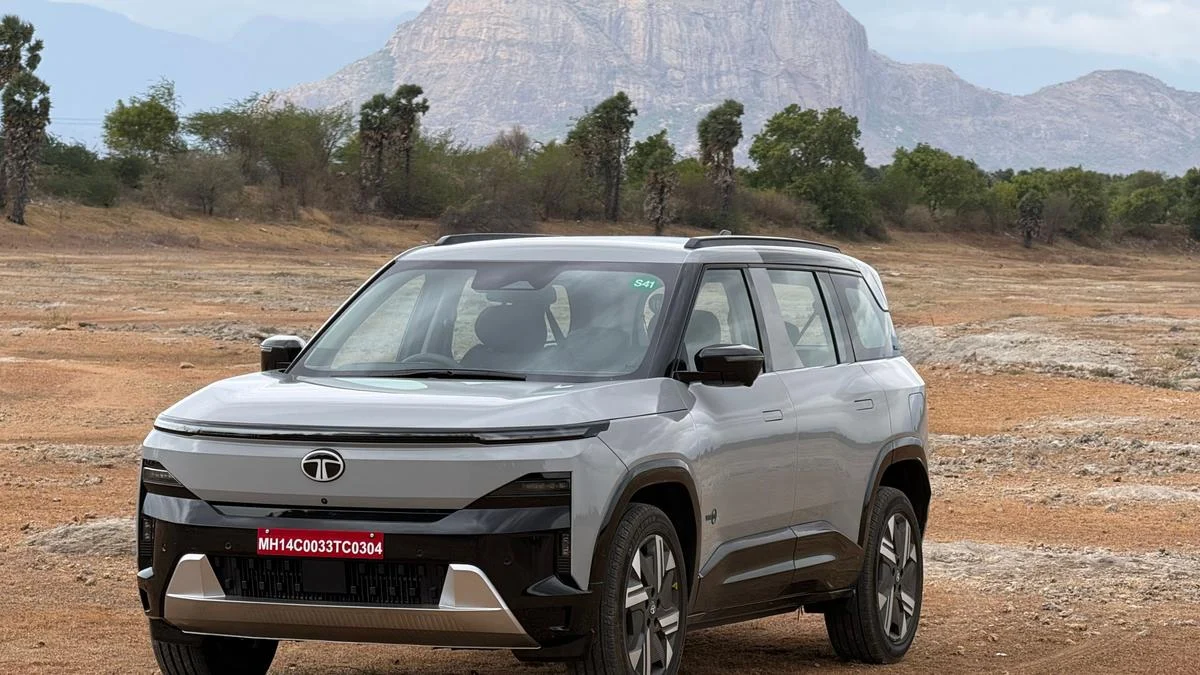
The automotive landscape in India is currently witnessing a paradigm shift, one where nostalgia meets the cutting edge of sustainable technology. Perhaps no vehicle embodies this intersection more than the Tata Sierra.ev. For many Indians, the "Sierra" nameplate evokes memories of the 1990s—a time when it stood as a bold, three-door pioneer in a market dominated by utilitarian hatchbacks. Today, Tata Motors has resurrected this legendary moniker, not as a mere retro-tribute, but as a sophisticated, high-performance electric SUV that aims to set a new benchmark for the domestic industry.
After an extensive day of testing in and around the diverse terrains of Coimbatore—ranging from congested city arteries and high-speed highways to a controlled test track and a punishing off-road circuit—it is clear that the Sierra.ev is the most complete vehicle Tata Motors has ever produced.
1. Main Facts: Positioning and Specifications
The Tata Sierra.ev is positioned at the premium end of the mid-size SUV segment, entering a market that is increasingly hungry for long-range, high-performance electric vehicles. Launched with a competitive price bracket of INR 18.79 – 24.79 Lakh (ex-showroom), it directly challenges established players and upcoming rivals alike.
The Powertrain Options
Tata offers the Sierra.ev in two distinct mechanical configurations to cater to different buyer profiles:

- The Flagship 75 kWh Variant: This version features a sophisticated dual-motor Quad Wheel Drive (QWD) system. It utilizes a 234 bhp motor at the rear axle and a 138 bhp motor at the front, culminating in a staggering combined torque output of 504 Nm.
- The 63 kWh Variant: Designed for those who prioritize efficiency and urban usability, this version utilizes a single rear-mounted motor, providing a more traditional Rear-Wheel Drive (RWD) experience while maintaining ample performance for daily duties.
On the efficiency front, the 75 kWh battery boasts a claimed MIDC range of 665 km. While laboratory figures often differ from real-world usage, the vehicle’s energy management systems suggest a highly usable range that significantly mitigates "range anxiety," a primary hurdle for EV adoption in India.
2. Chronology: A Day of Multi-Terrain Evaluation
To truly understand a vehicle that claims to be "uncompromising," one must subject it to the full spectrum of driving conditions. Our evaluation in Coimbatore was structured to mirror the diverse life of a modern Indian SUV.
Morning: Urban Maneuverability and Ride Quality
The day began in the heart of Coimbatore. In the stop-and-go traffic of the city, the Sierra.ev immediately demonstrated its refinement. The first standout feature is the Frequency Dependent Damping (FDD) suspension. Tata’s engineers have calibrated this system specifically for the "chaotic" nature of Indian roads.
As we navigated broken patches of tarmac and sharp expansion joints, the SUV displayed remarkable composure. Rather than the jarring "thud" often associated with heavy EVs, the Sierra.ev rounded off imperfections with a sophisticated, muted feel. The steering, light at low speeds, made navigating tight lanes and parking maneuvers effortless, belying the vehicle’s substantial footprint.

Midday: Highway Stability and Aerodynamics
Moving onto the L&T bypass and surrounding highways, the Sierra.ev transitioned from a city crawler to a long-distance cruiser. At triple-digit speeds, the vehicle’s low center of gravity—a natural benefit of the floor-mounted battery pack—kept it glued to the road. The steering gained a reassuring weight, providing the driver with the confidence to maintain speed without constant micro-corrections. It tracked "arrow straight," a testament to the rigid chassis and aerodynamic tuning.
Afternoon: The Performance Test Track
The most visceral part of the day took place on the test track. Tata claims a 0 to 100 km/h time of 5.8 seconds for the dual-motor version. In practice, the acceleration is potent but polished. Unlike some EVs that deliver an unsettling "kick" to the neck, the Sierra.ev builds momentum progressively, followed by a relentless surge of power.
Crucially, there was no evidence of torque steer—the tendency of a powerful car to pull to one side under hard acceleration. The braking exercises were equally impressive; the transition between regenerative braking (which recovers energy) and the mechanical friction brakes was seamless, allowing for stable, drama-free stops from high speeds.
Evening: Off-Road Capability
The final leg involved a demanding off-road course. While most owners may never take their electric SUV beyond a gravel driveway, the Sierra.ev’s Quad Wheel Drive system proved it is more than capable. The instant torque of the electric motors allowed the vehicle to crawl up steep, rocky inclines with a level of precision that traditional internal combustion engines struggle to match. The electronic "brains" of the QWD system managed traction at each wheel individually, ensuring forward momentum even when the terrain became slippery.

3. Supporting Data: Technology, Range, and Charging
The Sierra.ev is built on Tata’s Acti.ev architecture, a dedicated electric platform that allows for better packaging and technological integration.
Efficiency and Charging
The 75 kWh battery pack is the heart of the vehicle’s long-distance capability. While the MIDC claim is 665 km, our real-world estimation—based on mixed driving conditions—suggests a realistic range of 450 to 500 kilometres.
- Fast Charging: Using a compatible DC fast charger, the Sierra.ev can add 263 kilometres of range in just 15 minutes. This effectively transforms the vehicle into a viable option for inter-city travel, provided the charging infrastructure continues to expand.
The Digital Cockpit
The interior is dominated by a three-screen layout that serves as the nerve center of the vehicle.
- Driver’s Display: High-resolution instrumentation providing vital stats.
- Central Infotainment: A responsive interface for navigation and media.
- The Third Display/AirConsole: A unique addition that allows passengers to use their smartphones as controllers for multiplayer games via AirConsole. This feature is specifically designed to alleviate boredom during charging stops.
Audio and Comfort
The partnership with JBL has resulted in a Dolby Atmos-enabled audio system that is arguably the best in its class. The soundstage is expansive, with clarity that remains crisp even at high volumes. This is complemented by a panoramic sunroof, an exceptionally fast-cooling air conditioning system, and a suite of "convenience tech" including:

- Auto Park Assist
- Summon Mode (allowing the car to move forward or backward via a remote/app)
- Reverse Assist
- Augmented Reality Head-Up Display (HUD)
4. Official Context and Market Positioning
Tata Motors has been the clear leader in the Indian EV space, largely through "converted" platforms like the Nexon.ev and Tiago.ev. However, the Sierra.ev represents the "Phase 2" of their strategy. By using a dedicated EV platform, they have moved away from the compromises of ICE-to-EV conversions.
The company’s official stance emphasizes "Premiumization" and "Versatility." They are targeting the aspirational Indian buyer who wants the status of a luxury vehicle but the sustainability and lower running costs of an electric powertrain. The Sierra.ev isn’t just competing with other EVs; it is designed to pull buyers away from premium petrol and diesel SUVs in the 20–30 lakh range.
5. Implications: The Road Ahead and Verdict
The arrival of the Sierra.ev has significant implications for the Indian automotive market. It signals that domestic manufacturers are now capable of producing world-class electric vehicles that do not require "excuses" for their performance or build quality.
Areas for Improvement
No vehicle is flawless. During our extensive drive, two minor issues surfaced:

- Wind Noise: While the cabin is remarkably insulated from tyre and suspension noise, wind whistle becomes noticeable at speeds above 100 km/h. In an EV, where the engine is silent, these ambient noises become more pronounced.
- Software Gremlins: The one-touch driver’s window function showed occasional inconsistency, a small software or sensor calibration issue that Tata will likely address in early production batches.
The Competition
The Sierra.ev enters a "war zone" of competition. It faces the Hyundai Creta Electric, which brings Hyundai’s massive service network and brand loyalty; the MG ZS EV, a global stalwart; and the Mahindra BE 6, which promises a more futuristic, radical design.
However, the Sierra.ev holds a unique advantage: it feels "thoroughly resolved." It balances the ruggedness required for Indian terrain with a level of interior luxury that feels genuinely premium.
Final Conclusion
The Tata Sierra.ev is a landmark achievement. It honors its heritage not by looking backward, but by pushing the boundaries of what a domestic EV can be. It is comfortable, incredibly fast, technologically advanced, and surprisingly capable off the beaten path. For the buyer looking to make the switch to electric without sacrificing the "go-anywhere" spirit of a traditional SUV, the Sierra.ev is currently the most compelling package on the Indian market. It is not just a great electric car; it is a great car, period.
