

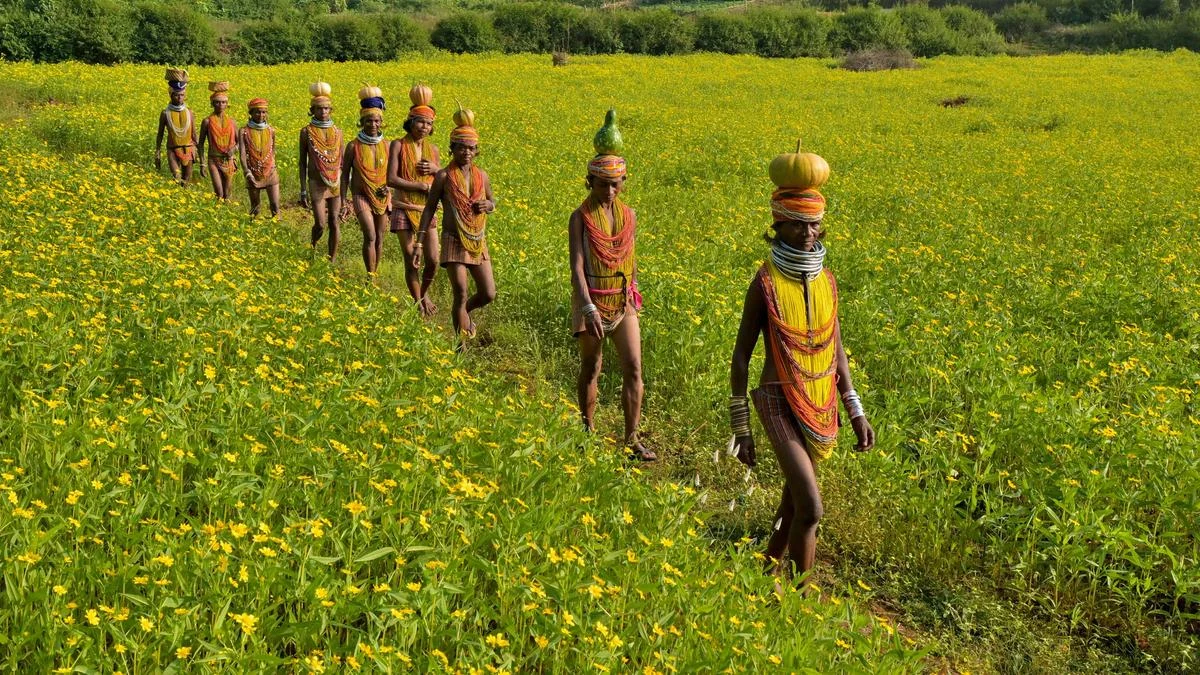
MALKANGIRI, ODISHA – In the secluded heights of the Bonda Hills, where the air is thick with the scent of wild shrubs and the rhythm of ancient life, a quiet revolution of preservation is unfolding. Here, in the village of Gokharipada, a woman named Muduli sits at a primitive loom, her hands moving with a grace inherited through millennia.
“Every Ringa we weave carries our family’s story,” Muduli says, her fingers tracing the vibrant, coarse texture of a freshly completed cloth. This garment, the Ringa, is more than just a piece of attire; it is a woven manuscript of the Bonda tribe, one of India’s most reclusive and culturally distinct Particularly Vulnerable Tribal Groups (PVTGs).
As the modern world inches closer to these remote highlands in Odisha’s Malkangiri district, the Bonda women find themselves at a precarious crossroads, balancing the weight of a 60,000-year-old heritage against the inevitable tide of globalization.
Main Facts: The Identity of the Ringa and the Bonda People
The Bonda tribe, often referred to as the ‘Remo’ (meaning ‘people’ in their native Austroasiatic language), occupies a unique niche in India’s ethnographic landscape. Their primary cultural identifier for women is the Ringa—a traditional handwoven wraparound skirt characterized by striking horizontal stripes in shades of red, maroon, black, white, and blue.

A Matriarchal Bastion
The Bondas are a rare example of a matriarchal society within the Indian subcontinent. In this community, women are the primary architects of both the economy and cultural preservation. They are the cultivators, the foragers, and the shrewd negotiators at the weekly markets. Most importantly, they are the sole custodians of the weaving tradition. Unlike many other Indian handloom sectors where men often operate the looms while women handle pre-loom activities, Bonda weaving is an exclusively female domain.
The Anatomy of the Textile
The Ringa is a short, narrow strip of cloth, designed for utility and durability. Traditionally, it was the only garment worn by Bonda women, supplemented by an elaborate array of bead necklaces and aluminum neck rings that cover the torso. The aesthetic is unmistakable:
- Colors: Deep ochres and maroons derived from natural sources, contrasted with stark blacks and whites.
- Texture: Thick and rugged, designed to withstand the rigors of forest life and hill farming.
- Design: Strict adherence to horizontal banding, which serves as a visual marker of tribal affiliation.
Chronology: From African Roots to the Cotton Era
The history of the Bonda people is a subject of intense anthropological fascination. To understand the current state of their weaving, one must look back through the layers of time.
The Ancient Migration (Approx. 60,000 Years Ago)
Geneticists and anthropologists suggest that the Bondas are descendants of one of the earliest waves of modern humans to migrate out of Africa. Having settled in the isolated pockets of the Eastern Ghats, they remained largely insulated from the successive waves of migration and empire-building that shaped the rest of the Indian subcontinent. This isolation allowed their language, Remo, and their textile traditions to remain virtually unchanged for thousands of years.

The Kerang Period (Pre-20th Century)
For centuries, the Ringa was not made of cotton. It was woven using the tough, fibrous inner bark of the Kerang tree, a wild shrub native to the local hills. The process was labor-intensive: women would harvest the bark, soak it in forest streams, beat it into fibers, and spin it by hand. The resulting fabric was nearly indestructible, mirroring the resilience of the people themselves.
The Transition to Cotton (Mid-20th Century to Present)
As trade routes opened and the Bondas began frequenting the "shandy" (weekly markets) in the lowlands, mill-spun cotton yarn became available. Gradually, cotton replaced the Kerang fiber. While the material changed, the visual identity—the stripes and the specific dimensions—remained frozen in time. Today, the use of Kerang is rare, reserved mostly for ritualistic purposes or by the oldest members of the community, while the cotton Ringa has become the standard.
Supporting Data: The Economics of "Slow" Weaving
The Bonda weaving tradition exists outside the conventional framework of the Indian textile industry. It is not a commercial enterprise but a domestic necessity that has only recently begun to see external valuation.
Production Metrics
- Time Investment: A single Ringa takes approximately two to three days to complete. This does not include the time spent on household chores, farming, or foraging.
- The Rhythm of Labor: Weaving is integrated into the "interstitial spaces" of the day. It is performed in the quiet hours of the afternoon or early morning, making it a slow, meditative process.
- Learning Curve: There are no formal schools for this craft. It is passed down through "muscle memory." Mothers guide daughters, and grandmothers correct the tension of the warp and weft, ensuring the family’s specific "archive" of patterns is maintained.
The Thursday Shandy: The Interface of Two Worlds
Every Thursday, the Onukudelli market in Koraput district becomes a theater of cultural exchange. Bonda women descend from the hills, draped in their Ringas and weighed down by kilograms of beads. Here, the Ringa is seen in its natural context—not as a luxury item, but as the uniform of a forest-dwelling people. While they primarily come to buy salt, kerosene, and trinkets, the market has recently become a place where visitors and collectors attempt to purchase the Ringa directly from the weavers.

Official Responses and Expert Perspectives
The survival of such a niche tradition requires a delicate balance between exposure and protection. Experts argue that the Bonda tradition is unique because it was never meant for the "other."
Identity Over Commerce
Navaldeep Thareja, a Punjab-based textile engineer and founder of Behrupiaa Arts, has spent years documenting these "vanishing" clusters. He emphasizes that the Bonda loom is a tool of identity, not profit.
“Unlike the famous Sambalpuri or Ikkat traditions of Odisha that evolved to meet market demands, the Bonda community wove the Ringa primarily for personal use,” Thareja explains. “It is one of the few textile traditions where a single garment has remained central to the community’s identity for generations without being diluted by commercial trends.”
The Ethics of Engagement
Thareja’s initiative focuses on "curated tours" that prioritize the dignity of the tribe. Participants are briefed on strict photography etiquette and local customs.
“We never treat the village as a tourist attraction,” Thareja states. To protect the privacy of the Bonda homes, weavers often meet visitors at locally managed homestays. This allows the artisans to control the narrative and the transaction, ensuring they are not merely "subjects" for a camera lens but participants in a fair-trade exchange.

Implications: The Fragile Future of the Bonda Loom
Despite the growing interest from textile scholars and "slow fashion" enthusiasts, the future of the Ringa is far from certain. The challenges are multifaceted, involving socio-economic shifts and the aspirations of a younger generation.
The Modernity Gap
Education and exposure to the plains have changed the aspirations of Bonda youth. Many young women are opting for ready-made synthetic saris or "salwar kameez" for daily wear, reserving the Ringa for festivals or ceremonial occasions.
“The biggest challenge is that weaving alone does not provide a steady income,” Muduli admits. “When the youth see that a job in the town provides more than the days spent at a loom, they choose the job.”
Cultural Dilution vs. Preservation
As the Ringa finds its way into urban homes as "textile art"—framed on walls or used as table runners—there is a risk of the garment losing its original context. However, proponents like Thareja believe this external appreciation is exactly what might save the craft.
“When a weaver sees that a collector from Delhi or Mumbai values her work as ‘art,’ it provides a psychological boost that goes beyond the money,” he says. This external validation often encourages younger women to pick up the shuttle again, seeing the craft not as a sign of "backwardness" but as a unique skill that the rest of the world admires.

Conclusion: The Loom as a Family Archive
The Ringa remains a symbol of defiance against the homogenization of global fashion. In the Bonda Hills, the loom continues to function as a family archive, a repository of a language that has no script but is written in threads of red and black.
For women like Muduli, the goal is simple yet profound: to ensure that the story of the Bonda people does not end with her generation. As long as the rhythmic thud of the loom continues to echo in the villages of Malkangiri, the 60,000-year-old journey of the Bonda people remains unbroken.
Behrupiaa Arts continues to conduct ethical textile tours to Malkangiri for those interested in supporting and documenting these traditions firsthand.
