

On a nondescript stretch of Rattray Street in the city of Dunedin, New Zealand, a peculiar sight greets passersby: a public tap protruding from the wall of an industrial brick building. Here, residents and travelers alike pull over, empty containers in hand, to collect free, untreated, and non-fluoridated spring water pumped directly from an aquifer deep beneath the city. This is more than a civic amenity; it is a literal siphoning of the city’s lifeblood. The water, which serves as the foundational ingredient for the legendary Speight’s Brewery, bridges the gap between industrial production and public heritage.
Dunedin, often referred to as the "Edinburgh of the South," is a city defined by its steep hills, Victorian architecture, and a beer culture that is inextricably woven into its social fabric. From the 19th-century gold rush origins of Speight’s to the 20th-century craft revolution sparked by Emerson’s, the city’s identity is measured in pints and pours. Today, these two breweries—one a mainstream titan and the other a craft pioneer—exist in a unique state of "co-opetition," both operating under the same corporate umbrella while maintaining fiercely distinct cultural identities.

Main Facts: A City Built on Barley and Brine
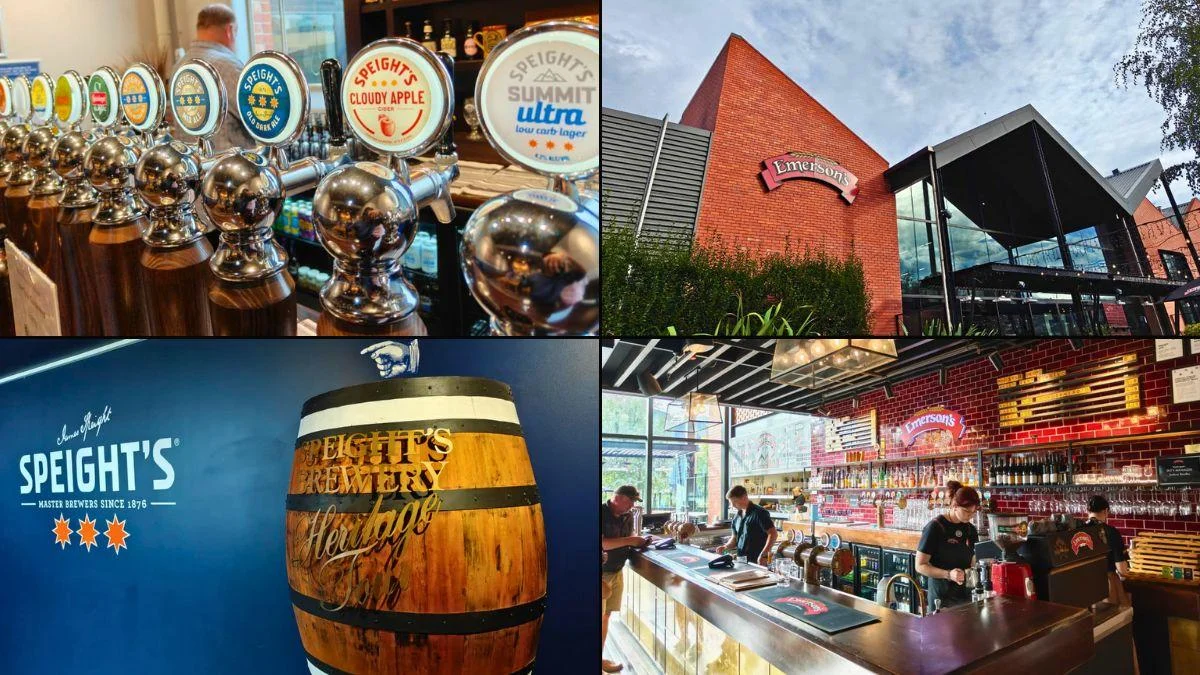
Dunedin’s brewing landscape is dominated by two pillars: Speight’s Brewery, established in 1876, and Emerson’s Brewery, founded in 1992. While they cater to different demographics, they share a common geography and a parent company, Lion (a subsidiary of the Japanese giant Kirin).
The city itself, with a population of approximately 130,000, is a university town (home to the University of Otago) where the Presbyterian work ethic of its Scottish founders meets a vibrant, often rowdy, student culture. In this environment, beer is more than a commodity; it is a social anchor. Speight’s represents the "Pride of the South," a symbol of rugged, rural masculinity and reliable tradition. Emerson’s represents the "New Frontier," a symbol of urban sophistication, experimentation, and the artisanal revival.

Key to this culture is the localized nature of production. Unlike global brands like Guinness, which are brewed under license in dozens of countries to a standardized profile, Dunedin’s breweries have rooted themselves in the specific textures of their environment. The spring water of Rattray Street, the local New Zealand hops, and the region’s intense rugby culture create a terroir that is difficult to replicate outside the city limits.
Chronology: From Gold Rush Gambles to Craft Revolutions
1876–1890: The Reckless Beginnings
The story of Speight’s begins with a gamble that bordered on the illegal. In 1876, three employees of Dunedin’s Well Park Brewery—James Speight (a salesman), Charles Greenslade (a maltster), and William Dawson (a brewer)—decided to strike out on their own. They secured a disused bottling house on Rattray Street and began brewing their first batch weeks before they even had a lease, and months before they possessed a brewing license.

This audacity coincided with the Otago Gold Rush, a period of immense wealth and rapid population growth. By the 1890s, Speight’s had outpaced all local competitors to become the largest brewery in New Zealand. They even operated their own merchant ship to transport their product to the North Island, cementing their status as a national powerhouse.
1970s–1990s: The Birth of the "Southern Man"
As the brewing industry consolidated in the 20th century, Speight’s leaned into its regional identity to survive. In 1977, the brewery began a formal partnership with Dunedin’s rugby community, sponsoring the club championships. This evolved into the iconic "Southern Man" advertising campaign—a series of commercials featuring stoic, hypermasculine South Island archetypes. This marketing masterstroke transformed Speight’s from a simple lager into a cultural shorthand for "Southern" identity.

1992: The Emerson’s Intervention
By the early 1990s, the New Zealand beer market was largely a duopoly of mainstream lagers. Richard Emerson, a local enthusiast who had tasted the diverse ales of Scotland and Europe, found the local offerings lacking. He began experimenting on a kitchen stove before moving to a makeshift setup using repurposed dairy equipment.
Emerson’s Brewery was born out of a desire for "flavour over volume." His first commercial success, the London Porter, was a dark, malty revelation for a city used to golden lagers. Throughout the 90s and 2000s, Emerson’s moved through various sites in Dunedin, scaling up while refusing to leave the city, eventually becoming the vanguard of the New Zealand craft beer movement.

2010s–Present: Corporate Convergence
In a move that mirrored global trends, both breweries eventually came under the ownership of Lion (Kirin). Speight’s had long been a corporate mainstay, but Emerson’s acquisition in 2012 signaled a new era where "craft" and "corporate" would coexist. Today, they share distribution networks and supply chains, yet they operate as separate entities with distinct taprooms and brand voices.
Supporting Data: The Mechanics of Scale
The disparity in scale between Speight’s and Emerson’s highlights the two different worlds of New Zealand brewing.

Speight’s Brewery (The Industrial Giant):
- Production Volume: A single day’s brew at Speight’s yields 164,000 liters of beer.
- Operational Capacity: The brewery operates 24/7 on three overlapping shifts.
- Efficiency: Modern automated cycles allow for 6 to 8 brews in a 24-hour period, a massive increase from the manual cleaning cycles of the past.
- Market Share: Speight’s holds approximately 75% of the market share in its category against its primary competitors in the region.
- Export Policy: Interestingly, Speight’s does not export. Because Lion owns various breweries in Australia, they avoid "cannibalizing" their own markets, keeping Speight’s a strictly New Zealand experience.
Emerson’s Brewery (The Craft Scale-Up):

- Production Volume: Emerson’s produces roughly 2.7 million liters of beer annually.
- Flagship Success: Their Pilsner accounts for nearly 50% of their total production, with weekly volumes reaching up to 30,000 liters.
- Ingredient Diversity: Emerson’s utilizes a mix of New Zealand hops (which provide citrus and "sauvignon blanc" notes) and American hops (which provide tropical and stone fruit characteristics).
Official Responses: Voices from the Brewfloor
The philosophies of these two institutions are best articulated by those who represent them daily.
Marty McPate, a veteran representative at Speight’s, views the brewery as a national monument. "If you mention Speight’s, everybody knows it," he notes. For McPate, the continuity of the brand is found in its people. He points to brewers who have spent decades on-site, transitioning from manual valves to computer-automated screens without losing the "feel" for the beer. "We’ve moved from being the ‘Pride of the South’ to a brand that aims to dominate the country," McPate explains, highlighting the aggressive expansion into the North Island and the massive Auckland production facility.

Conversely, Ella Walker, a tour guide and tasting expert at Emerson’s, emphasizes the narrative and "niche" appeal of their brews. "It’s good for these beers to have that bit of backstory," she says. She points to beers like the ‘Bookbinder’ (named after a local friend of Richard Emerson) and the ‘Bird Dog’ (a tribute to the Dunedin band The Verlaines).
Regarding the relationship with their larger neighbor, Walker is pragmatic. "We definitely do see them [Speight’s] as competition at times, but we sell different styles of beer. Speight’s is mainstream; this is niche. But we are both sister breweries."

Implications: Identity in a Pint Glass
The coexistence of Speight’s and Emerson’s in Dunedin offers a profound look at how regional identity survives in a globalized economy.
The Rugby-Beer Symbiosis
In Dunedin, beer is the currency of the sporting world. Speight’s ties to the Otago Rugby Football Union and the Highlanders (the regional Super Rugby team) have created a feedback loop where the brand is synonymous with the "Southern Man" archetype. When the Highlanders play at Forsyth Barr Stadium, the surrounding pubs are flooded with Speight’s drinkers. This isn’t just consumption; it is a ritual of regional loyalty.

The Social Node
Emerson’s, meanwhile, has become one of the city’s most vital "social nodes." Its proximity to both the University of Otago and the city center allows it to attract a diverse demographic—from students and professors to blue-collar workers and visiting tourists. By hosting events like the finish line for the Dunedin Marathon, Emerson’s has positioned itself as a community hub rather than just a production facility.
The Corporate Paradox
The fact that both breweries are owned by Kirin via Lion raises questions about the future of "local" beer. However, Dunedin’s experience suggests that corporate ownership does not necessarily lead to the erasure of local character. By allowing Speight’s to remain the "rugged traditionalist" and Emerson’s to remain the "innovative artisan," Lion has successfully captured both ends of the market. The rivalry between the two remains "healthy" because it is rooted in genuine differences in taste and social branding.

Conclusion: A Jolly Good Pour
As the public tap on Rattray Street continues to flow, it serves as a reminder that Dunedin’s brewing culture is built on a foundation of local resources and history. Whether one chooses the Gold Medal Ale of Speight’s or the London Porter of Emerson’s, the choice is a declaration of identity. In this "Edinburgh of the South," beer remains the lens through which the city remembers its past and toasts its future. For the visitor, the advice is simple: ask what the person next to you is having. In Dunedin, the answer is always more than just a drink; it’s a story.
