

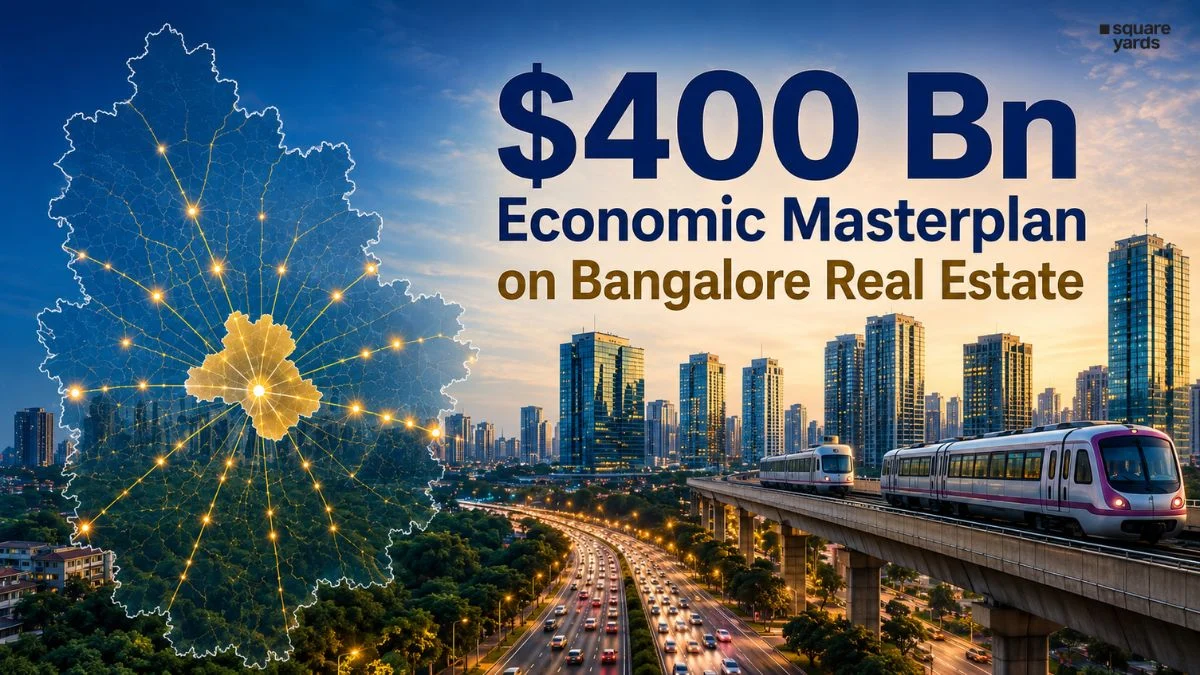
BENGALURU – In a move that signals a paradigm shift for India’s technological capital, the Karnataka state government has unveiled a comprehensive economic masterplan for the Bengaluru Metropolitan Region (BMR). This ambitious roadmap aims to nearly triple the region’s economy from its current valuation of approximately $149 billion to a staggering $400 billion by the year 2037. The target date is no coincidence; it marks the 500th anniversary of the city’s founding by Kempe Gowda I, positioning the next decade as a historical bridge between Bengaluru’s storied past and its high-tech future.
The blueprint, which extends far beyond mere infrastructure, seeks to formalize the city’s growth trajectory through aggressive job creation, a radical overhaul of public transit, and the strategic expansion of its economic footprint across three key districts. For stakeholders ranging from multinational corporations to first-time homebuyers, the plan represents the most significant policy document in a generation, offering a glimpse into the future of India’s fastest-growing metropolis.
Chronology: The Road to the 2037 Blueprint
The genesis of this masterplan lies in a strategic partnership between the State Government of Karnataka and the Institute for Sustainability, Employment and Growth (ISEG Foundation). Recognizing that Bengaluru’s organic, often chaotic growth required a more structured economic framework, the state initiated a formal planning process in the first half of 2026.
- May 2026: The Government of Karnataka signed a formal Statement of Intent (SoI) with the ISEG Foundation. This agreement tasked the institute with a high-pressure mandate: to synthesize complex economic data and urban planning requirements into a viable blueprint within a strict four-month window.
- Summer 2026: ISEG researchers and state planners conducted an intensive analysis of the 8,000-square-kilometer BMR, evaluating the economic output of Bengaluru Urban, Bengaluru Rural, and Ramanagara districts.
- September 2026: The completed masterplan was officially presented to Chief Minister D.K. Shivakumar. The presentation marked the transition from the planning phase to the implementation phase, setting the stage for the legislative and budgetary allocations required to meet the 2037 targets.
This timeline underscores the government’s sense of urgency. With the city already contributing nearly 40% of Karnataka’s GDP despite housing only 25% of its population, the state recognizes that the continued prosperity of Karnataka is inextricably linked to the structural efficiency of its capital.
Supporting Data: The Pillars of a $400 Billion Economy
The masterplan is built upon three quantitative pillars: economic output, employment, and mobility. To reach the $400 billion milestone, the ISEG Foundation identifies several critical growth levers.
1. Economic and Demographic Scale
The Bengaluru Metropolitan Region is a massive administrative entity spanning over 8,000 square kilometers. It encompasses a population of nearly 16 million people. The plan projects that by 2037, this region will not just be a hub for IT services but a diversified economic engine. The leap from $149 billion to $400 billion requires a compounded annual growth rate that leans heavily on the expansion of Global Capability Centers (GCCs), biotechnology, and high-end manufacturing.
2. The Employment Engine
A central tenet of the plan is the creation of 2 to 2.5 million new jobs. These are not intended to be limited to the "Silicon Plateau" of traditional software development. The roadmap envisions a surge in high-value roles within the aerospace, health-tech, and green energy sectors, aimed at absorbing the influx of talent migrating to the city from across India and the globe.
3. The 75% Mobility Mandate
Perhaps the most ambitious figure in the report is the target to increase public transport’s share of daily commuting to 75%. Currently, Bengaluru is infamous for its private vehicle dependency and subsequent gridlock. Achieving this target would require a fundamental shift in how the city moves.
To support this, Namma Metro is slated for a massive expansion. The network is projected to grow from its current 96 km to 137 km in the immediate future. Key projects include:
- Phase 2A: Currently under construction with funding from the Japan International Cooperation Agency (JICA).
- Phase 3: Expected to go to tender shortly, this phase includes a landmark "double-decker corridor," designed to maximize vertical space in densely populated areas.
Real Estate Implications: Redefining Land Value
For the real estate sector, the masterplan serves as a prophetic document. In 2026, residential property prices in Bengaluru already demonstrated robust growth, with a city-wide average appreciation of 9-10% year-on-year. However, the masterplan’s focus on transit-oriented development (TOD) is expected to create "hyper-growth" pockets.
Micro-Market Analysis
- Whitefield and ITPL: Already the city’s premier IT corridor, Whitefield saw 14% appreciation in 2026. With average prices around Rs 11,000 per sq. ft. and luxury segments exceeding Rs 15,000, this area remains the benchmark for GCC-led demand.
- Sarjapur Road and Outer Ring Road (ORR): Driven by proximity to major tech parks, this stretch recorded 12% appreciation. It remains the most sensitive to metro connectivity improvements.
- North Bengaluru (The Airport Corridor): Currently priced between Rs 5,500 and Rs 11,000 per sq. ft., North Bengaluru is positioned as the city’s next frontier. The masterplan’s emphasis on the airport region as an economic node makes it a primary target for long-term investors.
- Electronic City and South Bengaluru: Offering a more accessible entry point at Rs 6,000–Rs 10,500 per sq. ft., these areas currently boast the city’s highest gross rental yields at approximately 5%.
Land Value Capture (LVC) Financing
A critical financial innovation mentioned in the plan is "Land Value Capture." This mechanism allows the government to monetize the increase in land value resulting from public infrastructure projects. By taxing or feeing the windfall gains that property owners receive when a new metro station opens nearby, the state can create a self-sustaining loop to fund further expansion. For investors, this means that the link between infrastructure announcements and price hikes will become more formalized and potentially more rapid.
Official Responses and Expert Perspectives
The reception of the masterplan among industry leaders has been one of cautious optimism, focused on the necessity of execution.
Navin Dhanuka, Director of ArisUnitern RE Solutions Pvt. Ltd., emphasized the shift in development philosophy. "The proposed economic masterplan marks an important shift towards infrastructure-led and transit-oriented growth for the Bengaluru Metropolitan Region," Dhanuka noted. "Expanding Metro, suburban rail, and RRTS (Regional Rapid Transit System) networks can unlock new development corridors by improving access to employment hubs, social infrastructure, and residential markets."
Dhanuka further highlighted that the real estate ecosystem now has an opportunity to "plan and develop around connectivity, rather than simply around existing urban centers." However, he cautioned that the success of this $400 billion vision depends entirely on "coordinated execution across transport infrastructure, land-use planning, and supporting civic infrastructure."
Government officials have echoed this sentiment, suggesting that the masterplan is not a static document but a "living blueprint" that will guide zoning laws and municipal budgets for the next decade.
Implications for Stakeholders: A Decade-Long Bet
The masterplan represents a strategic pivot for Bengaluru. For the various stakeholders involved, the implications are profound:
For Homebuyers and Renters
The 75% public transport target is the most critical metric. If successful, it will decouple property value from "distance to office" and reattach it to "distance to transit." Neighborhoods once considered "peripheral" or "too far" will become viable residential hubs if they sit on a confirmed metro or suburban rail corridor. Homebuyers are being advised to treat a locality’s transit roadmap with the same scrutiny as its current price tag.
For Investors and NRIs
The formalization of growth corridors provides a clearer "buy" signal. The integration of Ramanagara and Bengaluru Rural into the BMR economic fold suggests that land banking in these outlying areas may yield significant returns as the $400 billion economy spills over the current city limits.
For the Global Tech Community
The plan reinforces Bengaluru’s status as a global hub. By setting a specific GDP target and a deadline, the city is signaling to multinational corporations that it is prepared to build the infrastructure necessary to support their next phase of expansion, particularly in the realm of GCCs.
Conclusion: The Gap Between Blueprint and Reality
As Bengaluru approaches its 500th anniversary, the $400 billion masterplan serves as both a challenge and a promise. The document is unusual in the Indian context for its specificity—pairing hard economic figures with a hard deadline. It provides a rare level of transparency regarding the government’s priorities, favoring transit-oriented development and high-value employment sectors.
However, the real test of the 2037 blueprint will not be found in the glossy pages of the ISEG Foundation’s report, but in the daily lived experience of the city’s 16 million residents. The next decade of Bengaluru real estate and economic history will be written in the "gap" between this ambitious plan and its on-ground execution. If the state can successfully bridge that gap, Bengaluru will not just be celebrating 500 years of history in 2037; it will be celebrating its emergence as a premier global economic titan.
