

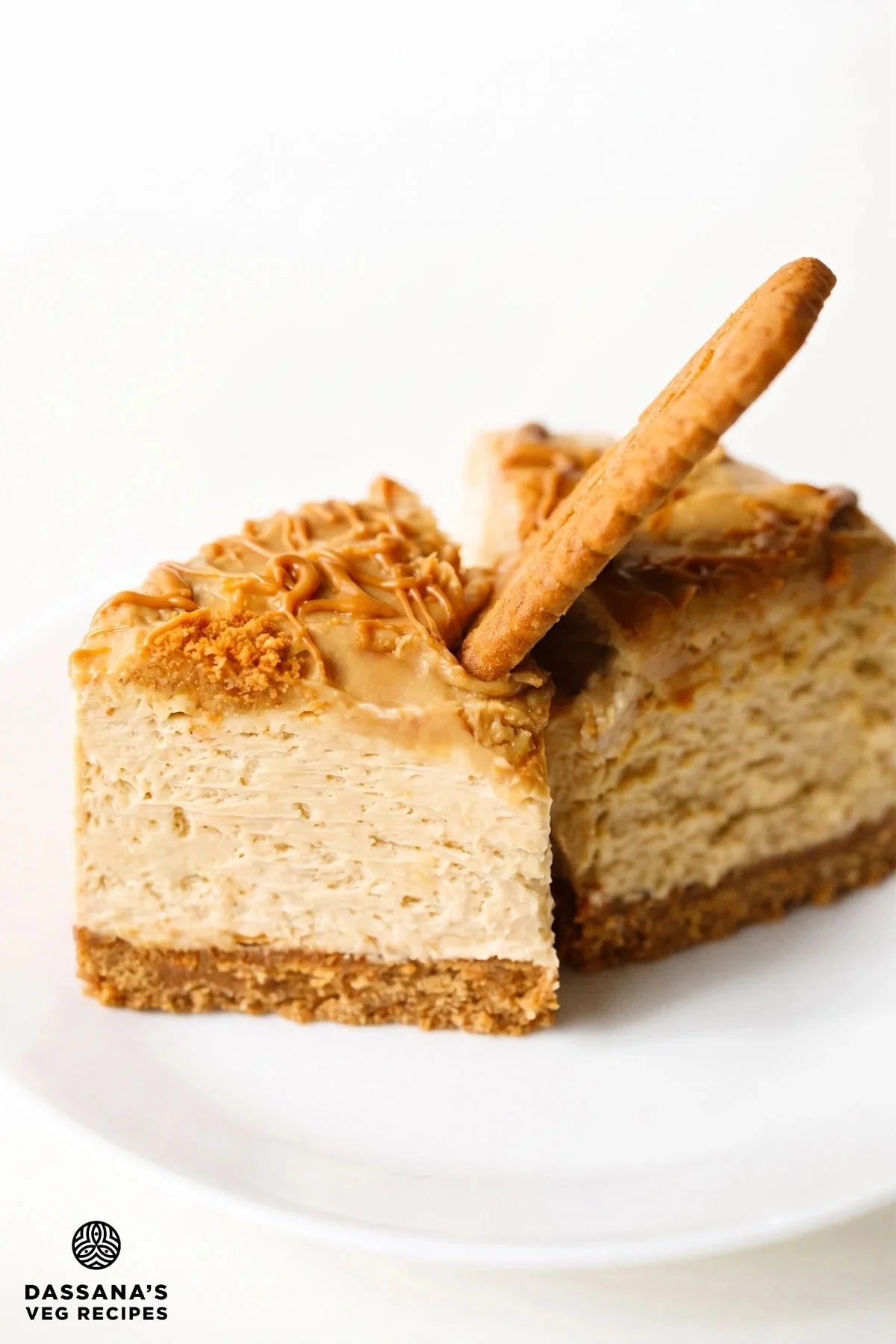
Main Facts: The Intersection of Convenience and Gourmet Pastry
In the evolving landscape of contemporary home baking, the "no-bake" movement has transitioned from a niche convenience to a sophisticated culinary category. At the forefront of this trend is the No-Bake Biscoff Cheesecake, a dessert that leverages the distinct, caramelized profile of Belgian Speculoos cookies to create a professional-grade confectionery experience without the need for thermal processing.

The core appeal of this specific iteration, popularized by culinary experts like Dassana of Veg Recipes of India, lies in its structural integrity and flavor complexity. Unlike traditional New York-style cheesecakes that require water baths and precise oven temperatures, the Biscoff variant relies on the science of emulsification and cold-setting. By utilizing a specific ratio of full-fat cream cheese, stabilized whipped cream, and the signature Lotus Biscoff spread, the recipe achieves a "smooth, stable" finish that allows for the "neat slices" typically reserved for baked counterparts.

Key highlights of this culinary development include:

- Zero-Gelatin Stability: The recipe eschews traditional setting agents like gelatin or agar-agar, relying instead on the fat content and chilling time to maintain its form.
- Flavor Synergy: The integration of caramelized biscuit crumbs with a tangy cream cheese base creates a balanced "sweet-and-salt" profile.
- Make-Ahead Utility: Designed for modern hosting, the dessert requires a minimum of five to six hours of refrigeration, though an overnight setting is recommended for optimal textural development.
Chronology: The Technical Execution of the No-Bake Method
The production of a Biscoff cheesecake is a multi-phased operation that requires attention to temperature and aeration. To achieve the results documented by professional pastry chefs, the following chronological steps are essential.

Phase I: Foundation and Structural Integrity
The process begins with the construction of the biscuit base. This is not merely a bottom layer but a structural foundation.

- Preparation: A five-inch detachable cake pan or springform pan is lined with parchment paper. This is a critical step for "unmoulding" the cheesecake without compromising its vertical edges.
- Crumb Homogenization: 125 grams of Lotus Biscoff Classic biscuits are processed into fine crumbs. The uniformity of the crumbs is vital; large chunks can cause the base to crumble upon slicing.
- Binding: 40 grams of melted butter (approximately three tablespoons) are integrated into the crumbs. The butter acts as a cooling adhesive, hardening in the refrigerator to create a crisp contrast to the soft filling. The mixture is pressed firmly into an even layer using a flat-bottomed tool to ensure density.
Phase II: The Emulsification of the Filling
The second phase involves the creation of the aerated cheese mixture. This stage is time-sensitive and temperature-dependent.

- The Cream Cheese Base: 200 grams of softened cream cheese are beaten with 40 grams of powdered sugar, vanilla extract, and a pinch of salt. The salt is a crucial additive, acting as a flavor enhancer that cuts through the richness of the dairy.
- Aeration: In a separate, chilled bowl, 150 ml of cold whipping cream (35% fat) is whipped to "stiff peaks." The high fat content is non-negotiable, as it provides the air bubbles necessary for a light mouthfeel.
- The Folding Technique: The whipped cream is folded into the cream cheese. This must be done gently to prevent "deflating" the mixture, which would result in a dense, heavy cheesecake.
Phase III: Integration and Maturation
The final stage is the infusion of the Biscoff flavor and the long-term setting process.

- Flavor Infusion: Five tablespoons of Biscoff spread are folded into the cream mixture. The spread must be at room temperature to ensure it incorporates without creating streaks or lumps.
- Assembly: The filling is transferred onto the chilled base and leveled with an offset spatula.
- The Setting Period: The cheesecake enters a controlled refrigeration environment. While a five-hour chill is the minimum requirement, experts suggest 12 to 24 hours to allow the moisture to redistribute, resulting in a more cohesive flavor profile.
Supporting Data: The Science of the Slice
To understand why this recipe is considered a success in the culinary community, one must look at the nutritional and chemical breakdown. The stability of a no-bake cheesecake is a result of the "fat-to-moisture" ratio.

Nutritional Breakdown (Per Serving)
The Biscoff cheesecake is a high-density dessert, designed for indulgence. Based on a standard six-serving yield:

- Calories: 482 kcal
- Total Fat: 37g (of which 19g is Saturated Fat)
- Carbohydrates: 34g (22g from Sugars)
- Protein: 5g
- Cholesterol: 76mg
- Sodium: 254mg
The Role of Ingredients
The data indicates that the success of the texture is largely due to the 35% fat content of the whipping cream. When whipped, these fat globules trap air, and when combined with the lactic acid-thickened cream cheese, they create a matrix that remains solid at refrigerator temperatures (approx. 4°C/40°F).

Furthermore, the Biscoff spread itself contains emulsifiers and oils that, once chilled, contribute to the "firm-yet-creamy" bite. The inclusion of Vitamin A (984 IU) and Calcium (51 mg) provides minor micronutrient value, though the primary focus remains the caloric energy and textural experience.

Official Responses: Expert Insights and Author Perspectives
Dassana, the creator of this specific recipe, emphasizes that the "balance of cream cheese, whipped cream, and Biscoff spread" is the definitive factor in the recipe’s success. In her technical notes, she addresses the common fear of no-bake desserts: the "slumping" or melting effect.

"I use a higher proportion of cream cheese than whipped cream to give the cheesecake a stable yet creamy texture," she explains. This insight is vital for home bakers who often over-rely on whipped cream, which can lead to a mousse-like consistency rather than a cheesecake texture.

Troubleshooting and Professional Tips
The author provides several "Official Tips" to ensure success:

- On Over-mixing: "Stop whipping as soon as the cream holds its shape. Over-whipping can make it grainy." This refers to the point where the fat begins to separate into butter.
- On Temperature: "Avoid leaving the cheesecake at room temperature for long as the filling will soften." This is a standard characteristic of high-fat, no-bake dairy desserts.
- On Aesthetics: For a professional finish, Dassana recommends an "Optional Extra Biscoff Layer." By melting the spread and pouring it over a partially set cheesecake, one creates a glass-like finish that is synonymous with high-end patisseries.
Implications: The Biscoff Phenomenon in Modern Gastronomy
The rise of the Biscoff cheesecake reflects a larger shift in global food culture. Originally a Belgian "Speculoos" biscuit served with coffee, the Biscoff brand has become a culinary "super-ingredient," similar to Nutella or Oreo crumbs.

The Accessibility of High-End Flavors
The implication of this recipe is the democratization of the "gourmet" experience. By utilizing pre-processed ingredients like Biscoff spread—which already contains the complex notes of cinnamon, nutmeg, and caramelized sugar—the home baker can bypass the hours required to develop these flavors from scratch.

The Future of "No-Bake" Technology
As domestic kitchen technology improves, we are seeing a move away from the oven for delicate desserts. The precision of modern refrigeration allows for more complex cold-set recipes. The Biscoff cheesecake serves as a blueprint for future desserts that prioritize:

- Energy Efficiency: Reducing the carbon footprint by eliminating the need for high-heat baking.
- Texture over Temperature: Focusing on the mouthfeel of cold fats rather than the crumb of baked flours.
- Global Fusion: Taking a traditional European biscuit and applying it to a quintessentially American dessert format (the cheesecake).
In conclusion, the No-Bake Biscoff Cheesecake is more than a simple dessert; it is a testament to the efficiency of modern pastry. It proves that with the correct scientific ratios and a disciplined chronological approach, the home kitchen can produce results that rival professional bakeries, all while celebrating the unique, spiced heritage of the Belgian Speculoos.
