

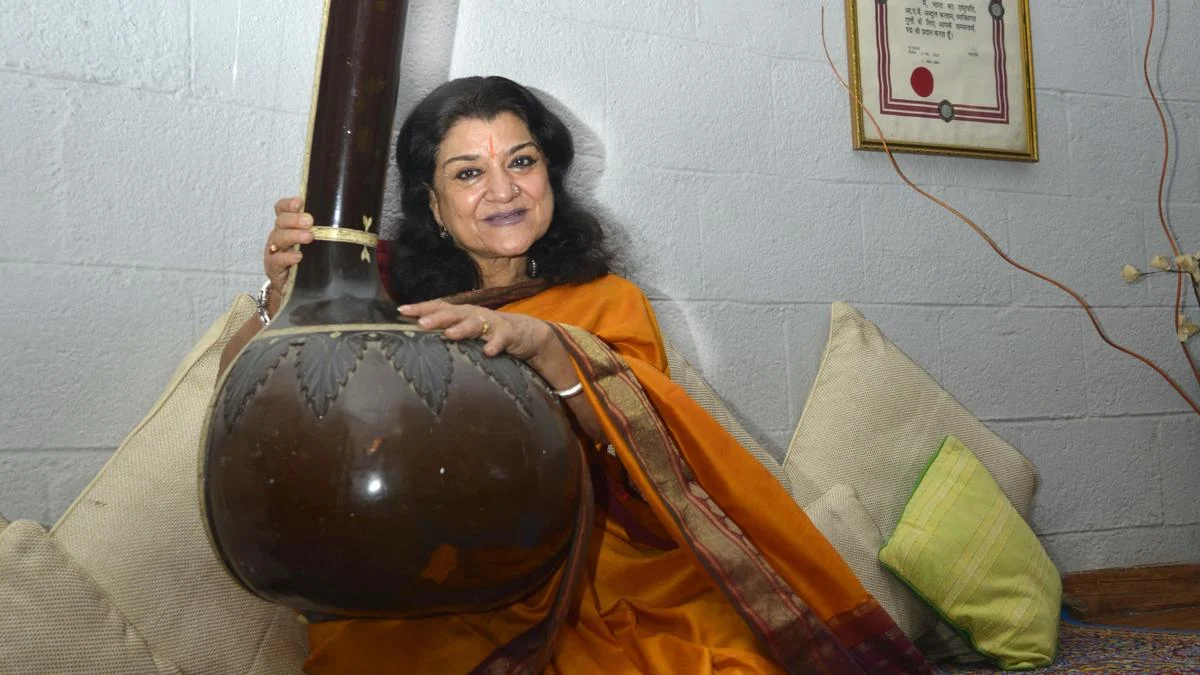
Noida, India – The serene Kaladham residence of Rita Ganguly, a sprawling, sun-drenched haven, immediately immerses visitors in an atmosphere steeped in artistic dedication. Tamburas stand in silent reverence, a testament to a life devoted to music, while a wood-panelled performance space whispers tales of a long and illustrious creative journey. Recently bestowed with the prestigious Sangeet Natak Akademi (SNA) Fellowship, Ganguly joins an esteemed echelon of artists whose profound influence has transcended generations, shaping the very contours of India’s performing arts landscape. Yet, to define her solely by accolades would be to diminish the breadth and depth of her contributions. A singer, dancer, actor, director, author, and fervent patron of the arts, she has navigated the complex currents of diverse disciplines with an almost effortless grace. Her intellect, sharp and refined, is matched only by her quick wit, and her meticulous attention to detail is a hallmark evident in every endeavor. This commitment to holistic artistic experience was vividly demonstrated at her music festival, Arohi, where she orchestrated a visually stunning spectacle of coordinated color themes and candlelit stage decor, creating an immersive environment where the visual and the aural converged in perfect harmony.
A Life Woven with Art: From "Baby Rita" to a National Treasure
Rita Ganguly’s extraordinary journey began in Lucknow in 1940, a city that nurtured her nascent artistic inclinations from a tender age. Her entry into the performing arts was serendipitous, marked by an unexpected childhood performance that earned her the endearing moniker "Baby Rita." With a twinkle in her eye and a laugh that belies her years, she recounts the incident: "I was quite young. Ustad Allaudin Khan and his disciples were on stage when the curtain got stuck, refusing to roll down. I too tried to do my bit, along with others, to extricate it. But I am told that amidst it all, I walked to the centre of the stage, did a namaskar, and started dancing! That, in a way, was my first public performance." This spontaneous act ignited a lifelong passion for dance, leading her to emulate the dancers she admired and, later, to formal training in Kathakali at the hallowed precincts of Shantiniketan.
Her dance education was nothing short of formidable, encompassing rigorous training under the tutelage of revered gurus. She honed her Kathakali skills under the guidance of Guru Kunchu Kurup and Guru Chandu Panikkar, mastered the nuanced art of abhinaya (expressive gesture) from Pt. Shambhu Maharaj, and delved into the graceful intricacies of Manipuri dance under Guru Maisnam Amubi Singh.
The reverence with which Ganguly speaks of her gurus is palpable, underscoring the profound impact they had on her artistic development. Her musical training, equally comprehensive, exposed her to the luminaries of 20th-century Indian classical music. She absorbed the melancholic beauty of ghazal from Begum Akhtar, the soulful expressions of thumri from Siddheshwari Devi, the profound depths of dhrupad from Pt. Gopeshwar Bandopadhyay, and the intricate melodic explorations of khayal from the Kirana gharana vocalist Pt. Mani Prasad. "I used to go to his house most evenings," she reminisces. "There would always be rasikas gathered there, and he was a very giving guru." Her repertoire was further enriched by her study of the Rajasthani maand singing under the tutelage of the legendary Allah Jilai Bai.
Global Stages, Enduring Love: A Performer’s Odyssey
Rita Ganguly’s artistic odyssey extended far beyond Indian shores, with extensive international tours cementing her reputation as a versatile and captivating performer. She looks back on her years abroad with a profound sense of gratitude. "I was fortunate to participate in many events overseas," she shares. "I performed Kathakali, travelled with Yamini Krishnamurthy’s Bharatanatyam productions, Birju Maharaj’s Kathak presentations, and the Jhaveri Sisters’ Manipuri performances. Putana Moksha was my most popular work. I travelled all over the world with it." It was during this vibrant period of her life that she met her husband, Keshav Kothari, a partnership that proved to be a cornerstone of her enduring success. "He supported me in every way and was always so proud of me," she states, her voice filled with affection. She attributes her considerable achievements not to innate talent alone, but to "hard work and an unwavering pursuit of perfection."
The Interconnectedness of Art: A Philosophy of Wholeness
The sheer diversity of Rita Ganguly’s training is remarkable, yet she firmly rejects the notion of artificial boundaries between artistic disciplines. "The arts are linked," she asserts, her conviction unwavering. "You should not separate them. Without being a trained musician, you can’t be a dancer. Without being a dancer, you cannot be a theatre artiste." She elaborates on the indispensable role of dance training in theatrical performance, emphasizing the necessity of "total control of your body and its movements. Theatre is all about movement; you cannot falter on stage." This holistic understanding of the arts informs her approach to teaching and practice, fostering a generation of artists who appreciate the synergistic relationship between different forms of expression.

A Legacy in Theatre: Shaping the National School of Drama
Rita Ganguly’s influence on generations of theatre practitioners is profound and far-reaching. Her association with the National School of Drama (NSD), beginning in 1968, has been a continuous and active engagement. Her most recent theatrical endeavor, the ambitious five-hour outdoor Sanskrit play Damayanti Nal Gatha (2025), based on a work attributed to Sage Veda Vyasa, stands as a testament to her directorial vision and deep understanding of classical Indian theatre. Drawing inspiration from the ancient Natyashastra, she meticulously choreographed the production to recreate the grandeur and aesthetic sensibilities of a bygone theatrical era. Despite the magnitude of her achievements, she remains remarkably humble, stating, "It was music that was my entry into theatre."
While her contributions to theatre are significant, many audiences also fondly remember her memorable rendition of the wedding song "Dhinak Dhinak Dha" in the 2005 film Parineeta. However, Ganguly dismisses the experience with characteristic candor: "Films were a waste of time for me. Without the live interaction, acting in films didn’t appeal." Her heart, she maintains, lies with the immediacy and visceral connection of live performance.
The Primacy of Music: A Singer’s Dedication
Despite her multifaceted artistic persona, Rita Ganguly primarily identifies herself as a musician. "I have really worked hard on this; accepted almost all concerts that came my way," she declares, highlighting her unwavering dedication to her craft. Her daughter, Meghna, who was present throughout the interview, corroborates this sentiment. "I remember Ma literally accepting any baithak however small," she says. "Baba (Keshav Kothari) used to play the tabla, accompanying her during her extensive riyaz at home." This unwavering commitment to music is reflected in the prestigious awards she has received, all recognizing her profound contributions to the field: the Sangeet Natak Akademi Award in 1999, the Padma Shri in 2003, and now, the Sangeet Natak Akademi Fellowship for 2025.
Inspiring Lights: A Pantheon of Artistic Mentors and Influences
A true role model, Rita Ganguly readily shares the names of the artistes who have ignited her imagination and guided her artistic path. "The dancer who moved me the most was Yamini Krishnamurthy," she states. "As a singer, right now I feel it is young Dagar (Ustad Wasifuddin Dagar)… what voice control! Ravi Shankar was the finest musician, I feel. In theatre, Ebrahim Alkazi. And in the past, I loved the rendition of ‘Nadiya kinare‘ by Badi Moti Bai." This curated list reflects a deep appreciation for artistry that transcends stylistic boundaries and historical periods.
A Legacy of Literary Expression and Unfulfilled Ambitions
Beyond her performing and directing prowess, the multifaceted artiste has also authored two books. She expresses particular excitement about her book on Begum Akhtar, slated for adaptation into a film, a testament to her enduring admiration for her guru. Looking back on a life richly adorned with artistic accomplishments across a broad spectrum of disciplines, Ganguly admits to a single, poignant regret. "I wish I could have produced more plays," she muses, a flicker of longing in her eyes. "Perhaps the Mahabharata." This desire to bring epic narratives to life on stage speaks volumes about her artistic aspirations and the boundless potential she still sees within herself. The Sangeet Natak Akademi Fellowship is not merely an acknowledgment of past achievements but a recognition of an artist whose spirit of inquiry and dedication to the arts continues to inspire and resonate.
