

The Indian automotive sector is currently witnessing a paradigm shift as legacy manufacturers pivot from internal combustion engines (ICE) toward sustainable mobility. At the forefront of this transition is Hyundai Motor India Limited (HMIL), which is preparing a multi-pronged offensive to capture the burgeoning electric vehicle (EV) market. While the upcoming Creta Electric has dominated headlines, a new, more accessible contender has recently emerged from the shadows.
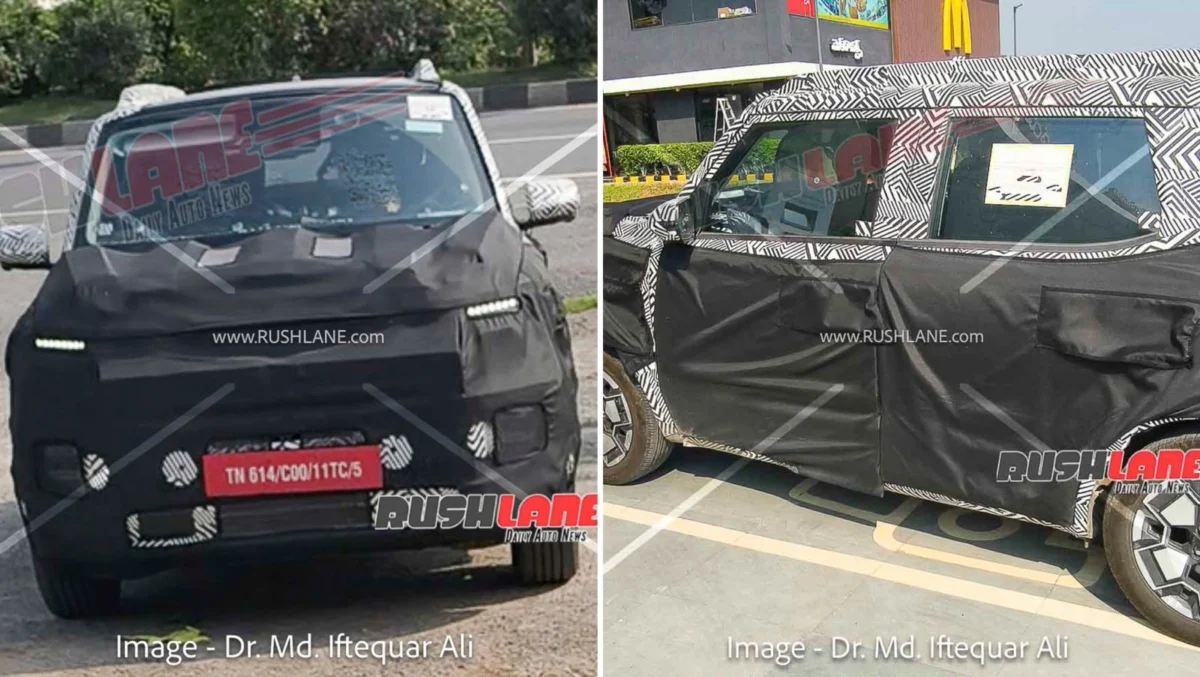
Codenamed the HE1i, Hyundai’s upcoming sub-4-metre electric SUV was recently spotted undergoing rigorous testing and charging validation in Vijayawada and other parts of India. These sightings have provided the most detailed look yet at the vehicle that could potentially democratize high-tech electric mobility in the country.

1. Main Facts: The Vijayawada Sighting and Technical Clues
The most recent development in the HE1i’s road to production occurred at the Hyundai Maya Autobahn charging station in Vijayawada. A prototype, heavily draped in fabric camouflage, was photographed while the testing team engaged with station personnel.
The 120 kW Charging Mystery
According to eyewitness reports from Dr. Md. Iftequar Ali, the Hyundai testing team specifically enquired about the availability of a 120 kW DC fast-charging connector. This detail is significant for several reasons:

- Infrastructure Stress-Testing: Hyundai is currently expanding its own "Ultra-Fast" charging network across India. Testing the vehicle’s compatibility with 120 kW and 180 kW units suggests that the HE1i is being engineered to handle high-output charging environments.
- Charging Capabilities: While the current Creta EV (based on international specs) supports roughly 100 kW DC fast charging, the HE1i’s request for a 120 kW unit hints at a sophisticated Battery Management System (BMS). Even if the vehicle’s peak intake is lower (e.g., 50-70 kW), testing on higher-rated chargers ensures the hardware can safely communicate with the most powerful chargers currently available on Indian highways.
- Segment Benchmarking: If the HE1i supports charging speeds north of 50 kW, it would place it at the top of the compact EV segment, potentially offering a 10% to 80% charge in under 30 minutes.
Aesthetic and Functional Design
Simultaneous sightings by road observers (including Reddit user u/lightnextnow) have revealed a split-headlamp architecture. Interestingly, two different configurations have been spotted:
- Variant A (Likely High-Trim): Features slim horizontal LED lighting elements housed behind a mesh, suggesting a futuristic "pixel" aesthetic similar to the IONIQ series.
- Variant B (Likely Mid/Base-Trim): Utilizes a more traditional, larger projector-style assembly in the lower bumper.
Both versions retain the signature high-mounted slim DRL strip, confirming that Hyundai is maintaining a consistent family identity across different price points.

2. Chronology: The Evolution of the HE1i Project
The journey of the HE1i from a global concept to an Indian-localized prototype has been swift, reflecting Hyundai’s urgency to counter domestic rivals like Tata Motors.
- Late 2023: Hyundai announces a massive investment of ₹20,000 crore in Tamil Nadu to establish an EV ecosystem, including battery pack assembly and new model development.
- Mid-2024: The Hyundai "Inster" (the international version of the HE1i) is unveiled globally. Speculation begins regarding its arrival in India as a successor to the Santro or an electric alternative to the Exter.
- Late 2024: First "mule" sightings appear in South Korea and near Hyundai’s Chennai plant. The codename HE1i is identified by industry insiders.
- Early 2025 (Projected): Finalization of the localized component supply chain, specifically focusing on the battery chemistry suited for Indian ambient temperatures.
- Late 2026: Expected production start at the Sriperumbudur facility.
- February 2027: Official market launch anticipated at the Bharat Mobility Auto Expo.
3. Supporting Data: Platform, Battery, and Interior Technology
To understand the HE1i, one must look at its architectural DNA. The vehicle is built on the E-GMP (K) platform, a modified version of the Electric Global Modular Platform designed specifically for smaller, more affordable vehicles.

Performance Specifications (Based on Global Counterpart ‘Inster’)
While Indian specifications are yet to be finalized, the international model provides a reliable baseline:
- Battery Options: A standard 42 kWh battery and a long-range 49 kWh variant.
- Range: The 49 kWh version delivers a WLTP-rated range of approximately 355 km. In the Indian context (MIDC cycle), this could translate to a range of 400-420 km.
- Powertrain: A single motor driving the front wheels, producing between 97 PS and 115 PS depending on the battery configuration.
The "Living Room" Interior
Spy shots of the HE1i’s cabin reveal a departure from the rugged, utilitarian interiors of traditional small cars.

- Screens: A dual-screen setup featuring a 10.25-inch digital instrument cluster and a 10.25-inch infotainment touchscreen.
- Connectivity: The "Pleos Connect" system is expected to debut, offering advanced telematics, remote climate control, and EV-specific route planning that integrates charging station stops.
- Safety: In a segment-first move, Hyundai is expected to equip the HE1i with Level 2 ADAS (Advanced Driver Assistance Systems), including autonomous emergency braking, lane-keep assist, and adaptive cruise control.
4. Official Strategy and Localisation Efforts
Hyundai Motor India has been vocal about its "India First" strategy for EVs. Unlike the IONIQ 5, which is a halo product brought in via CKD (Completely Knocked Down) kits, the HE1i is a cornerstone of Hyundai’s volume aspirations.
The Tamil Nadu Hub
The Sriperumbudur plant in Tamil Nadu is being transformed into a dedicated EV hub. The HE1i will benefit from:

- Local Battery Sourcing: Hyundai has signed a Memorandum of Understanding (MOU) with Exide Energy Solutions for the local production of LFP (Lithium Iron Phosphate) cells. These cells are known for their thermal stability and longevity, making them ideal for the Indian climate.
- Supply Chain Integration: By localizing the motor, inverter, and battery assembly, Hyundai aims to price the HE1i competitively against the Tata Punch EV.
Official Statements
While Hyundai executives have remained tight-lipped about specific codenames, Unsoo Kim, MD & CEO of Hyundai Motor India, has previously stated that the company plans to launch five EV models by 2030. The HE1i is widely understood to be the second major pillar of this plan, following the Creta EV.
5. Market Implications: Disrupting the Status Quo
The arrival of the HE1i carries significant weight for the Indian automotive market, affecting competitors, consumers, and infrastructure providers alike.

Challenging the Incumbent
Currently, Tata Motors commands over 70% of the Indian EV market, largely due to the success of the Tiago.ev and Punch.ev. The HE1i is a direct shot across the bow. With Hyundai’s reputation for superior "fit and finish" and a more extensive global R&D pool, the HE1i could attract buyers who have been hesitant to switch to EVs due to perceived quality or reliability concerns in domestic offerings.
Redefining the Sub-4-Metre Segment
The HE1i’s boxy profile and high ground clearance cater perfectly to the Indian preference for SUVs. However, its electric nature allows for a "wheels-at-the-corners" design, maximizing interior legroom beyond what is possible in an ICE vehicle of the same length. This makes it a viable primary car for small urban families, rather than just a secondary "city runabout."

Accelerating Infrastructure
The sighting in Vijayawada highlights a crucial trend: as manufacturers launch vehicles capable of higher charging speeds, private and public charging providers will be incentivized to upgrade their hardware. Hyundai’s proactive testing at 120 kW stations signals to the industry that the "slow charging" era of early Indian EVs is coming to an end.
Conclusion: The Road Ahead
The Hyundai HE1i represents more than just a new model; it is a testament to the maturity of the Indian EV market. By bringing a global platform (E-GMP K) to a local manufacturing base and tailoring it with localized battery technology and high-end features like ADAS, Hyundai is refusing to compromise on the "small car" experience.

As the prototype continues its journey across the diverse terrains of India—from the humid plains of Andhra Pradesh to the congested streets of Chennai—each sighting brings us closer to a vehicle that could very well be the tipping point for mass EV adoption in India. When it finally rolls onto the stage at the Bharat Mobility Auto Expo in 2027, the HE1i will not just be competing for sales; it will be defining the new standard for the modern Indian commuter.
