

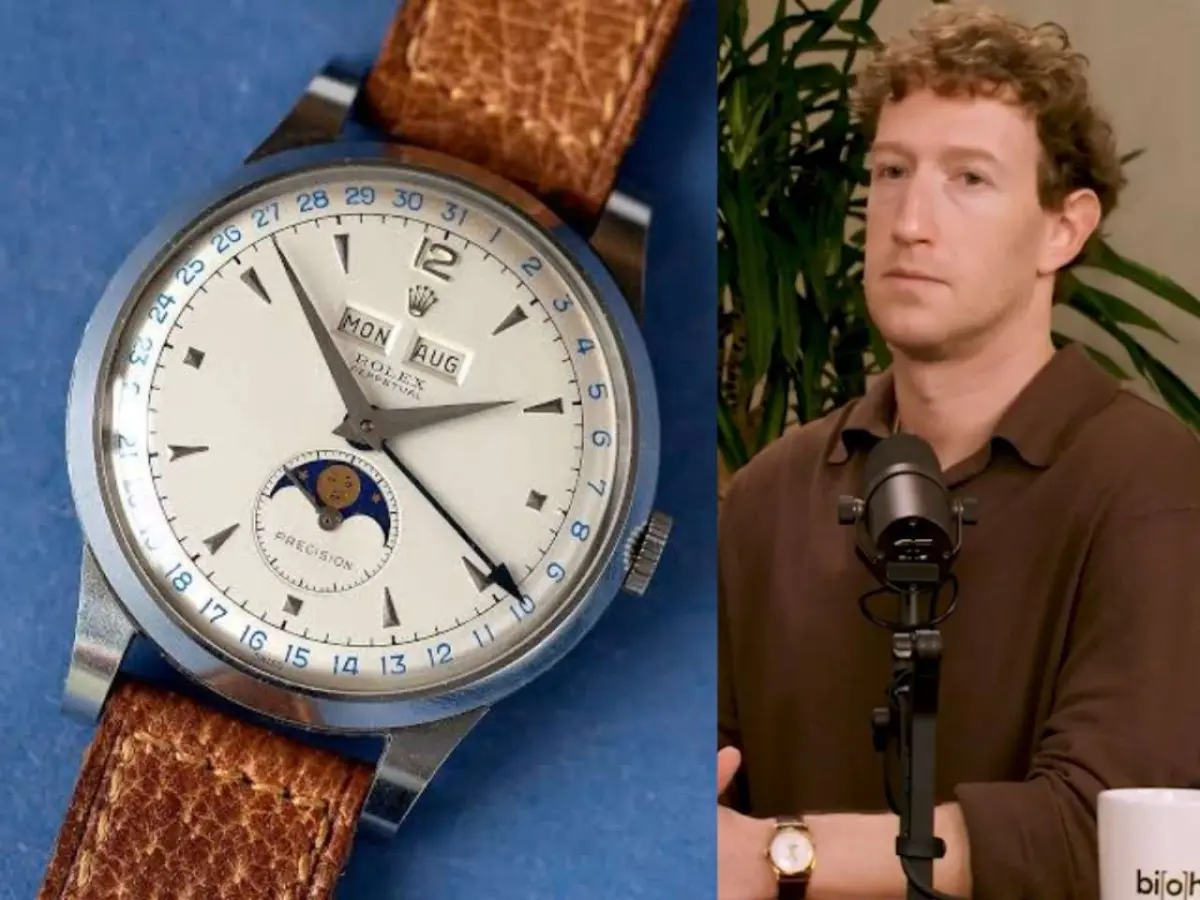
San Francisco, CA – In a rare public display that transcended the typical Silicon Valley discourse on artificial intelligence and its future, Meta CEO Mark Zuckerberg recently captivated a different kind of audience: horological enthusiasts and luxury watch aficionados. During an appearance on the "No Priors" podcast, Zuckerberg was spotted sporting a vintage Rolex Ref. 6062 "Stelline," a timepiece so exclusive and historically significant that its estimated value has soared to a staggering USD 2 million. This exquisite mechanical marvel, designed to meticulously track the moon’s cyclical journey, inadvertently stole the spotlight from the couple’s profound discussions on leveraging AI to revolutionize biomedical research.
While Zuckerberg and his wife, Priscilla Chan, eloquently articulated their ambitious vision for the Chan Zuckerberg Initiative’s Biohub – a cutting-edge medical research facility dedicated to developing sophisticated computer models for disease identification, treatment, and eradication – it was the gleam of gold on Zuckerberg’s wrist that ignited a global conversation. The juxtaposition of a tech titan at the forefront of digital innovation, discussing the most advanced frontiers of AI, with a meticulously crafted analogue instrument from the mid-20th century, offered a compelling narrative of enduring craftsmanship and timeless elegance.
)
A Glimpse into a Coveted Past: The Allure of the Rolex Ref. 6062 Stelline
The Rolex Ref. 6062, particularly the "Stelline" variant, represents a pinnacle of mid-century horological artistry and rarity. Its desirability stems from a confluence of factors: limited production, an exceptionally complex complication for its era, and the enduring prestige of the Rolex brand. Unlike the robust, tool-focused watches that would later define Rolex’s professional collections, the Ref. 6062 was a dress watch of unparalleled sophistication, showcasing Rolex’s early prowess in creating intricate and aesthetically refined timepieces.

The "Stelline" moniker, derived from the Italian word for "little stars," refers to the distinctive star-shaped hour markers that adorn the dials of some of these rare examples. This particular detail, combined with the watch’s iconic moon phase complication, elevates it to a level of exclusivity that few timepieces can rival. The moon phase indicator, a complex mechanism that displays the current phase of the moon, was not merely a decorative feature; it was a testament to the intricate mechanical engineering capabilities of Rolex in the 1950s. For a watch to accurately track these lunar cycles required a sophisticated understanding of gear trains and astronomical movements, a feat that was both technically challenging and highly coveted by discerning collectors.
)
The Genesis of a Legend: Rolex’s Post-War Horological Ambitions
The Rolex Ref. 6062 emerged during a pivotal period in Rolex’s history, around 1950. This era predated the widespread recognition of Rolex for its legendary professional watches like the Submariner, Explorer, and GMT-Master. Instead, Rolex was actively cultivating its reputation for producing elegant and technically advanced dress watches, catering to a clientele that valued both precision and prestige. The Ref. 6062, along with its sibling reference the Ref. 8171 (which lacked the waterproof case of the 6062), represented the zenith of Rolex’s calendar and moon phase complications in wristwatch form.
)
The production of the Ref. 6062 was remarkably limited. Rolex manufactured only a few thousand examples of this reference over its production run, which spanned from approximately 1950 to 1956. This scarcity alone contributes significantly to its current market value. Furthermore, the variations in case materials – including yellow gold, rose gold, and the exceptionally rare stainless steel – and the specific dial configurations, such as the aforementioned "Stelline" markers, further stratify its rarity and desirability.
)
The Unseen Value: What Drives the $2 Million Price Tag?
The astronomical valuation of Zuckerberg’s Rolex Ref. 6062 "Stelline" is not merely a speculative figure; it is a reflection of the confluence of exceptional condition, historical significance, and the escalating demand for rare vintage timepieces. Several factors contribute to such a substantial price:
)
- Rarity of Production: As mentioned, the limited number of Ref. 6062 watches ever produced makes each surviving example inherently valuable.
- Condition and Originality: In the realm of vintage watches, originality and pristine condition are paramount. A watch that retains its original dial, case, movement, and even its original finishing commands a significantly higher price. Many vintage watches have undergone polishing, dial refinishing, or component replacements over the decades, diminishing their historical integrity and, consequently, their value. A timepiece that has been exceptionally well-preserved, with minimal signs of wear and all original parts intact, is a rare find.
- Complication and Dial Variants: The presence of the moon phase complication itself adds a layer of mechanical complexity and visual appeal that is highly sought after. Specific dial configurations, such as the "Stelline" dial, are considered exceptionally rare and desirable, often fetching premiums at auctions.
- Provenance and Ownership: While not explicitly stated in the initial report, the ownership of such a timepiece by a prominent figure like Mark Zuckerberg can, in some circles, lend an additional layer of mystique and desirability, although its inherent value is primarily driven by its horological merit.
- Market Demand: The vintage watch market has experienced a significant boom in recent years, with collectors and investors actively seeking out rare and historically important timepieces. This increased demand, coupled with limited supply, naturally drives up prices.
Pieces in exceptional condition, retaining their original dials and cases, have consistently fetched figures exceeding USD 1 million at major international auctions. The rarest configurations, like the "Stelline" with a pristine dial and unpolished case, can indeed reach or surpass the USD 2 million mark, as estimated for Zuckerberg’s timepiece. Prestigious auction houses such as Phillips, Christie’s, and Sotheby’s regularly feature these horological treasures, witnessing fierce bidding wars among collectors.
)
A Philosophical Counterpoint: The Analog Heart in a Digital World
The presence of this exquisite mechanical watch on the wrist of a man who has fundamentally shaped the digital landscape, and who is now a leading proponent of AI’s transformative power, offers a compelling philosophical counterpoint. Zuckerberg, with an estimated net worth of $200 billion, has built his empire on the bedrock of digital innovation. Yet, his choice of a 1950s analogue instrument, a product of intricate mechanical engineering and traditional craftsmanship, stands in stark contrast to the cutting-edge AI algorithms he discussed on the podcast.
)
This choice can be interpreted in several ways. It could signify an appreciation for enduring quality and heritage, a personal preference for tangible craftsmanship in an increasingly virtual world. It might also suggest a deeper understanding of the cyclical nature of innovation – how past technological advancements, even those seemingly superseded, hold intrinsic value and can inform future progress. The moon phase complication itself, a constant reminder of natural cycles and ancient timekeeping methods, serves as a grounding element amidst discussions of futuristic technologies.
)
The Broader Implications: Beyond the Wristwatch
The revelation of Zuckerberg’s Rolex Stelline has implications that extend beyond the realm of luxury goods and celebrity spotting.
)
- The Enduring Appeal of Mechanical Horology: In an age where smartphones provide the time with unparalleled accuracy, the continued fascination with mechanical watches, particularly vintage ones, highlights a persistent human desire for craftsmanship, heritage, and a tangible connection to history. These timepieces are not merely tools; they are miniature works of art and engineering marvels that carry stories and evoke emotions.
- The Intersection of Technology and Tradition: Zuckerberg’s choice underscores the intriguing ways in which cutting-edge technologists engage with traditional crafts. It suggests that innovation does not necessarily necessitate the abandonment of the past but can often be enriched by an appreciation for its foundational elements.
- A Shift in Public Perception: For many, this glimpse into Zuckerberg’s personal life, specifically his appreciation for such a rare and valuable item, humanizes him and offers a different perspective beyond his public persona as a tech mogul. It sparks curiosity about the individuals behind the technological revolutions and their personal tastes and values.
- The Value of Rarity and Craftsmanship in the Age of AI: As AI continues to automate and optimize various aspects of our lives, the intrinsic value of unique, handcrafted objects, made with human skill and artistry, may become even more pronounced. The Rolex Stelline, a testament to human ingenuity from a bygone era, serves as a powerful reminder of what can be achieved through dedication to craft and a pursuit of perfection.
In conclusion, Mark Zuckerberg’s appearance on the "No Priors" podcast offered a dual narrative. While the substance of his and Priscilla Chan’s discussion delved into the profound potential of AI to reshape healthcare, the visual spectacle of his $2 million Rolex Ref. 6062 "Stelline" provided a captivating subplot. It served as a poignant reminder that even in the relentless march of technological progress, the allure of enduring craftsmanship, historical significance, and mechanical artistry continues to hold an undeniable and considerable value. The billionaire’s lunar timepiece, a symbol of a different era of innovation, has undoubtedly etched its place in the ongoing narrative of human achievement, both technological and artisanal.
