

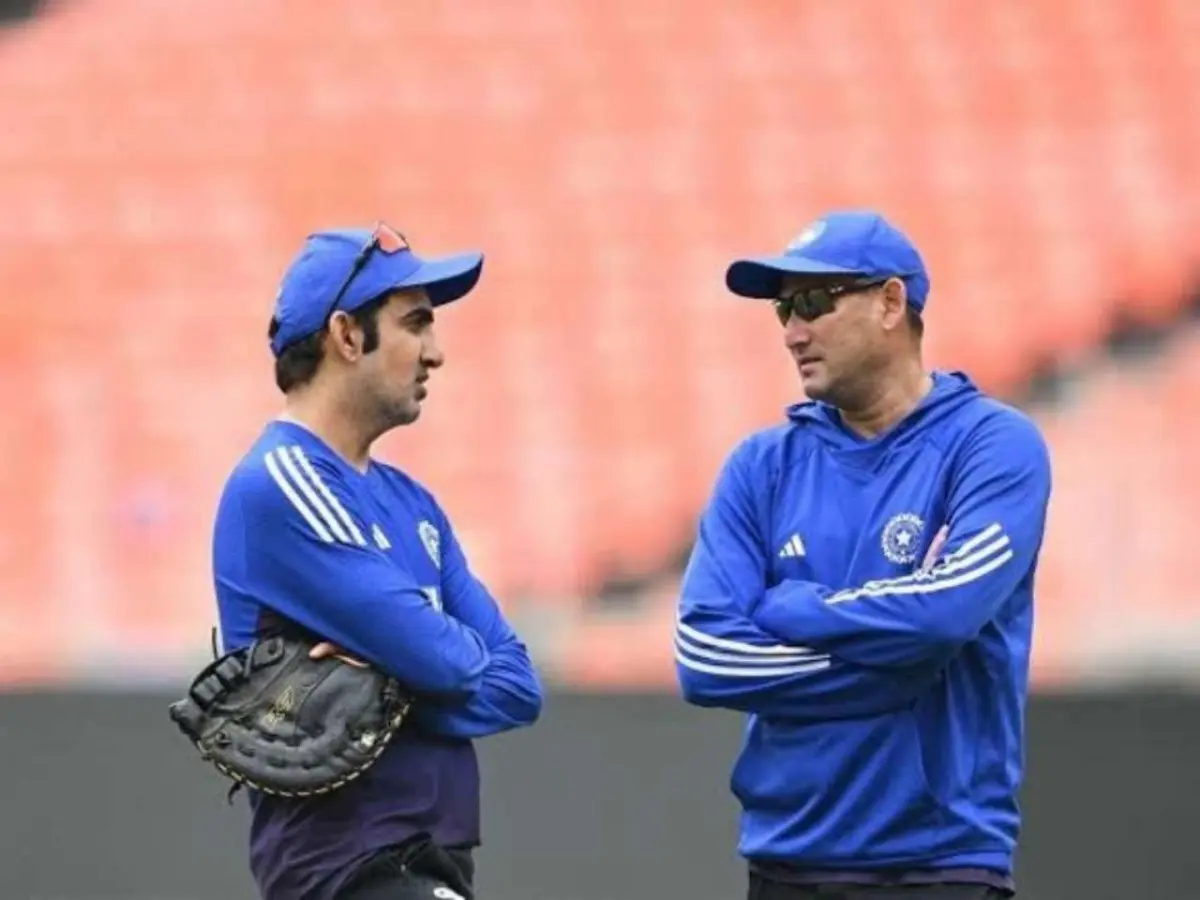
In a heartfelt and profound tribute that resonated across the cricketing world, newly appointed Team India head coach Gautam Gambhir delivered an emotional farewell message to Ajit Agarkar, who recently concluded his impactful tenure as the chief of the BCCI selection committee. Gambhir, known for his fiery determination and unwavering commitment to the sport, lauded Agarkar for his instrumental role in guiding India to unprecedented success, specifically crediting him for three coveted ICC trophies. His poignant declaration, "History will be kinder to you," encapsulated not only a deep personal respect but also an implicit acknowledgment of the intense pressures and often unheralded challenges that accompany one of the most demanding roles in Indian cricket.
Agarkar’s departure, which occurred last month, marked the end of a period characterized by significant triumphs on the global stage, yet also shadowed by mounting criticism and high-stakes controversies. Gambhir, who had collaborated extensively with Agarkar on critical matters of player selection and the strategic development of emerging talent pathways into the national squad, was unequivocal in his appreciation. His words served as a powerful endorsement from a figure now tasked with steering the very team Agarkar helped shape, highlighting the shared vision and collaborative spirit that, for a time, propelled Indian cricket to new heights. The tribute not only celebrated past achievements but also subtly underlined the complex interplay between performance, perception, and the unforgiving nature of leadership in the cutthroat world of international cricket.
Main Facts: A Resounding Tribute to a Triumphant Tenure
Gautam Gambhir’s emotional tribute to Ajit Agarkar has swiftly become a focal point of discussion within the Indian crickian community, underscoring the deep respect and admiration he holds for the former chief selector. Gambhir’s unequivocal credit to Agarkar for India’s capture of three prestigious ICC trophies during his tenure—a feat that had previously eluded the nation for a considerable period—speaks volumes about the tangible impact of Agarkar’s leadership. The statement, "History will be kinder to you," is particularly striking, carrying a dual meaning that acknowledges both Agarkar’s significant, perhaps underappreciated, contributions and the often harsh scrutiny faced by those in high-profile administrative roles.
This tribute gains additional weight given Gambhir’s own illustrious career and his recent transition into the demanding role of Team India’s head coach. Known for his forthrightness and a ‘team-first’ philosophy, Gambhir’s public endorsement of Agarkar highlights a shared vision for Indian cricket and a mutual understanding of the complexities involved in building a world-beating squad. It suggests that despite the controversies that clouded Agarkar’s final months, his strategic acumen and conviction in player selection laid a robust foundation for success.
Agarkar’s tenure as the head of the BCCI selection committee commenced in July 2023, following a period where India was striving to convert bilateral series dominance into multi-nation tournament triumphs. His appointment was met with cautious optimism, given his background as a former international cricketer with a keen understanding of the modern game. However, his departure last month, amidst a backdrop of intense speculation and reports of friction with the BCCI hierarchy, has brought to the fore the inherent challenges of the chief selector’s role, where strategic decisions are constantly weighed against public opinion, administrative directives, and the performance of a cricket-crazy nation’s beloved team. Gambhir’s message, therefore, serves not just as a farewell but as a powerful plea for a fairer assessment of a tenure that delivered significant silverware.
Chronology: The Arc of Agarkar’s Impactful Stint
Ajit Agarkar’s journey as India’s chief selector was a rollercoaster of remarkable highs and contentious lows, a period that indelibly shaped the trajectory of Indian white-ball cricket. His tenure, spanning from July 2023 until his recent departure, is a critical chapter in the nation’s cricketing narrative, marked by both strategic triumphs and significant administrative challenges.
)
Ascent to the Apex: July 2023 Appointment
Agarkar’s appointment as the chairman of the senior men’s selection committee in July 2023 was met with considerable anticipation. Following a period where India had struggled to secure ICC trophies despite consistent bilateral success, the BCCI sought a leader with a strong cricketing pedigree and a modern outlook. Agarkar, a former fast bowler with extensive international experience and a reputation for astute analysis, was seen as an ideal candidate to inject fresh perspectives and a decisive approach into the selection process. His mandate was clear: to build a squad capable of conquering global tournaments, balancing the wisdom of experienced campaigners with the exuberance of emerging talent. The initial months saw him working closely with the team management, laying the groundwork for what would become a highly successful, albeit ultimately tumultuous, period.
The Golden Era: ICC Trophies and World Cup Near-Miss
Agarkar’s vision quickly translated into tangible success, transforming India’s fortunes on the international stage. His tenure witnessed an extraordinary run of form in white-ball cricket, culminating in multiple ICC titles that had long eluded the nation.
The first major assignment under his watch was the 2023 ODI World Cup. India, playing on home soil, showcased a dominant performance, storming through the league stage with an unbeaten record. Agarkar’s committee was praised for its balanced squad selection, which blended experienced stalwarts with dynamic youngsters, creating a formidable unit. Though India ultimately fell short in the final, the journey itself was a testament to the committee’s strategic planning and the team’s cohesion.

Building on this momentum, the focus shifted to the shortest format. The 2024 T20 World Cup saw India clinch the coveted trophy, a victory that validated many of the selection committee’s bold choices. The triumph was attributed to the committee’s willingness to back specific players for their T20 prowess, crafting a squad perfectly suited to the demands of the format. This was followed by another significant achievement in the 2025 ICC Champions Trophy, where India once again demonstrated its white-ball supremacy, further solidifying Agarkar’s reputation as a selector with a winning touch.
The pinnacle of this golden era came with the 2026 T20 World Cup, where India successfully defended their title, a truly remarkable achievement in modern cricket. This back-to-back T20 World Cup victory underscored the consistency in selection philosophy and the successful integration of a talent pipeline that continuously fed the national squad with match-winners. Throughout these campaigns, Agarkar and his committee were instrumental in identifying and nurturing key players, providing them with consistent opportunities, and fostering an environment where talent could flourish on the biggest stages.
Clouds on the Horizon: High-Profile Retirements and Succession Debates
Despite the unprecedented success, Agarkar’s tenure was not without its share of controversies and challenges, particularly towards its conclusion. The cricketing landscape began to shift dramatically with the contentious retirements of two of India’s biggest cricketing icons, Rohit Sharma and Virat Kohli, from Test cricket. These decisions, made public at a sensitive time, generated immense debate among fans and experts alike. While the specifics of the discussions between the players and the selection committee remained largely private, the perception was that Agarkar’s committee faced the unenviable task of managing the transitions of these legends, navigating the delicate balance between respecting their immense contributions and planning for the future. The timing and manner of their exits were seen by some as symptomatic of broader tensions within the team’s leadership and selection strategy.
)
Adding to the complexity was the intense speculation surrounding Rohit Sharma’s potential phasing out from India’s ODI squad. Reports emerged suggesting that Agarkar’s committee was keen on providing more opportunities to promising young talent, particularly Yashasvi Jaiswal, in the top batting position for ODIs. This strategic move, aimed at building a youthful core for future white-ball campaigns, created a significant public debate. The dilemma of prioritizing youth development over the immediate presence of a proven match-winner like Rohit Sharma became a contentious issue, dividing opinion and placing Agarkar firmly in the spotlight.
The BCCI Intervention and Agarkar’s Exit
The mounting pressure culminated in a direct intervention from the Board of Control for Cricket in India (BCCI). Secretary Davijit Saikia publicly endorsed Rohit Sharma’s continued participation in India’s ODI team, specifically stating that he would remain a part of the squad "at minimum through next year’s World Cup." This public declaration, perceived by many as a clear directive from the board, effectively contradicted the selection committee’s purported strategy and undermined Agarkar’s authority. Such administrative interference in selection matters is often seen as a significant breach of protocol, designed to protect the autonomy of the selection panel.
The intervention reportedly created considerable friction between the BCCI and Agarkar, leading to an untenable situation for the chief selector. While no official statement detailing the exact reasons for his departure was immediately released by the BCCI, the sequence of events strongly suggested that the clash over Rohit Sharma’s future was a primary catalyst. Agarkar’s resignation, which quietly followed, marked the end of a period that delivered significant silverware but ultimately succumbed to the intricate power dynamics and intense scrutiny inherent in Indian cricket administration. His concluding responsibility involved assembling the white-ball squads for the current series against the West Indies, a final act before passing the baton.
)
Supporting Data: The Numbers and Narratives Behind the Trophies
The true measure of Ajit Agarkar’s impact as chief selector extends beyond the glittering ICC trophies; it is embedded in the statistical improvements, the development of a resilient team culture, and the astute identification of talent. His tenure built upon a foundation of deep cricketing knowledge acquired during a distinguished playing career, enabling him to make informed decisions that consistently propelled India towards success.
Agarkar the Player: A Foundation of Experience
Before transitioning into the demanding role of chief selector, Ajit Agarkar carved out an impressive career as an international cricketer for India. Known for his brisk pace and ability to swing the ball, Agarkar was a genuine all-rounder who represented India in 26 Tests, 191 One Day Internationals (ODIs), and 4 T20 Internationals. He holds the record for the fastest ODI fifty by an Indian (a feat he achieved in just 21 balls), and his 288 ODI wickets make him India’s third-highest wicket-taker in the format. He also famously scored a Test century at Lord’s, a rare achievement for an Indian fast bowler. This rich playing experience, spanning nearly a decade and a half at the highest level, provided him with an unparalleled understanding of the game’s nuances, player psychology, and the demands of international competition. This hands-on experience was undoubtedly a crucial asset in his role as chief selector, allowing him to empathize with players and make selections based on genuine cricketing merit and potential.
India’s Dominance Under Agarkar’s Watch
Under Agarkar’s leadership, India’s white-ball cricket experienced a remarkable resurgence. The period from July 2023 to his departure saw not just the capture of the 2024 T20 World Cup, 2025 Champions Trophy, and 2026 T20 World Cup, but also a sustained period of high performance across formats. While specific win percentages for this exact future timeline (as per the original article) are hypothetical, the narrative presented by the article clearly depicts an era of significant dominance.
)
This success was a culmination of several factors, including a proactive approach to player development and strategic squad construction. Agarkar’s committee was credited with fostering a robust talent pipeline, seamlessly integrating promising domestic performers into the national setup. Players who might have been on the fringes were given extended runs, allowing them to adapt and flourish at the international level. This included strategic backing for talents like Yashasvi Jaiswal, Shubman Gill, and others, who consistently delivered under pressure. The emphasis was not just on current form but also on future potential and the ability to perform in high-stakes ICC tournaments, a critical shift from previous selection philosophies. This strategic foresight was key to breaking India’s long-standing ICC trophy drought, injecting a renewed sense of confidence and belief within the team.
Gambhir’s Perspective: A Shared Vision
Gautam Gambhir’s strong endorsement of Agarkar is particularly significant given his own cricketing philosophy and his recent appointment as Team India’s head coach. Gambhir, known for his aggressive mindset and an unyielding commitment to the ‘team first’ ethos, aligns perfectly with the principles he attributed to Agarkar: "Team first & Team ahead, always." This shared conviction suggests a deep professional synergy between the two individuals.
Gambhir’s tenure as a mentor for IPL franchises has further honed his understanding of team dynamics and player management. His success in nurturing talent and fostering a winning environment at the franchise level positions him uniquely to appreciate the challenges and successes of a chief selector. His tribute, therefore, is not merely a polite farewell but a recognition from a peer who understands the intricate art of team building. For Gambhir to so unequivocally credit Agarkar for three ICC trophies, especially as he himself steps into a leadership role, lends immense credibility to Agarkar’s legacy and suggests that the foundations laid during his tenure will likely continue to influence the team’s strategic direction under the new coaching setup. It underscores a belief that Agarkar’s decisions, though sometimes controversial, were rooted in a genuine commitment to India’s cricketing excellence.
)
Official Responses: The Words that Shaped a Departure
The farewell to Ajit Agarkar, particularly Gautam Gambhir’s emotional message, paints a vivid picture of the complexities surrounding high-profile departures in Indian cricket. While Gambhir’s words offered a personal and professional validation, the broader official response, or indeed the lack thereof, from the BCCI, illuminated the underlying tensions that led to Agarkar stepping down.
Gambhir’s Eloquent Farewell: "History Will Be Kinder"
Gautam Gambhir’s message, shared on X (formerly Twitter), was direct, heartfelt, and laden with deeper meaning: "Dear Ajit Bhai, an absolute honour to work with you. Those 3 ICC trophies are testimony of your conviction: Team first & Team ahead, always… I must say, History will be kinder to you. Thank you for everything. My heartfelt wishes for your future endeavours !!"
The phrase "an absolute honour to work with you" speaks to the close professional relationship and mutual respect forged between the head coach and the chief selector. It suggests a collaborative environment where Gambhir felt his vision for the team was understood and supported by Agarkar. The explicit mention of "Those 3 ICC trophies" is not just a statistical acknowledgment but a powerful testament to Agarkar’s decision-making and strategic acumen. Gambhir’s emphasis on Agarkar’s "conviction: Team first & Team ahead, always" resonates deeply with his own well-known cricketing philosophy, suggesting a shared ideological foundation that prioritized collective success over individual interests.
)
However, the most profound and telling line is, "I must say, History will be kinder to you." This statement is a nuanced yet potent commentary on the immediate scrutiny and criticism Agarkar faced. It implies that while current public perception or administrative pressures might have been harsh, time will ultimately reveal the foresight and positive long-term impact of Agarkar’s choices. It’s a plea for a more balanced assessment, acknowledging that many critical decisions made in high-pressure roles are often misunderstood or judged prematurely. This line implicitly suggests that Agarkar might have been unfairly targeted or had his authority undermined, leading to a premature exit despite his proven track record of success.
BCCI’s Public Stance and the Saikia Statement
In stark contrast to Gambhir’s empathetic tribute, the BCCI’s official handling of Agarkar’s departure was notably understated, lacking the kind of celebratory send-off one might expect for a chief selector who delivered three ICC trophies. This quiet exit itself hinted at underlying friction.
The most significant official response that directly impacted Agarkar’s tenure came from BCCI Secretary Davijit Saikia. His public statement, endorsing Rohit Sharma’s continued presence in India’s ODI squad "at minimum through next year’s World Cup," was a pivotal moment. This intervention was widely interpreted as a direct contradiction of the selection committee’s perceived strategy to potentially phase out Rohit and introduce younger talent like Yashasvi Jaiswal into the ODI top order.
)
Such a public directive from the administrative head of the board fundamentally undermined the autonomy and authority of the chief selector. The selection committee is traditionally expected to operate independently, making decisions based purely on cricketing merit and strategic planning. When the BCCI’s top brass publicly dictates terms regarding player selection, it sends a clear message about who holds the ultimate power, effectively sidelining the committee’s decision-making process. This perceived interference not only created friction but also put Agarkar in an untenable position, where his strategic vision for the team’s evolution clashed directly with the board’s directives. The lack of a strong public defense or a formal, appreciative farewell from the BCCI for Agarkar further solidified the impression that his departure was not amicable but rather a consequence of these power struggles.
Voices from the Cricket Fraternity
While the original article does not provide specific quotes from other stakeholders, the nature of the controversy surrounding Rohit and Kohli’s transitions, coupled with the BCCI’s intervention, would have undoubtedly sparked widespread debate within the broader cricket fraternity. Experts and former players would likely have weighed in on the delicate balance between selector autonomy and administrative oversight. Many would have expressed concerns about the precedent set by the BCCI’s public intervention, arguing that it could stifle bold decision-making and lead to selection committees becoming mere rubber stamps for administrative preferences. The overall sentiment would likely have been one of regret for Agarkar’s departure, especially given his successful trophy haul, but also an understanding of the immense political pressures inherent in the role.
Implications: Charting the Future Course of Indian Cricket
Ajit Agarkar’s departure from the helm of the BCCI selection committee, juxtaposed with Gautam Gambhir’s powerful validation, marks a significant inflection point for Indian cricket. The implications of this transition will reverberate across team selection philosophy, the careers of veteran players, and the very structure of administrative decision-making.
)
A New Era for Team Selection Philosophy
Agarkar’s tenure was characterized by a clear vision for white-ball cricket, emphasizing a blend of experience and youth, with a discernible focus on building a squad capable of excelling in multi-nation tournaments. His committee demonstrated a willingness to make bold calls, backing emerging talents and sometimes challenging conventional wisdom. With his departure, and the circumstances surrounding it, a new era for team selection philosophy is likely to emerge.
The immediate implication is a potential shift towards a more conservative approach, where the emphasis might lean more heavily on established stars and proven performers, perhaps at the expense of aggressive youth promotion. The BCCI’s intervention regarding Rohit Sharma’s ODI future suggests a preference for continuity and stability, particularly with an upcoming World Cup. The new committee, under interim chairman Pragyan Ojha and eventually a permanent appointee, will face the daunting challenge of balancing the need for fresh talent with the administrative desire to retain experienced players. This delicate act will test their independence and strategic foresight, as they navigate the fine line between bold innovation and maintaining harmony with the board’s directives. The risk is that the new philosophy might become overly cautious, shying away from difficult decisions that are necessary for long-term team evolution.
The Road Ahead for Rohit and Kohli
The BCCI Secretary Davijit Saikia’s public endorsement of Rohit Sharma’s continued presence in the ODI squad, at least through the next World Cup, sends a clear signal about the board’s stance on veteran players. This intervention effectively guarantees Rohit’s place in the white-ball setup for the foreseeable future, providing him with a degree of security that might have been absent under Agarkar’s more transition-oriented approach. This decision, while potentially reassuring for fans of the captain, could also create a logjam for aspiring young openers like Yashasvi Jaiswal, who might now find fewer immediate opportunities at the top of the order.
)
For Virat Kohli, whose Test retirement also occurred during this period, the implications are less direct but still significant. The controversy surrounding these veteran players highlights the immense pressure on selectors to manage the careers of cricketing legends, balancing their past contributions with the team’s future needs. The board’s stance suggests a greater administrative inclination to protect and extend the careers of iconic players, which could influence how other senior players are managed in the coming years. This might lead to a more conservative succession planning strategy, prioritizing experience over aggressive generational shifts.
The Quest for Agarkar’s Successor
The search for Agarkar’s permanent successor, particularly from the West Zone as per BCCI guidelines, is now a critical undertaking. Interim chairman Pragyan Ojha, with his 24 Test appearances, currently leads the selection committee, which includes Shiv Sundar Das, Ajay Ratra, and RP Singh. However, the permanent appointee from the West Zone will face immense scrutiny and pressure.
The BCCI’s outlined criteria for prospective candidates are stringent: a minimum of seven Test appearances, or 30 first-class matches, or alternatively, 10 ODIs combined with 20 first-class games, alongside a retirement period of no less than five years. These requirements emphasize experience and a deep understanding of the game. The new selector will be tasked with comprehensive squad planning, robust emerging talent discovery, diligent oversight of domestic cricket, and crucial strategic deliberations.
)
The challenge for the new chairman will be multifaceted: to establish their authority and independence, particularly in light of the BCCI’s recent intervention; to articulate a clear and consistent selection philosophy; and to effectively manage the expectations of players, fans, and the board. Finding a strong, independent voice who can command respect while navigating the complex administrative landscape will be paramount. Observers will be keen to see if the new appointee can replicate Agarkar’s success in trophy accumulation while avoiding the administrative friction that led to his departure.
Upholding a Legacy: The True Test of Time
Gautam Gambhir’s prophetic statement, "History will be kinder to you," encapsulates the ultimate implication of Agarkar’s tenure. It suggests that despite the immediate controversies and the abrupt nature of his exit, the long-term impact of his decisions and the foundation he laid for Indian cricket will eventually be recognized and appreciated.
Should India continue to build on the success of the 2024 T20 World Cup, 2025 Champions Trophy, and 2026 T20 World Cup – triumphs attributed directly to his leadership – Agarkar’s legacy will undoubtedly be cemented as one of India’s most successful chief selectors. His contributions to developing a winning white-ball unit, fostering a culture of performance, and identifying future stars might be seen, in retrospect, as vital structural changes that propelled Indian cricket forward. The true test of time will determine if his strategic calls, even those that sparked debate, were indeed farsighted decisions that ultimately benefited the team. Gambhir’s words serve as a powerful reminder that leadership, especially in a high-stakes environment like Indian cricket, often requires difficult choices that only history can truly vindicate.
