

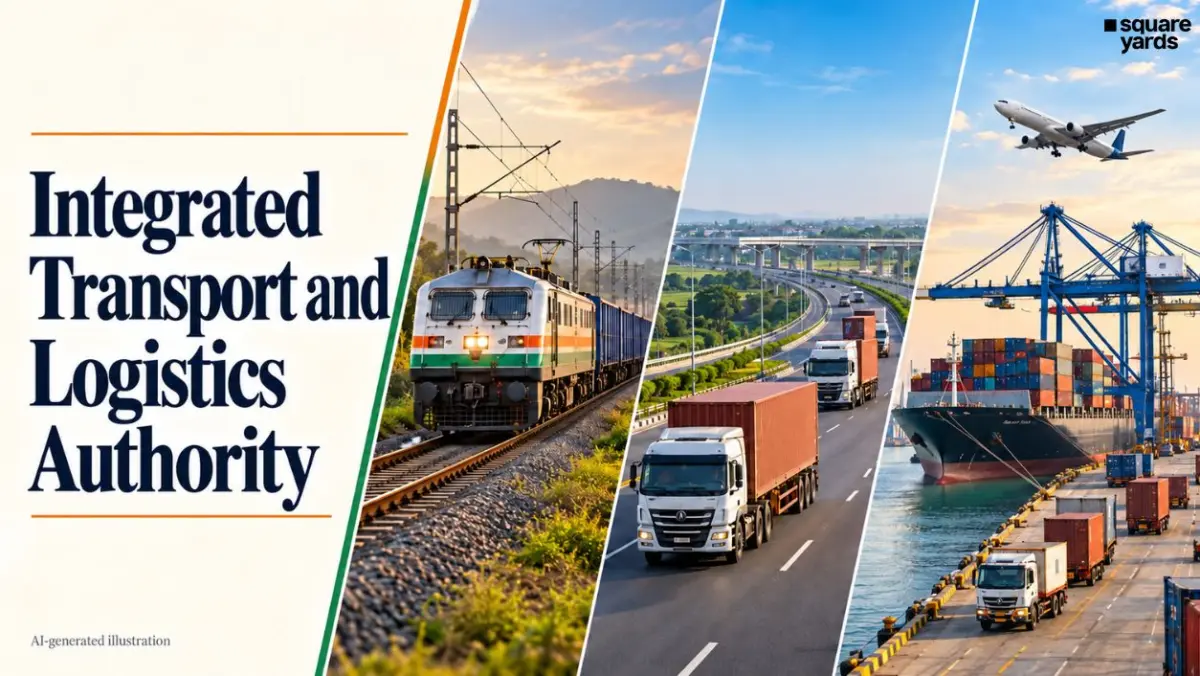
NEW DELHI – In a move set to redefine the structural landscape of India’s infrastructure planning, the Union Cabinet, chaired by the Prime Minister, officially approved the creation of the Integrated Transport and Logistics Authority (ITLA) on October 6, 2026. Designed as a high-powered Special Purpose Vehicle (SPV), ITLA is envisioned as the apex body responsible for the unified planning and execution of the nation’s transport and logistics framework.
The establishment of ITLA marks a departure from the traditional "silo-based" approach to infrastructure, where ministries for roads, railways, and ports often operated independently. With a mandate to streamline multi-billion dollar investments and reduce logistical friction, ITLA is poised to become the most influential entity in India’s journey toward becoming a global manufacturing and logistics hub.
The Mandate: Architecture of a National Master Plan
The core objective of ITLA is the formulation and management of a comprehensive National Transport Master Plan. This plan will carry a minimum horizon of ten years, providing a long-term roadmap that integrates roads, railways, ports, aviation, inland waterways, coastal shipping, urban mobility, and general logistics.
Unlike previous advisory bodies, ITLA has been granted the authority to:
- Review Sectoral Plans: The authority will audit the five-year and annual plans of individual transport ministries (such as MoRTH and Ministry of Railways) to ensure they are consistent with the National Master Plan.
- Technical Appraisal: ITLA will provide technical clearance for all central infrastructure projects with a capital expenditure of ₹500 crore or more. While financial appraisal remains with the Ministry of Finance, ITLA will ensure that projects are technically viable and strategically aligned.
- Post-Completion Monitoring: For the first time, a central authority will systematically monitor the progress of mega-projects and conduct "impact assessments" after completion to determine if the intended socio-economic benefits were realized.
Chronology: From Fragmented Planning to Unified Governance
The journey toward ITLA has been a decade-long evolution of policy aimed at curbing India’s historically high logistics costs.
- 2014–2021: The government focused on massive capital expenditure in individual sectors—doubling highway construction rates and revitalizing the railway network. However, the lack of "last-mile connectivity" remained a bottleneck.
- October 2021: The launch of PM Gati Shakti—a digital platform for integrated planning—provided the data-driven foundation for what would eventually become ITLA.
- 2022–2024: The National Logistics Policy (NLP) was introduced to bring down logistics costs from 14% of GDP to a single-digit target.
- FY 2025–2026: Significant progress was noted as logistics costs dropped to an estimated 10-10.7% of GDP, backed by approximately $360 billion in cumulative infrastructure investment.
- October 6, 2026: Recognizing that a digital platform (Gati Shakti) needed an institutional "anchor" with statutory powers, the Union Cabinet approved ITLA as the definitive SPV to lead this transition.
Supporting Data: The Economic Engine of Logistics
The rationale behind ITLA is rooted in hard economic data. According to recent industry reports, the efficiency of India’s supply chain has seen a dramatic shift over the last decade.
- Logistics Cost Reduction: From a high of 13-14% of GDP a decade ago, costs have been pared down to 10-10.7% in the current fiscal year. ITLA’s goal is to drive this further toward the 8% mark, which is the global benchmark for developed economies.
- Investment Scale: The $360 billion invested over the last few years has created a massive network of assets, but the "efficiency gap"—the cost of moving goods between different modes of transport—remains a challenge that ITLA is designed to solve.
- Data Integration: ITLA will manage a National Transport Data Repository. This system will aggregate real-time data from GST e-way bills, FASTag (toll data), Vahan (vehicle registration), GPS tracking systems, and urban traffic sensors. This "big data" approach will allow the government to see exactly where goods and people are moving, identifying bottlenecks with surgical precision.
Official Responses: Steering the Vision
While the official notification was released via the Press Information Bureau (PIB), senior officials and industry leaders have weighed in on the significance of the move.
A senior official from the Ministry of Commerce and Industry stated, "ITLA is the ‘brain’ that the Gati Shakti ‘body’ needed. It ensures that when we build a port, the rail line and the highway to that port are planned simultaneously, not years apart. This is about maximizing the ROI of every rupee of public money."
Industry experts from the logistics sector have welcomed the move but remain cautiously optimistic. Anupreet Singh, a logistics consultant, noted, "The technical appraisal of projects over ₹500 crore is a game-changer. It prevents ‘vanity projects’ and focuses on utility. However, the success of ITLA depends on its ability to bypass bureaucratic red tape rather than adding to it."
Implications for the Real Estate Market
For the real estate sector, ITLA is more than just a transport regulator; it is a market maker. Real estate value is inherently tied to connectivity, and ITLA’s role in eliminating the "weakest link" in transport chains will directly impact property valuations.
1. Strengthening Established Logistics Clusters
Cities that already serve as primary logistics hubs—Delhi-NCR, Mumbai, Pune, Chennai, and Bengaluru—stand to benefit the most. In these regions, "warehousing belts" have often suffered from congested feeder roads. ITLA’s focus on multimodal integration means that a warehouse in Bhiwandi (Mumbai) or Dharuhera (NCR) will likely see improved rail-to-port connectivity, increasing the yield and demand for Grade-A industrial spaces.
2. The Rise of Emerging Freight Corridors
Data shows that Ahmedabad and Kolkata are witnessing logistics leasing growth exceeding 30% year-on-year. However, these cities often face "thin" infrastructure. ITLA’s coordinated planning is expected to fast-track freight corridors in these emerging markets, offering early-mover advantages to developers who align their projects with the upcoming National Transport Master Plan.
3. Transit-Oriented Development (TOD) and Residential Premiums
In the residential sector, the "connectivity dividend" is most apparent near metro and transit nodes. With ITLA overseeing urban mobility, there is a renewed push for Unified Metropolitan Transport Authorities (UMTAs). For homebuyers, this means that a housing project located near a well-coordinated interchange (where metro, bus, and rail meet) will command a significantly higher premium. As commute times decrease, the "trade-off" between price and distance becomes more favorable for suburban developments.
The Fine Print: Challenges and Cautions
Despite the optimistic outlook, the path forward for ITLA is fraught with structural challenges.
- The "Advisory" Trap: India has a history of creating coordination bodies that lack the "teeth" to enforce decisions. If ITLA remains merely a consultative layer without the power to influence funding or halt inefficient projects, its impact may be neutralized.
- Overlap with Gati Shakti: There is a potential for jurisdictional overlap between ITLA and the existing PM Gati Shakti framework. Clear demarcation of roles is essential to avoid administrative confusion.
- Implementation Lag: The National Common Mobility Card (NCMC) serves as a cautionary tale. Launched in 2019 to unify transport payments, it was functional in only 13 metro projects and 11 bus corporations as of July 2026. Integration of data and systems is a slow process that often lags behind policy announcements.
- Threshold Limits: The ₹500 crore threshold means that ITLA will focus on mega-projects. However, for many property buyers, the "last-mile" local roads—which fall under the ₹500 crore limit—are what determine daily quality of life. ITLA may improve the highway, but the neighborhood road remains the responsibility of local municipalities.
Strategic Outlook: The Connectivity Dividend
For developers, investors, and homebuyers, the message is clear: the next property boom will not be driven by mere location, but by coordinated connectivity.
The "connectivity dividend" will go to those who study the National Transport Master Plan with the same rigor they apply to market reports. ITLA represents a shift toward a more predictable infrastructure environment. If it succeeds, it will not only reduce the cost of doing business in India but also stabilize real estate markets by providing clearer signals on where the next growth corridor will emerge.
As ITLA begins its work, the sensible approach for stakeholders is a combination of patience and proactive research. Investors are advised to look for "multimodal convergence points"—locations where at least three modes of transport (e.g., highway, rail, and air/water) intersect. In the coming decade, these nodes will be the epicenters of India’s economic and real estate growth, provided the planning and execution finally line up.
