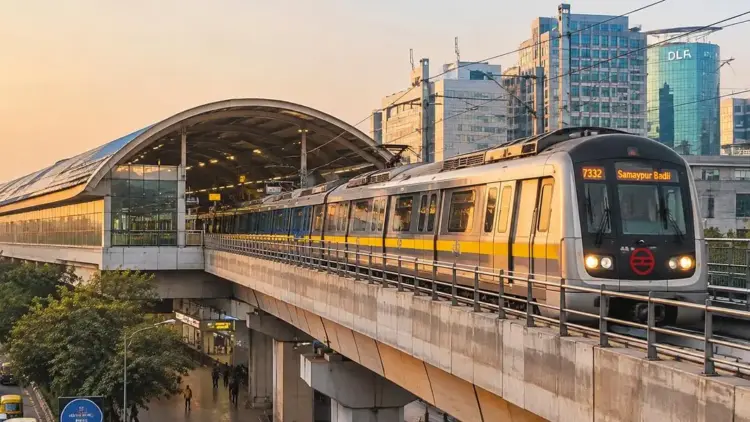
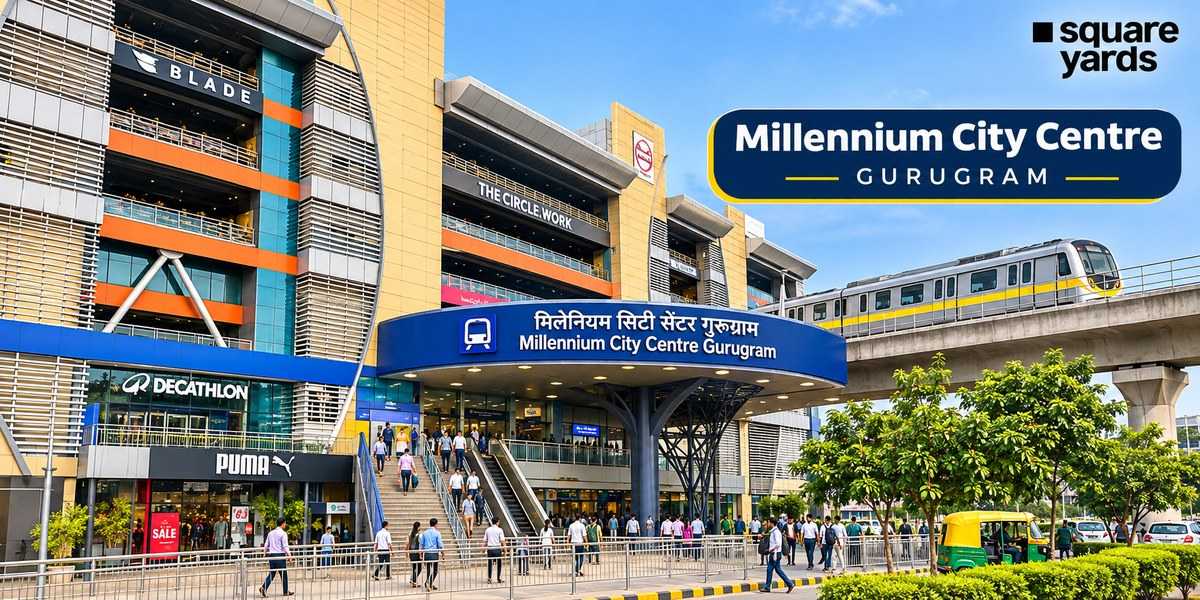
The Delhi Metro’s Yellow Line serves as the primary longitudinal artery of the National Capital Region (NCR), connecting the historic depths of North Delhi to the glass-and-steel skyline of Gurugram. At the very end of this 49-kilometer corridor lies a station that is currently undergoing a dual identity crisis: Huda City Centre, officially rechristened as Millennium City Centre Gurugram.
As the southern terminus of one of the world’s busiest metro lines, this station is more than just a transit stop; it is a gateway to Gurugram’s premium medical district, corporate hubs, and the vibrant Sector 29 leisure valley. This comprehensive report explores the station’s technical profile, its chaotic renaming history, its critical role in current commuting patterns, and its future as a multimodal hub for the upcoming Gurugram Metro expansion.
1. Main Facts: The Profile of a Transit Powerhouse
Strategically located in Sector 29, the Millennium City Centre Gurugram (MCCG) station is an elevated facility that has served as the anchor for Gurugram’s public transport since 2010.
Station Specifications at a Glance
- Official Name: Millennium City Centre Gurugram (formerly Huda City Centre)
- Station Code: HCC
- Structure: Elevated, featuring two side platforms and four entry/exit gates.
- Line: Yellow Line (Line 2), serving as the southern terminus.
- Coordinates: 28.4593 N, 77.0724 E.
- Accessibility: Fully wheelchair-friendly with dedicated lifts and tactile flooring.
- Operational Hours: Generally 05:50 AM to 11:00 PM (subject to scheduling changes).
The station is uniquely positioned to serve three distinct demographics: the daily corporate commuter working in Unitech Business Park, the medical tourist visiting world-class facilities like Fortis and Max, and the weekend reveler heading to the Sector 29 markets or Appu Ghar.
2. Chronology: From HUDA to Millennium City
The history of the station reflects the rapid urbanization of Gurugram itself. Its journey from a suburban outpost to a central landmark has been marked by significant milestones and a rather unusual naming controversy.
The 2010 Launch
The station opened its doors on June 21, 2010. At the time, it was named Huda City Centre, a nod to the Haryana Urban Development Authority (HUDA). Its opening was a watershed moment for the NCR, finally providing a high-speed rail link between the heart of Delhi (Connaught Place) and the burgeoning corporate offices of Gurugram.
The Renaming Saga of 2023
On July 3, 2023, the Delhi Metro Rail Corporation (DMRC) initiated a renaming process that became a viral talking point. In a span of less than 24 hours, the station’s name was changed three times:
- Morning: DMRC announced the name would change from Huda City Centre to Gurugram City Centre.
- Afternoon: Following requests from the State and Central governments, the name was revised to Millennium City Centre.
- Night: The final iteration, Millennium City Centre Gurugram, was confirmed to fully reflect the city’s identity.
By July 4, 2023, the new branding was official. While the DMRC website and digital displays have been updated, the legacy name "Huda City Centre" remains deeply embedded in the local lexicon, appearing on older maps, third-party apps, and in the daily speech of commuters.
3. Supporting Data: Operational Logistics and Commuter Facilities
Managing the flow of over 20 lakh passengers daily across the Yellow Line requires precision. As a terminus, Millennium City Centre acts as a "buffer" for the entire line’s schedule.
Train Timings and Reliability
According to DMRC’s operational data, the first train typically departs for Samaypur Badli at 06:00 AM. The last train is scheduled for 11:00 PM. However, commuters are advised to enter the station by 10:50 PM, as entry gates may close shortly before the final departure.
Note: Timings are subject to variation during Phase 4 construction or administrative holidays. For instance, in June 2024, schedules were temporarily adjusted to accommodate expansion work near Haiderpur Badli Mor.
Gate-Specific Connectivity
The station’s four gates are strategically placed to minimize walking distances to key landmarks:
- Gate 1 & 2: Provide the most direct access to Fortis Memorial Research Institute.
- Gate 3: Leads directly to Unitech Business Park.
- Gate 4: Positioned for visitors to Max Hospital.
Parking Capacity: A Two-Wheeler Focus
The station boasts one of the largest parking footprints in the Gurugram sector, though it heavily favors two-wheelers.
- Total Car Capacity: 497 spaces across four lots.
- Total Two-Wheeler Capacity: 3,452 spaces.
- Bicycle Capacity: 718 spaces.
The disparity—roughly seven bike spots for every one car spot—highlights the station’s role as a "last-mile" hub where commuters from surrounding sectors drop off their scooters before boarding the train to Delhi.
4. Official Responses and Infrastructure Projects
The future of Millennium City Centre is tied to two massive infrastructure projects managed by the Gurugram Metro Rail Limited (GMRL) and the Gurugram Metropolitan Development Authority (GMDA).
The GMRL Loop: Connecting Old and New Gurugram
The most significant development is the Millennium City Centre to Cyber City Metro line. This 28.5 km elevated corridor will finally bridge the gap between the Yellow Line and the Dwarka Expressway.
- Status: The foundation stone was laid on February 16, 2024.
- Phase 1: Covers 14 stations from MCCG to Sector 9. Construction is currently underway with a target completion year of 2028.
- Phase 2: Extends from Sector 9 to Cyber City, completing the loop. The tender for civil works was cleared in October 2026.
This project will transform Millennium City Centre from a "dead-end" terminus into a massive interchange, allowing passengers from Old Gurugram to access the Delhi Metro network without relying on road transport.
The Sector 29 Underpass
To address the chronic surface-level congestion, the GMDA has approved a ₹57 crore underpass at the junction of Sectors 27, 29, 43, and 44. This 1,350-meter project aims to streamline traffic flow toward IFFCO Chowk and Ardee City, reducing the "bottleneck" effect often seen outside the metro station gates during peak hours.
5. Implications: Real Estate and Urban Connectivity
The presence of the Millennium City Centre station has fundamentally altered the real estate landscape of Gurugram’s "New" sectors.
Impact on Residential Real Estate
Proximity to the station remains the single most important factor for property valuation in Sectors 40, 41, 43, and South City 1. Data suggests a high density of "Ready-to-Move" projects in this belt.
- Affordable Entry Points: Projects like Unitech Rakshak and South City Heights offer units starting near ₹1 crore.
- Premium Options: The Retreat Gurgaon and Ivory Towers see asking prices exceeding ₹3 crore.
However, prospective buyers are urged by market analysts to perform rigorous due diligence. Since many nearby projects are developed by Unitech, verifying RERA registrations, occupancy certificates (OC), and current litigation status is mandatory to avoid legal complications.
Economic and Commuter Trends
The Yellow Line’s record-breaking ridership—hitting a network peak of 78.67 lakh passengers in November 2024—underscores the station’s economic weight. It facilitates a massive daily transfer of human capital from affordable residential zones in Delhi to the high-paying corporate offices of Gurugram.
For the business traveler, the station offers a seamless (though long) connection:
- To Rajiv Chowk (CBD): ~50 minutes | ₹54 fare.
- To IGI Airport: Requires a change at New Delhi Station to the Airport Express Line.
- To Cyber City: Currently requires a change at Sikandarpur to the Rapid Metro.
Conclusion: A Landmark in Transition
Millennium City Centre Gurugram stands as a testament to the city’s meteoric rise. While the name change from "Huda City Centre" reflects a new era of branding, the station’s core mission remains unchanged: providing a reliable, high-capacity link for a city that never stops growing.
With the upcoming GMRL loop set to turn this terminus into a pivotal interchange and the GMDA underpass promising to de-clog the surface roads, the station is poised to remain the most critical piece of Gurugram’s infrastructure for decades to come. For the commuter, the patient, or the property seeker, Millennium City Centre is not just a stop—it is the heart of Gurugram’s connectivity.
Quick Travel Checklist:
- Check the App: Use the DMRC app to verify the "Last Train" time, especially on Sundays.
- Know Your Gate: Gate 3 for offices, Gate 4 for Max, Gate 1/2 for Fortis.
- Parking Strategy: If driving a car, arrive before 8:30 AM; two-wheeler spots are usually more available.
- Smart Card: Always use a smart card to avoid long token lines and avail of the 10-20% discount.