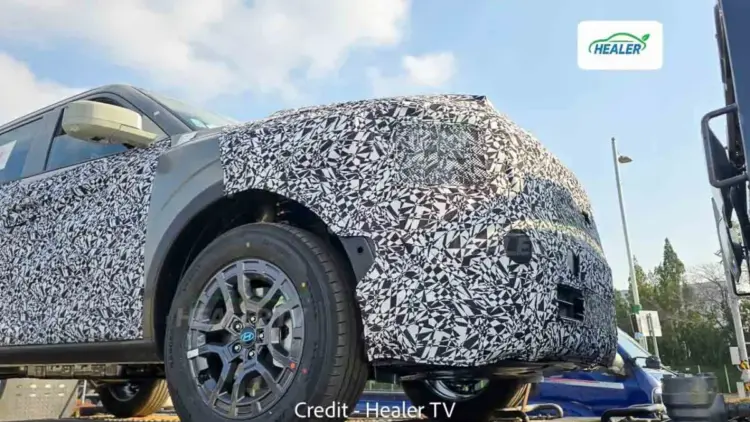
SEOUL/NEW DELHI — In a move that underscores the shifting tectonic plates of the Indian automotive landscape, Hyundai Motor Company has commenced road testing for its most ambitious SUV project for the Indian market to date. Codenamed "Ni1i," the upcoming three-row hybrid SUV was recently captured in high-resolution spy photographs during testing in South Korea. The vehicle, shrouded in heavy camouflage, provides the first tangible evidence of Hyundai’s strategic pivot toward high-performance petrol-hybrid powertrains, aimed at challenging the long-standing dominance of homegrown giants and Japanese rivals in the premium mid-size SUV segment.
The sighting confirms several industry rumors regarding Hyundai’s intention to bridge the gap between the Alcazar and the premium Tucson, while simultaneously addressing the growing consumer demand for "strong hybrid" technology as an alternative to diesel.
I. Main Facts: Deciphering the Ni1i Prototype
The prototype, identified through internal testing stickers and unique componentry, reveals a vehicle that is significantly larger and more imposing than the current Hyundai Alcazar. While the camouflage masks specific character lines, the silhouette speaks volumes about Hyundai’s new design direction for its flagship Indian SUVs.

A Boxy, Commanding Aesthetic
The "Ni1i" moves away from the "Sensuous Sportiness" fluid design language seen on the Creta, opting instead for a more rugged, "boxy" profile. Key visual takeaways from the spy shots include:
- Upright Stance: A near-vertical tailgate and a high, flat roofline suggest a focus on maximizing third-row headroom and cargo capacity.
- Rugged Elements: The prototype features pronounced, squared-off wheel arches with thick cladding, large rectangular wing mirrors, and a wide-set grille that likely integrates Hyundai’s signature "Parametric Hidden Lights."
- Wheel and Tyre Configuration: The vehicle was seen riding on dark-finished, multi-spoke 18-inch alloy wheels. Most notably, these were shod with 245/60 R18 JK Tyre Ranger H/T rubber. The presence of an Indian tyre brand on a Korean-tested prototype is a "smoking gun," confirming that the vehicle is being calibrated specifically for Indian road conditions, temperatures, and load requirements.
The "HEV" Confirmation
Perhaps the most critical piece of evidence is the "HEV" (Hybrid Electric Vehicle) sticker affixed to the rear bodywork. This confirms that the Ni1i will not merely be an internal combustion engine (ICE) vehicle but will feature a sophisticated petrol-electric hybrid system. This marks a significant departure for Hyundai India, which has previously focused on a mix of naturally aspirated petrol, turbocharged petrol, and CRDi diesel engines.
II. Chronology: From Concept to Camouflage
The journey of the Ni1i project reflects Hyundai’s rapid response to the changing regulatory and consumer environment in India.

- Early 2024: The Strategic Realignment: Following the success of the Toyota Innova Hycross and the Maruti Suzuki Invicto, Hyundai’s internal strategy shifted. While the company remained committed to EVs (like the Ioniq 5 and the upcoming Creta EV), it recognized a "hybrid gap" in its portfolio for buyers not yet ready for full electrification.
- September 2024: Initial Reports: Industry insiders first leaked the existence of the "Ni1i" project. The "i" suffix in Hyundai’s internal nomenclature traditionally denotes an India-specific model (similar to the Ai3 for the Exter).
- October 2024: Talegaon Plant Integration: Hyundai finalized plans to utilize its newly acquired manufacturing facility in Talegaon, Maharashtra (formerly a General Motors plant). The Ni1i was earmarked as one of the flagship products to be rolled out from this high-capacity site.
- November 2024: First Sighting: The prototype was spotted by South Korean car-spotters (Healer TV), revealing the "HEV" labeling and the Indian-sourced JK Tyres, suggesting that the development cycle has moved from computer simulations to real-world durability testing.
- 2027–2028: Projected Launch: While Hyundai has not officially confirmed a date, the development stage suggests a market debut in late 2027 or early 2028, aligning with the next generation of CAFE (Corporate Average Fuel Efficiency) norms in India.
III. Supporting Data: The Hybrid Advantage and Market Context
The decision to equip the Ni1i with a hybrid powertrain is backed by compelling market data. In the above-4.5-meter SUV segment, the competition is fierce and polarized.
The Competitive Landscape
Currently, the segment is dominated by:
- Mahindra Scorpio-N & XUV700: Strong performers with powerful diesel and petrol engines but lacking a hybrid option.
- Tata Safari: Recently refreshed with a premium interior and a focus on diesel, but currently no hybrid or petrol variant.
- Toyota Innova Hycross: The segment leader in hybrid sales, demonstrating that Indian buyers are willing to pay a premium for the 20+ kmpl fuel efficiency offered by a strong hybrid system.
Technical Specifications (Estimated)
While official specs are under wraps, the Ni1i is expected to borrow from the Hyundai-Kia global parts bin. The most likely candidate is the 1.6-liter turbocharged petrol-hybrid system currently used in the international-spec Kia Sorento and Hyundai Santa Fe.

- Combined Output: Approximately 230 hp and 350 Nm of torque.
- Transmission: A 6-speed torque converter automatic, which offers a more traditional driving feel compared to the e-CVT units found in Toyota hybrids.
- Fuel Efficiency: Targeted at 18–22 kmpl, a figure that would drastically undercut the fuel costs of the XUV700 petrol and rival the economy of the Safari diesel.
IV. Official Responses and Corporate Strategy
Hyundai Motor Group (HMG) has been vocal about its long-term commitment to the Indian subcontinent. During the 2024 CEO Investor Day, Hyundai executives outlined a roadmap that positions India as a global manufacturing hub and a primary market for diversified powertrains.
The $15.5 Billion Commitment
Hyundai and Kia have collectively committed $15.5 billion (approx. ₹1.3 lakh crore) to their Indian operations between 2026 and 2032. This investment covers:
- R&D Expansion: Enhancing the Hyderabad R&D center to lead global small-car and mid-size SUV development.
- Localisation: Increasing the "Made in India" content for hybrid batteries and motors to ensure competitive pricing.
- Product Offensive: A goal to launch 26 new models and updates by 2030, with the Ni1i serving as a cornerstone of the premium SUV pillar.
In a recent investor briefing, Hyundai India leadership emphasized that while they are "all-in" on EVs, they remain "engine agnostic," meaning they will provide whatever technology the market demands—be it CNG, Diesel, or Hybrid. The Ni1i is the physical manifestation of this "multi-pathway" strategy.

V. Implications: What This Means for the Indian Market
The arrival of a Hyundai 7-seater hybrid SUV has far-reaching implications for consumers, competitors, and the environment.
1. The Death Knell for Diesel?
For years, the three-row SUV segment has been a diesel stronghold due to the torque required to move heavy loads and the fuel economy needed for long highway cruises. However, as BS7 emission norms loom and the price gap between petrol and diesel narrows, a "strong hybrid" offers the torque and economy of a diesel without the associated "dirty" stigma or the complications of DPF (Diesel Particulate Filter) clogging.
2. Premiumization of the Hyundai Brand
By positioning the Ni1i above the Alcazar, Hyundai is attempting to move its brand perception further upmarket. If successful, the Ni1i will compete in the ₹25 lakh to ₹35 lakh price bracket, challenging not just the XUV700 but also the entry-level variants of luxury SUVs and the Toyota Fortuner.

3. Supply Chain Evolution
The use of JK Tyres on a Korean prototype indicates a deepening of the local supply chain. This is not just about tyres; it suggests that Hyundai is working with Indian vendors to validate suspension components, cooling systems, and electronics for the Ni1i from the ground up. This localization will be key to avoiding the "import tax trap" and keeping the hybrid SUV competitively priced.
4. Pressure on Mahindra and Tata
The Ni1i will put immense pressure on Mahindra and Tata Motors to accelerate their own hybrid programs. While both companies have focused on a "Jump to EV" strategy, the success of the Toyota Hycross and the anticipated arrival of the Ni1i suggest that the Indian consumer views hybrids as a necessary and desirable "bridge" technology.
Conclusion
The Hyundai Ni1i is more than just another SUV; it is a calculated gamble that the future of the Indian premium market lies in the marriage of internal combustion and electric power. With its boxy proportions, three-row utility, and a powertrain designed to bypass the fuel pump, the Ni1i is poised to be a formidable contender when it sheds its camouflage in 2027. For now, the sight of a Korean-made prototype running on Indian tyres in the streets of Seoul serves as a potent reminder of India’s growing importance in the global automotive hierarchy.